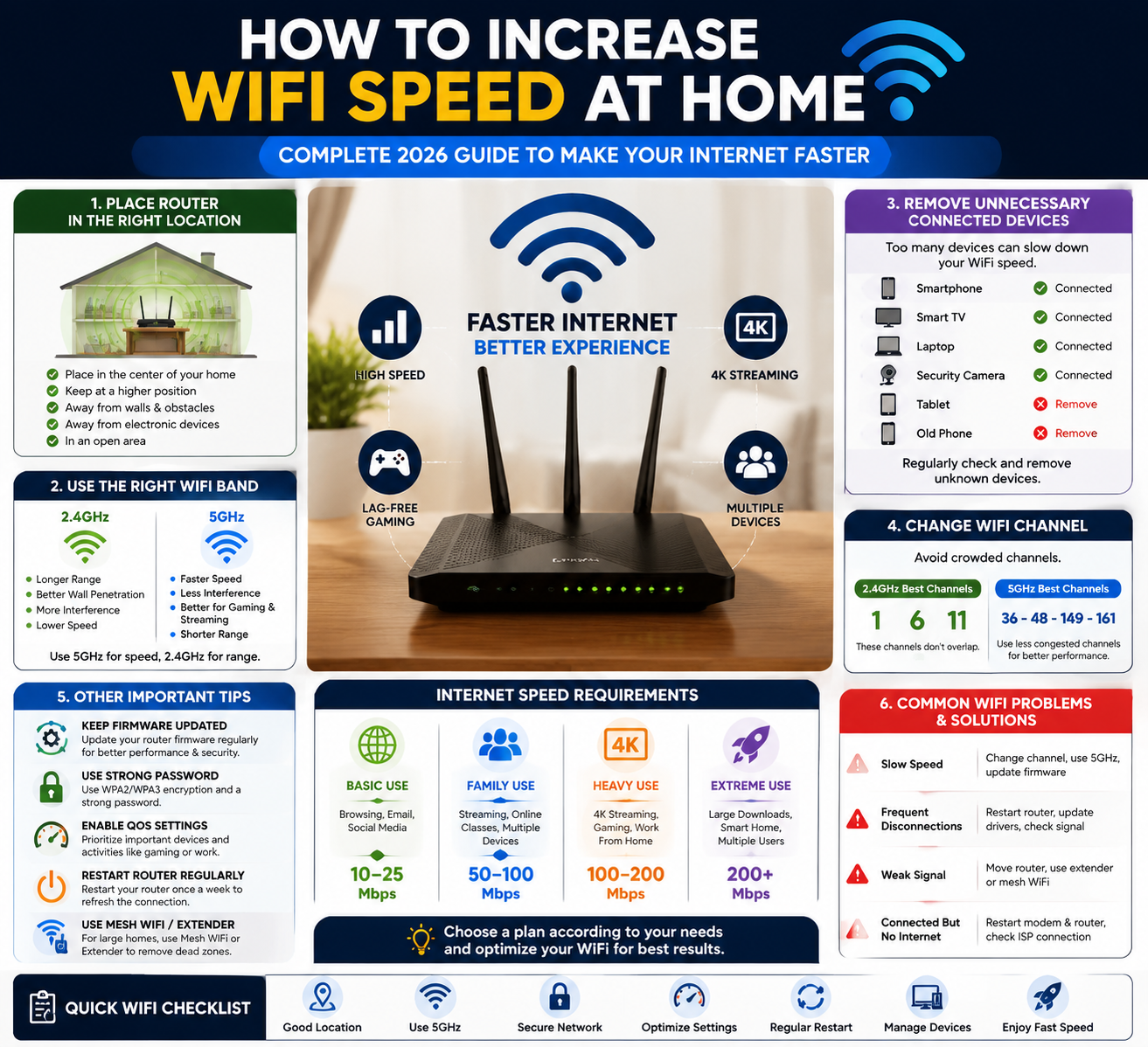
Introduction: Why Is Your Home WiFi Slow?
How to Increase WiFi Speed at Home A fast and reliable internet connection has become an essential part of modern life. Whether you are working from home, attending online classes, streaming 4K videos, playing online games, or managing smart home devices, a slow WiFi connection can create frustration.
Many people think that slow internet always means they need a better internet package. However, this is not always true. In many cases, the problem is not your internet provider but your WiFi setup, router location, network settings, or connected devices.How to Increase WiFi Speed at Home
Learning how to increase WiFi speed at home can help you get better performance without spending extra money. Simple changes like moving your router to a better location, updating firmware, reducing interference, and optimizing settings can significantly improve your wireless connection.
In this complete guide, we will explain proven methods to make your home WiFi faster, more stable, and ready for modern internet usage in 2026.How to Increase WiFi Speed at Home
Understanding Your WiFi Speed
Before improving your WiFi, it is important to understand how wireless internet works.
Your WiFi speed depends on several factors:How to Increase WiFi Speed at Home
- Internet plan speed
- Router quality
- WiFi frequency band
- Distance between device and router
- Number of connected devices
- Network interference
- Router configuration
- Building structure
For example, you may have a 100 Mbps internet package, but your phone may only receive 30 Mbps because of weak WiFi signals or router limitations.How to Increase WiFi Speed at Home
Check Your Actual Internet Speed First
Before making changes, test your current internet speed.
You can use online speed testing tools to check:
- Download speed
- Upload speed
- Ping
- Connection stability
Perform the test:
- Near your router
- In different rooms
- At different times of the day
This helps you understand whether the problem is your internet connection or your WiFi network.How to Increase WiFi Speed at Home
Method 1: Place Your Router in the Right Location
One of the easiest ways to increase WiFi speed at home is improving router placement.How to Increase WiFi Speed at Home
Many people keep routers:
- Inside cabinets
- Behind furniture
- Near walls
- On the floor
- Near electronic devices
These locations reduce signal strength.
Best Router Placement Tips
Place your router:
✅ In the center of your home
✅ At a higher position
✅ Away from walls and obstacles
✅ Away from microwaves and Bluetooth devices
✅ In an open area
A router placed correctly can improve coverage and reduce dead zones.How to Increase WiFi Speed at Home
Method 2: Restart Your Router Regularly
A simple router restart can solve many common WiFi problems.How to Increase WiFi Speed at Home.
Routers work continuously and may experience:
- Memory issues
- Temporary connection errors
- Overheating
- Performance slowdown
Restarting your router once every few weeks can refresh the connection.How to Increase WiFi Speed at Home.
Correct Router Restart Method:
- Turn off the router.
- Wait 30 seconds.
- Turn it back on.
- Wait until all lights become stable.
Avoid restarting repeatedly because frequent disconnections can affect network stability.
Method 3: Use the 5GHz WiFi Band
Modern routers usually support two frequency bands:How to Increase WiFi Speed at Home.
2.4GHz WiFi
Advantages:
- Longer range
- Better wall penetration
Disadvantages:
- More interference
- Lower speed
5GHz WiFi
Advantages:
- Faster speed
- Less interference
- Better for streaming and gaming
Disadvantages:
- Shorter range
If your device is close to the router, connecting to the 5GHz network can significantly increase WiFi speed.How to Increase WiFi Speed at Home.
Method 4: Update Your Router Firmware
Router manufacturers regularly release firmware updates that improve:How to Increase WiFi Speed at Home
- Speed
- Security
- Stability
- Performance
Old firmware may cause:
- Slow connections
- Frequent disconnections
- Compatibility problems
Check your router manufacturer’s website or router settings page for available updates.How to Increase WiFi Speed at Home
Method 5: Remove Unnecessary Connected Devices
Too many connected devices can slow down your WiFi.How to Increase WiFi Speed at Home
Examples:
- Smartphones
- Smart TVs
- Security cameras
- Gaming consoles
- Tablets
- Smart home devices
Every connected device uses network resources.How to Increase WiFi Speed at Home
Check your router admin panel and remove unknown devices from your network.How to Increase WiFi Speed at Home
How to Increase WiFi Speed at Home: Complete 2026 Guide to Make Your Internet Faster
Part 2: Advanced Ways to Improve Your Home WiFi Speed
In the first part, we discussed basic methods like router placement, restarting your device, using the correct WiFi band, updating firmware, and removing unnecessary connected devices.
Now we will explore advanced techniques that can help you get maximum performance from your home network.How to Increase WiFi Speed at Home
Method 6: Change Your WiFi Channel for Better Performance
WiFi networks use different channels to communicate with your devices. When many nearby routers use the same channel, interference increases and your internet speed can become slow.
This problem is common in:How to Increase WiFi Speed at Home
- Apartments
- Offices
- Residential areas
- Crowded cities
Changing your WiFi channel can reduce interference and improve connection quality.How to Increase WiFi Speed at Home
Best WiFi Channels for 2.4GHz Network
The 2.4GHz band usually has three non-overlapping channels:How to Increase WiFi Speed at Home
- Channel 1
- Channel 6
- Channel 11
Try switching between these channels to find the best performance.
Best WiFi Channels for 5GHz Network
The 5GHz band offers more channels and usually provides better performance because it has less interference.How to Increase WiFi Speed at Home
If your router supports automatic channel selection, enable this option.How to Increase WiFi Speed at Home
Method 7: Upgrade Your Old Router
Your router is one of the most important parts of your internet setup.How to Increase WiFi Speed at Home
An old router may limit your internet speed even if you have a fast connection.How to Increase WiFi Speed at Home
Older routers may not support:
- Modern WiFi standards
- Higher speeds
- Multiple devices
- Better security features
Modern WiFi Standards
WiFi 5 (802.11ac)
Good for:
- HD streaming
- Online gaming
- Multiple devices
WiFi 6 (802.11ax)
Better for:
- Smart homes
- Heavy internet usage
- Faster wireless speeds
- Many connected devices
WiFi 7
The latest generation provides:
- Extremely high speeds
- Lower latency
- Better performance in crowded networks
Upgrading your router can be one of the fastest ways to improve home WiFi.How to Increase WiFi Speed at Home.
Method 8: Secure Your WiFi Network
A slow WiFi connection can sometimes happen because unknown people are using your internet.How to Increase WiFi Speed at Home
If your WiFi password is weak, neighbors or unauthorized users may connect to your network.
This can reduce your speed because bandwidth is shared.How to Increase WiFi Speed at Home
How to Secure Your WiFi
Follow these steps:
- Use a strong WiFi password
- Enable WPA2 or WPA3 security
- Change the default router password
- Disable WPS if not needed
- Check connected devices regularly
A secure network provides better speed and safety.How to Increase WiFi Speed at Home
Method 9: Use Quality Ethernet Connection for Important Devices
WiFi is convenient, but wired connections are often faster and more stable.
Devices that benefit from Ethernet:
- Gaming PCs
- Gaming consoles
- Desktop computers
- Smart TVs
- Work computers
Using an Ethernet cable can provide:
- Lower ping
- More stable connection
- Faster data transfer
For competitive gaming and professional work, a wired connection is usually the best choice.
Method 10: Reduce WiFi Interference
Many household devices can interfere with wireless signals.
Common sources of interference:
- Microwave ovens
- Wireless cameras
- Bluetooth devices
- Baby monitors
- Other WiFi routers
To improve signal quality:
- Keep your router away from electronic devices
- Use the 5GHz band when possible
- Avoid placing the router near thick walls
Method 11: Adjust Router Antenna Position
Many people ignore router antennas, but their position affects coverage.
For routers with external antennas:
Recommended Position
Keep one antenna vertical and another horizontal.
Why?
Because devices receive signals differently depending on their position.
Proper antenna placement can improve coverage in different areas of your home.
Method 12: Use a WiFi Mesh System for Large Homes
If your house has multiple floors or large areas, a single router may not provide full coverage.
A WiFi mesh system uses multiple connected devices to create one strong network.
Benefits of Mesh WiFi:
- Better coverage
- Fewer dead zones
- Automatic switching between access points
- Improved performance
Mesh WiFi is useful for:
- Large houses
- Offices
- Multiple-floor buildings
Method 13: Manage Background Applications
Some applications consume internet bandwidth without users noticing.
Examples:
- Cloud backup software
- Automatic updates
- Game downloads
- Video syncing apps
These programs can slow down your connection.
Check Background Usage:
On Windows:
- Open Settings
- Go to Network & Internet
- Check Data Usage
On smartphones:
- Open Settings
- Go to Mobile/WiFi Data Usage
- Review applications
Close unnecessary applications to improve available bandwidth.
Method 14: Change Your DNS Settings
DNS (Domain Name System) converts website names into IP addresses.
Your default DNS may not always be the fastest.
Using a faster DNS service can improve:
- Website loading time
- Browsing experience
- Connection reliability
Popular DNS options include:
- Google DNS
- Cloudflare DNS
- OpenDNS
Note: DNS usually improves browsing speed but does not increase your actual internet package speed.
Method 15: Keep Your Router Cool
Routers can slow down when they overheat.
Avoid placing your router:
- Inside closed cabinets
- Near heat sources
- Under direct sunlight
Keep enough space around the router for airflow.
A cooler router usually performs more reliably.
Method 16: Use Quality Network Cables
If your internet setup uses Ethernet cables, cable quality matters.
Older cables may limit speed.
Modern options:
- Cat5e
- Cat6
- Cat6a
For high-speed internet connections, Cat6 cables are a good choice.
Method 17: Restart Your Network Equipment Together
Sometimes restarting only the router is not enough.
A complete restart can include:
- Turn off modem/ONT device
- Turn off router
- Wait 60 seconds
- Turn on modem first
- Turn on router after modem connects
This can refresh your complete network connection.
Method 18: Check Your Internet Package Speed
Sometimes WiFi problems are actually caused by a slow internet package.
For example:
- Basic browsing: 10–25 Mbps
- HD streaming: 25–50 Mbps
- 4K streaming: 50–100 Mbps
- Gaming + multiple users: 100 Mbps+
Choose a package according to your household requirements.
Method 19: Limit High Bandwidth Activities
When many people use the internet at the same time, speed can decrease.
Examples:
- Someone watching 4K videos
- Large file downloads
- Online gaming updates
- Cloud backups
Using Quality of Service (QoS) settings in your router can prioritize important activities.
Method 20: Factory Reset Your Router When Necessary
If your router settings have become incorrect, a factory reset can help.
A reset removes:
- Custom settings
- Old configurations
- Connection problems
Before resetting, save important information like:
- ISP username
- Password
- WiFi settings
How to Increase WiFi Speed at Home: Complete 2026 Guide to Make Your Internet Faster
Part 3: Advanced WiFi Optimization Tips for Gaming, Streaming, Mobile & PC
A fast WiFi connection is not only about having a high-speed internet package. Proper optimization of your router, devices, and network settings can make a huge difference.
In this section, we will discuss advanced techniques that help improve WiFi speed for gaming, streaming, smartphones, laptops, and smart devices.
How to Increase WiFi Speed for Online Gaming
Online gaming requires more than just high download speed. Gamers need:
- Low ping
- Stable connection
- Low latency
- Minimum packet loss
A slow or unstable WiFi connection can cause:
- Game lag
- Delayed response
- Disconnections
- High ping issues
Tips to Improve Gaming WiFi Speed
1. Use 5GHz WiFi Band
The 5GHz network provides:
- Faster speed
- Lower interference
- Better gaming performance
Keep your gaming device close to the router for the best results.
2. Connect Gaming Devices with Ethernet Cable
For serious gaming, a wired connection is recommended.
Benefits:
- Lower ping
- Stable connection
- Faster response time
Gaming consoles and PCs perform better with Ethernet connections.
3. Enable QoS Settings
Quality of Service (QoS) allows you to prioritize important devices.
Example:
You can give priority to:
- Gaming PC
- PlayStation
- Xbox
- Work laptop
This prevents other devices from consuming all bandwidth.
How to Increase WiFi Speed on Android Phones
Many users experience slow WiFi on smartphones even when their internet connection is fast.
Follow these steps:
1. Forget and Reconnect WiFi Network
Sometimes saved network information becomes outdated.
Steps:
- Open Phone Settings
- Select WiFi
- Tap your network
- Choose Forget Network
- Connect again with password
2. Disable Battery Saving Mode
Some smartphones reduce network performance to save battery.
Turn off:
- Battery saver
- Ultra power mode
when you need maximum WiFi performance.
3. Update Your Phone Software
Software updates often fix:
- WiFi bugs
- Connection problems
- Compatibility issues
Keep your smartphone updated.
How to Increase WiFi Speed on iPhone
iPhone users can improve WiFi performance by following these tips:
Restart Network Settings
Go to:
Settings → General → Transfer or Reset iPhone → Reset Network Settings
This removes old network configurations.
Disable VPN When Not Needed
A VPN can reduce internet speed because your data travels through an additional server.
If you experience slow browsing, check whether your VPN is active.
How to Increase WiFi Speed on Windows 11 PC
Windows computers can sometimes have slow WiFi because of:
- Old drivers
- Background programs
- Incorrect settings
Update WiFi Drivers
Steps:
- Open Device Manager
- Select Network Adapters
- Right-click WiFi Adapter
- Choose Update Driver
Updated drivers can improve:
- Speed
- Stability
- Compatibility
Disable Background Internet Usage on Windows
Many programs use internet automatically.
Examples:
- Cloud storage apps
- Windows updates
- Game launchers
- Software updates
Close unnecessary programs when you need maximum speed.
Best Router Settings for Faster WiFi
Changing router settings can improve performance.
Recommended Settings:
Security Mode:
Use:
✅ WPA2
✅ WPA3 (if supported)
Avoid old security methods.
WiFi Mode:
Select:
- 802.11ac for WiFi 5 routers
- 802.11ax for WiFi 6 routers
Channel Width:
For 5GHz:
Use:
- 80MHz for higher speed
For 2.4GHz:
Use:
- 20MHz for better stability
Enable MU-MIMO Technology
Modern routers include MU-MIMO technology.
It allows routers to communicate with multiple devices simultaneously.
Benefits:
- Better performance
- Less waiting time
- Improved speed with many users
Useful for homes with:
- Smart TVs
- Phones
- Tablets
- Gaming devices
Enable Beamforming Feature
Beamforming improves signal direction.
Instead of spreading signals equally everywhere, the router focuses signals toward connected devices.
Benefits:
- Stronger signal
- Better range
- More stable connection
Use WiFi Analyzer Tools
WiFi analyzer apps can help identify:
- Crowded channels
- Weak signal areas
- Network interference
You can use these tools to optimize router placement and channel selection.
Remove WiFi Dead Zones
Dead zones are areas where WiFi signals are weak or unavailable.
Common causes:
- Thick walls
- Large distance
- Multiple floors
- Metal objects
Solutions:
Option 1: Move Router
Place the router in a central location.
Option 2: Use WiFi Extender
A WiFi extender repeats your existing signal.
Good for:
- Medium-size homes
Option 3: Use Mesh WiFi
Best for:
- Large houses
- Multiple floors
- Professional setups
WiFi Extender vs Mesh WiFi: Which Is Better?
| Feature | WiFi Extender | Mesh WiFi |
|---|---|---|
| Price | Cheaper | More Expensive |
| Coverage | Medium | Large |
| Speed | Moderate | Better |
| Setup | Simple | Advanced |
| Best For | Small homes | Large homes |
Reduce Number of Connected Devices
Modern homes have many connected devices:
- Smart cameras
- TVs
- Phones
- Tablets
- Smart speakers
Too many devices can slow your network.
Remove devices that are not being used.
Check for Unauthorized WiFi Users
Unknown users can consume your bandwidth.
Check:
- Router connected devices list
- Change WiFi password regularly
- Use strong encryption
A secure WiFi network performs better.
Best Internet Speed Requirements for Home
Basic Usage
Suitable for:
- Browsing
- Social media
Recommended:
10–25 Mbps
Family Usage
Suitable for:
- Streaming
- Online classes
- Multiple devices
Recommended:
50–100 Mbps
Heavy Usage
Suitable for:
- Gaming
- 4K videos
- Remote work
- Smart homes
Recommended:
100 Mbps+
Common WiFi Problems and Quick Solutions
Problem: WiFi Connected But No Internet
Solutions:
- Restart router
- Check ISP connection
- Restart modem
- Check cables
Problem: WiFi Speed Drops at Night
Possible reasons:
- Network congestion
- Too many users
- ISP traffic load
Solution:
- Contact ISP
- Upgrade package
- Optimize router settings
Problem: WiFi Signal Is Weak
Solutions:
- Move router
- Use mesh system
- Change WiFi channel
- Upgrade router
Problem: Internet Is Fast Near Router But Slow in Other Rooms
Solutions:
- Improve router location
- Add extender
- Install mesh WiFi
Check Your Router’s Signal Strength
WiFi signal strength determines how well your devices communicate with the router.
A weak signal can cause:
- Slow downloads
- Video buffering
- Website loading delays
- Gaming lag
- Frequent disconnections
How to Improve Signal Strength
Follow these steps:
- Place your router in an open area
- Avoid placing it behind furniture
- Keep it away from thick concrete walls
- Place it at a higher location
- Adjust antenna direction
A small change in router placement can sometimes improve performance significantly.
Use Separate WiFi Names for 2.4GHz and 5GHz
Many modern routers combine both networks into one WiFi name. While this is convenient, manually separating them can give you more control.
Example:
Home_WiFi_2.4G
For:
- Long distance
- Better wall penetration
- Smart devices
Home_WiFi_5G
For:
- Gaming
- Streaming
- Video calls
- High-speed downloads
This allows you to connect each device to the best available network.
Enable Automatic Router Updates
Many new routers support automatic updates.
Keeping your router updated helps improve:
- Security
- Speed
- Stability
- Device compatibility
Old router software can sometimes create performance problems.
Check your router settings regularly for available updates.
Optimize WiFi for Video Streaming
Streaming services require a stable connection.
For HD streaming:
- 5–10 Mbps is usually enough
For 4K streaming:
- 25 Mbps or more is recommended
To improve streaming:
- Use 5GHz WiFi
- Reduce unnecessary downloads
- Connect streaming devices closer to the router
- Use Ethernet for smart TVs when possible
Improve WiFi Speed for Video Calls
Online meetings require a stable upload and download connection.
Slow WiFi can cause:
- Frozen video
- Audio delays
- Poor call quality
Tips:
- Close background applications
- Move closer to the router
- Use 5GHz WiFi
- Avoid downloading large files during meetings
Restart Your Router Automatically
Some advanced routers allow scheduled reboots.
Automatic restarting can help:
- Refresh network connection
- Clear temporary problems
- Maintain performance
A weekly restart schedule can keep your router running smoothly.
Change Router Login Password
Many users only change their WiFi password but forget the router admin password.
Leaving the default admin password can create security risks.
Change:
- Router username/password
- WiFi password
Use strong passwords containing:
- Numbers
- Letters
- Special characters
Check Your Internet Speed Regularly
Testing your speed regularly helps identify problems early.
Check:
- Download speed
- Upload speed
- Ping
- Connection stability
If your speed is consistently lower than your subscribed package, contact your internet provider.
Upgrade Your Internet Equipment
Your internet provider may install basic equipment, but advanced users may benefit from upgrading.
Important equipment includes:
- Router
- Ethernet cables
- WiFi adapters
- Mesh devices
A better network setup allows you to get maximum performance from your internet connection.
Avoid Placing Router Near These Objects
Certain objects block or weaken WiFi signals.
Avoid placing your router near:
❌ Microwave ovens
❌ Metal shelves
❌ Refrigerators
❌ Thick walls
❌ Large electronic devices
A clear area provides better wireless coverage.
Use Network Priority Features
Many modern routers include traffic management features.
These features allow you to prioritize:
- Work computers
- Gaming devices
- Smart TVs
- Security cameras
This prevents one device from using all available bandwidth.
Best Practices for Maximum WiFi Speed
Follow these simple habits:
✅ Restart your router regularly
✅ Keep firmware updated
✅ Use strong passwords
✅ Remove unknown devices
✅ Use 5GHz for high-speed activities
✅ Keep router in a central location
✅ Upgrade old networking equipment
✅ Monitor connected devices
Future of Home WiFi Technology in 2026
Home internet technology continues to improve rapidly.
Modern homes are moving toward:
- WiFi 6 and WiFi 7 routers
- Faster fiber internet
- Smart home networks
- AI-powered network optimization
- Better mesh systems
Future routers will automatically manage traffic and provide better performance for multiple devices.
Final Thoughts: How to Increase WiFi Speed at Home
Improving your home WiFi speed does not always require buying an expensive internet package. Many speed problems can be solved by optimizing your existing setup.
The most effective improvements include:
- Choosing the right router location
- Using the correct WiFi band
- Updating firmware
- Securing your network
- Managing connected devices
- Using modern WiFi technology
By following these methods, you can create a faster, safer, and more reliable home internet experience in 2026.