Introduction
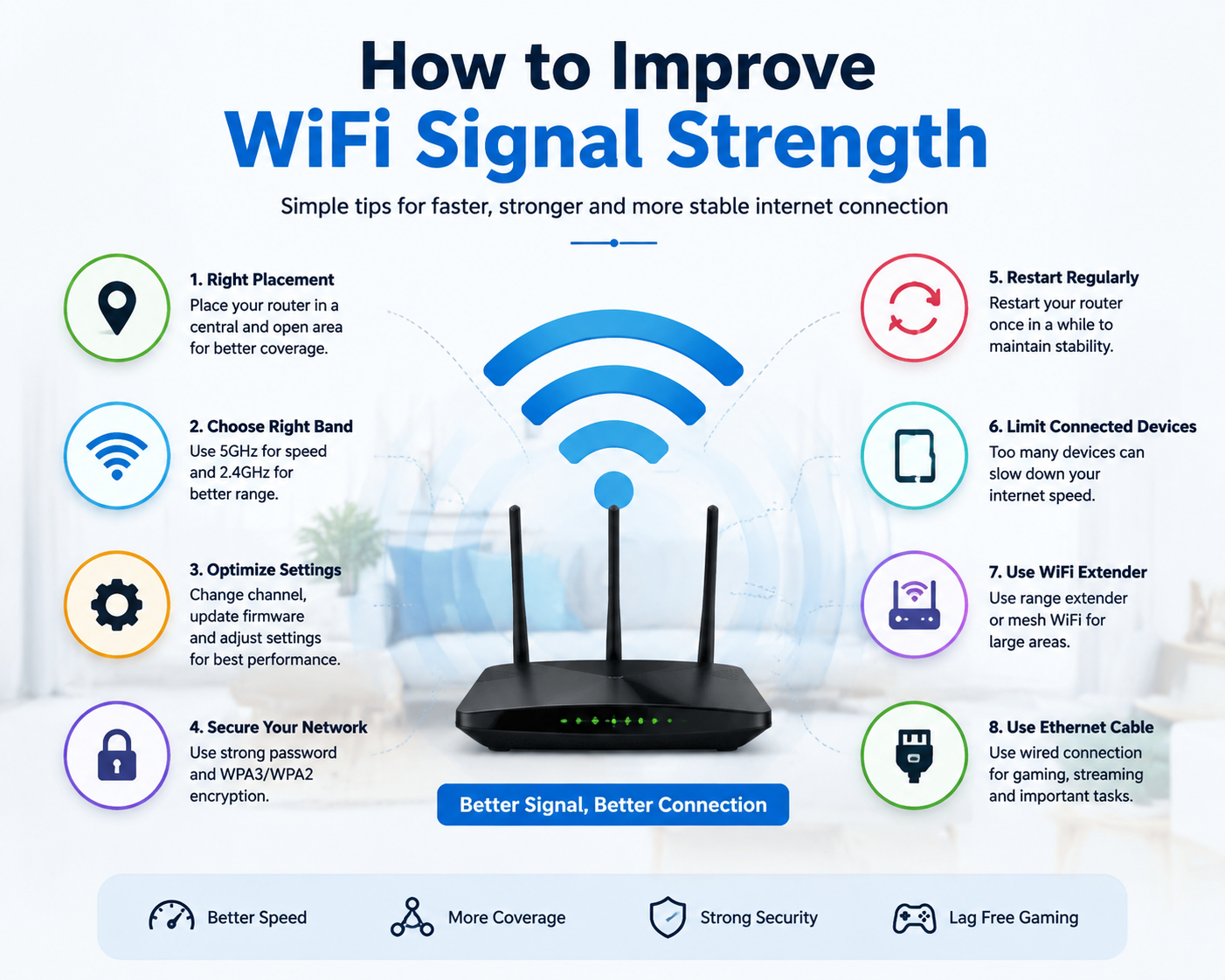
How to Improve WiFi Signal Strength In today’s digital world, a strong WiFi connection has become an essential part of our daily lives. From online education and remote work to video streaming, gaming, smart home devices, and business operations, almost everything depends on a reliable internet connection. However, many users face common problems such as weak WiFi signals, slow browsing speed, frequent disconnections, buffering videos, and unstable connections.
A weak WiFi signal does not always mean that your internet package is slow. In many cases, the problem is caused by poor router placement, incorrect settings, signal interference, outdated hardware, or network congestion.
Improving WiFi signal strength can significantly enhance your online experience. With the right techniques, you can increase coverage, reduce connection drops, improve speed, and enjoy a more stable wireless network throughout your home or office.How to Improve WiFi Signal Strength
This complete guide explains proven methods to improve WiFi signal strength, optimize router performance, remove connectivity issues, and create a faster wireless network.
Understanding WiFi Signal Strength
Before improving your WiFi connection, it is important to understand how wireless signals work.How to Improve WiFi Signal Strength
WiFi uses radio waves to transmit data between your router and connected devices. The strength and quality of these signals depend on several factors, including:
- Distance between router and device
- Walls and physical obstacles
- Router technology
- Frequency band selection
- Number of connected devices
- Wireless interference
- Router settings
WiFi signal strength is usually measured in decibels per milliwatt (dBm).How to Improve WiFi Signal Strength
A stronger signal provides better performance, while a weaker signal can cause:How to Improve WiFi Signal Strength
- Slow download speeds
- Video buffering
- Online gaming lag
- Website loading problems
- Connection failures
What Is a Good WiFi Signal Strength?
WiFi signal strength is commonly categorized as follows:How to Improve WiFi Signal Strength
Excellent Signal (-30 dBm to -50 dBm)
This is an ideal WiFi signal level.
Benefits include:
- Maximum internet speed
- Stable connection
- Smooth HD and 4K streaming
- Better gaming performance
Good Signal (-50 dBm to -60 dBm)
A good connection for normal activities.How to Improve WiFi Signal Strength
Suitable for:How to Improve WiFi Signal Strength
- Browsing websites
- Social media
- Video calls
- Online classes
Weak Signal (-70 dBm to -80 dBm)
At this level, users may experience:
- Slow speed
- Frequent disconnections
- Poor streaming quality
Very Weak Signal (-80 dBm or lower)
The connection becomes unreliable and requires improvement.How to Improve WiFi Signal Strength
Why Is My WiFi Signal Weak?
Many reasons can cause poor WiFi performance. Understanding these issues helps you find the right solution.How to Improve WiFi Signal Strength
1. Router Placement Problems
One of the biggest reasons for weak WiFi signals is incorrect router placement.
Many people place their router:How to Improve WiFi Signal Strength
- Behind furniture
- Inside cabinets
- Near the floor
- In closed rooms
- Near electronic devices
These locations block wireless signals and reduce coverage.
Best Router Placement
For better performance:
- Place your router in a central location
- Keep it at a higher position
- Avoid placing it near walls
- Keep antennas vertical
- Place it in an open area
A properly positioned router can improve WiFi coverage significantly.How to Improve WiFi Signal Strength
2. Remove Physical Obstacles
WiFi signals can be weakened by different materials.How to Improve WiFi Signal Strength
Common signal blockers include:How to Improve WiFi Signal Strength
- Concrete walls
- Metal objects
- Mirrors
- Thick doors
- Glass barriers
- Large appliances
For example, a router placed behind multiple concrete walls may provide poor coverage in other rooms.How to Improve WiFi Signal Strength
Try to keep a clear path between your router and connected devices.How to Improve WiFi Signal Strength
3. Restart Your Router Regularly
Many users keep their routers running continuously for months.How to Improve WiFi Signal Strength
Over time, routers can experience:How to Improve WiFi Signal Strength
- Memory issues
- Software glitches
- Overheating
- Performance slowdown
Restarting your router once every few weeks can refresh the connection.
A simple restart can often fix:How to Improve WiFi Signal Strength
- Slow speed
- Connection drops
- Network errors
4. Update Router Firmware
Router manufacturers regularly release firmware updates to improve:How to Improve WiFi Signal Strength
- Security
- Speed
- Stability
- Device compatibility
An outdated router firmware may cause:How to Improve WiFi Signal Strength
- Poor performance
- Connection problems
- Security risks
Check your router manufacturer’s website or admin panel for updates.How to Improve WiFi Signal Strength
5. Choose the Right WiFi Frequency Band
Modern routers usually support two main frequency bands:How to Improve WiFi Signal Strength
2.4 GHz WiFi Band
Advantages:How to Improve WiFi Signal Strength
- Longer range
- Better wall penetration
- Works well for large homes
Disadvantages:How to Improve WiFi Signal Strength
- More interference
- Lower speed compared to 5 GHz
5 GHz WiFi Band
Advantages:
- Faster speeds
- Less interference
- Better for gaming and streaming
Disadvantages:
- Shorter range
- Weakens faster through walls
For devices near the router, use 5 GHz.
For devices far away, 2.4 GHz may provide better coverage.How to Improve WiFi Signal Strength
6. Change Your WiFi Channel
WiFi networks operate on different channels.How to Improve WiFi Signal Strength
In crowded areas, many routers may use the same channel, causing interference.How to Improve WiFi Signal Strength
Changing your WiFi channel can improve performance.
For 2.4 GHz networks, commonly recommended channels are:
- Channel 1
- Channel 6
- Channel 11
For 5 GHz networks, more channels are available and usually experience less congestion.
7. Reduce Connected Devices
Every connected device uses network resources.How to Improve WiFi Signal Strength
Too many devices can slow down your WiFi.
Examples:
- Smartphones
- Smart TVs
- Security cameras
- Gaming consoles
- Tablets
- Smart home devices
Remove unused devices from your network to improve performance.
8. Use a Strong WiFi Password
Unauthorized users connected to your WiFi can reduce speed.
Always use:
- WPA2 security
- WPA3 security (if available)
- Strong passwords
Avoid simple passwords like:
- 12345678
- password
- your name
A secure network ensures better performance.
Conclusion
Improving WiFi signal strength does not always require buying expensive equipment. Simple changes like better router placement, updating firmware, selecting the correct frequency band, and reducing interference can dramatically improve your wireless connection.
In the next part, we will discuss advanced techniques including router settings optimization, WiFi extenders, mesh networks, antenna upgrades, and professional methods to achieve maximum WiFi coverage.
Part 2: Advanced Methods to Improve WiFi Signal Strength and Performance
After applying basic WiFi improvement techniques, the next step is to optimize your router settings and use advanced methods to increase wireless coverage. Many users only use default router settings, but changing a few important options can improve speed, stability, and signal strength.
A properly optimized router can provide better performance without immediately spending money on new equipment.
9. Access Your Router Admin Panel and Optimize Settings
Every WiFi router has an admin panel where users can control network settings.
Usually, you can access it by entering an IP address in your browser:
Common router addresses:
- 192.168.1.1
- 192.168.0.1
- 192.168.8.1
After logging in, you can change:
- WiFi name (SSID)
- Password
- Security settings
- Channel selection
- Frequency settings
- Bandwidth options
- Device management
Optimizing these settings can improve your WiFi experience.
10. Change WiFi Network Name (SSID)
Your WiFi name helps identify your wireless network.
A clear and unique SSID makes it easier to manage your connection.
Avoid using personal information such as:
- Full name
- Phone number
- Home address
A professional WiFi name improves security and network management.
Example:
Instead of:
“Ahmed123”
Use:
“Home_Fiber_5G”
11. Enable WPA3 Security
Modern routers support WPA3, which is the latest WiFi security standard.
Benefits of WPA3:
- Better protection against hackers
- Improved encryption
- Safer wireless communication
If your router does not support WPA3, use WPA2-AES.
Avoid outdated security types:
- WEP
- WPA-TKIP
These can reduce security and performance.
12. Adjust WiFi Transmit Power
Many routers have a transmit power option.
Transmit power controls how strongly your router broadcasts signals.
Higher transmit power can:
- Increase coverage area
- Improve signal strength
- Reduce connection drops
However, extremely high power settings may create unnecessary interference.
Recommended:
- Small apartment: Medium power
- Large home: High power
13. Change Channel Width Settings
Channel width affects WiFi speed.
Common options include:
20 MHz
Advantages:
- More stable
- Less interference
- Better for crowded areas
40 MHz
Advantages:
- Higher speed
- Better performance in less crowded networks
80 MHz
Advantages:
- Very fast speeds
- Ideal for 5 GHz networks
For normal users:
2.4 GHz:
- Use 20 MHz or 20/40 MHz
5 GHz:
- Use 40 MHz or 80 MHz
14. Enable Band Steering
Many modern routers support band steering.
This feature automatically moves devices between:
- 2.4 GHz
- 5 GHz
depending on signal quality.
Benefits:
- Better speed
- Less network congestion
- Automatic optimization
It is especially useful in homes with many smart devices.
15. Use Quality of Service (QoS)
Quality of Service, also known as QoS, allows you to prioritize important devices.
For example:
You can give higher priority to:
- Work laptop
- Gaming console
- Smart TV
- Video conferencing device
While reducing priority for:
- Background downloads
- Updates
- Less important devices
QoS helps maintain stable performance when many devices are connected.
16. Upgrade Router Antennas
Router antennas affect signal distribution.
Some routers allow antenna upgrades.
Better antennas can provide:
- Wider coverage
- Stronger signals
- Improved connection stability
Before upgrading, check:
- Router compatibility
- Antenna connector type
- Required antenna gain
17. Use WiFi Range Extenders
A WiFi extender receives your existing signal and rebroadcasts it.
It is useful for:
- Large houses
- Multiple floors
- Areas with weak signals
Advantages:
- Affordable solution
- Easy installation
- Improves coverage
Disadvantages:
- May reduce speed
- Requires proper placement
The extender should be placed where it still receives a strong signal from the main router.
18. Install a Mesh WiFi System
Mesh WiFi is one of the best solutions for large homes and offices.
A mesh system uses multiple connected devices called nodes.
Benefits:
- Complete home coverage
- Seamless roaming
- Better stability
- Easy management
Unlike traditional extenders, mesh systems create one unified network.
Mesh WiFi is ideal for:
- Large houses
- Offices
- Internet businesses
- Smart homes
19. Keep Router Software Updated
Router manufacturers release updates to improve performance.
Firmware updates can fix:
- Connection problems
- Security vulnerabilities
- Speed issues
- Compatibility problems
Always download updates from official manufacturer sources.
20. Avoid WiFi Interference
Many household devices can interfere with WiFi signals.
Common sources:
- Microwave ovens
- Bluetooth devices
- Wireless cameras
- Baby monitors
- Cordless phones
Try keeping your router away from these devices.
21. Use Ethernet Cable for Important Devices
WiFi is convenient, but wired connections are usually faster and more stable.
Use Ethernet for:
- Desktop computers
- Gaming PCs
- Smart TVs
- Network storage devices
Benefits:
- Lower latency
- Higher speed
- No wireless interference
22. Restart Router Automatically
Some advanced routers include automatic restart schedules.
A scheduled restart can help maintain:
- Better performance
- Stable connection
- Reduced memory problems
A weekly restart is usually enough for home networks.
23. Check Internet Speed Before Making Changes
Before improving WiFi, test your current speed.
Check:
- Download speed
- Upload speed
- Ping
- Connection stability
If your wired speed is also slow, the problem may be your internet provider instead of WiFi.
24. Replace Old Routers
Older routers may not support modern WiFi technologies.
Old devices may have:
- Limited range
- Lower speeds
- Poor security
- Weak hardware
Consider upgrading if your router is:
- More than 5 years old
- Only supports older WiFi standards
- Frequently disconnecting
25. Choose Modern WiFi Standards
Modern WiFi technologies provide better performance.
WiFi 5 (802.11ac)
Good for:
- HD streaming
- Normal home usage
WiFi 6 (802.11ax)
Better for:
- Multiple devices
- Gaming
- Smart homes
WiFi 6E
Adds extra 6 GHz spectrum.
Benefits:
- Less congestion
- Higher speeds
WiFi 7
The latest generation offering:
- Extremely high speeds
- Lower latency
- Better multi-device performance
Expert Tip: Combine Multiple Improvements
The best WiFi performance usually comes from combining different methods:
✔ Correct router placement
✔ Updated firmware
✔ Proper frequency selection
✔ Strong security
✔ Reduced interference
✔ Modern hardware
✔ Optimized settings
Small improvements together can create a major difference.
Conclusion
Advanced WiFi optimization allows you to get maximum performance from your existing network. By adjusting router settings, improving security, managing devices, and upgrading equipment when necessary, you can achieve faster speeds and stronger coverage.
In the next part, we will discuss WiFi optimization for gaming, streaming, mobile phones, laptops, offices, and professional networks.
Part 3: How to Improve WiFi Signal Strength for Gaming, Streaming, Mobile Phones and Offices
A strong WiFi signal is not only about having more bars on your device. Real WiFi performance depends on speed, stability, latency, and connection quality. Different activities require different types of optimization.
For example:
- Online gaming requires low ping and stable connection.
- 4K streaming requires high speed.
- Video calls require consistent upload performance.
- Office networks need reliability for multiple users.
In this section, we will explain how to optimize WiFi for different devices and activities.
How to Improve WiFi for Online Gaming
Online gaming requires a fast and stable internet connection. Even if your download speed is high, poor WiFi quality can cause:
- High ping
- Lag spikes
- Game disconnects
- Slow response time
1. Use 5 GHz WiFi for Gaming
The 5 GHz band is usually better for gaming because it provides:
- Faster speed
- Lower interference
- Better response time
Keep your gaming device close to the router for the best results.
2. Connect Gaming Devices with Ethernet
For professional gaming, a wired Ethernet connection is the best option.
Advantages:
- Lowest latency
- No wireless interference
- More stable connection
If possible, connect:
- Gaming PC
- PlayStation
- Xbox
directly using an Ethernet cable.
3. Enable Gaming QoS
Many modern routers have gaming optimization features.
QoS settings can prioritize:
- Gaming traffic
- Console devices
- Gaming computers
This prevents other users from affecting your gaming performance.
4. Reduce Background Internet Usage
During gaming sessions, avoid heavy activities such as:
- Large downloads
- Cloud backups
- Multiple HD streams
These activities consume bandwidth and increase ping.
How to Improve WiFi for Video Streaming
Streaming services like:
- YouTube
- Netflix
- Disney+
- Online learning platforms
require stable internet performance.
A weak WiFi signal can cause:
- Buffering
- Low video quality
- Frequent pauses
1. Place Router Near Streaming Devices
If possible, keep your router closer to:
- Smart TV
- Streaming box
- Entertainment area
A stronger signal improves video quality.
2. Use 5 GHz for HD and 4K Streaming
5 GHz provides faster speeds that are useful for:
- Full HD videos
- 4K movies
- Live streaming
However, if your TV is far from the router, 2.4 GHz may provide better coverage.
3. Avoid Too Many Connected Devices
Every connected device uses network resources.
Before watching high-quality videos:
Disconnect unnecessary devices such as:
- Old phones
- Unused tablets
- Background downloads
Improving WiFi Signal on Mobile Phones
Smartphones are the most common devices connected to WiFi networks.
Weak WiFi on mobile can happen because of:
- Distance from router
- Phone settings
- Signal interference
- Router limitations
1. Keep Phone Software Updated
Mobile updates often improve:
- WiFi compatibility
- Network stability
- Security
Always keep your phone operating system updated.
2. Forget and Reconnect WiFi Network
Sometimes saved network information becomes outdated.
Steps:
- Open WiFi settings
- Select your network
- Choose “Forget Network”
- Connect again using your password
This can fix many connection problems.
3. Disable Battery Saving Mode
Some smartphones reduce background network activity to save battery.
Battery saving mode may affect:
- WiFi performance
- Background syncing
- Connection stability
Disable it when you need maximum performance.
Improving WiFi Signal on Laptops
Laptops are commonly used for:
- Remote work
- Online classes
- Business meetings
A weak WiFi connection can affect productivity.
1. Update WiFi Drivers
Outdated drivers can cause:
- Connection drops
- Slow speeds
- Compatibility issues
Update your laptop’s wireless drivers regularly.
2. Use a Better USB WiFi Adapter
If your laptop has a weak built-in WiFi card, a USB WiFi adapter can improve performance.
Modern adapters support:
- WiFi 5
- WiFi 6
- Better antennas
3. Adjust Laptop Power Settings
Some laptops reduce WiFi power to save battery.
Change settings to:
- Maximum performance mode
- High power wireless settings
This can improve connection quality.
Improving WiFi in Large Homes
Large houses often have WiFi dead zones.
Common problem areas:
- Bedrooms
- Upper floors
- Gardens
- Basements
Solutions include:
1. Mesh WiFi System
Mesh systems are ideal for large areas.
Benefits:
- Full coverage
- Better roaming
- Stable connection
2. Add Additional Access Points
Professional networks often use multiple access points.
Advantages:
- Strong signals everywhere
- Better device handling
- Improved performance
Improving WiFi in Offices and Businesses
Business networks require more than simple home WiFi.
Offices often have:
- Many employees
- Multiple computers
- Security cameras
- Cloud systems
1. Use Business-Grade Routers
Professional routers provide:
- Better performance
- More connections
- Advanced security
2. Create Separate Networks
Businesses should create separate networks for:
- Employees
- Guests
- IoT devices
Benefits:
- Better security
- Improved management
- Less congestion
3. Monitor Connected Devices
Network monitoring helps identify:
- Unknown users
- Bandwidth problems
- Performance issues
Regular monitoring keeps the network healthy.
Common WiFi Mistakes to Avoid
Many users damage WiFi performance by making simple mistakes.
Mistake 1: Hiding Router Inside Furniture
Closed spaces block signals.
Mistake 2: Using Default Passwords
Default passwords create security risks.
Mistake 3: Ignoring Firmware Updates
Old software reduces performance.
Mistake 4: Placing Router Near Electronics
Electronic interference affects signals.
Mistake 5: Using Old Equipment
Old routers cannot deliver modern speeds.
Professional Tips for Maximum WiFi Performance
Follow these expert recommendations:
✔ Place router in the center of your home
✔ Use 5 GHz for speed-demanding devices
✔ Use Ethernet for critical devices
✔ Update router firmware regularly
✔ Select less crowded channels
✔ Use modern WiFi standards
✔ Secure your network
✔ Remove unnecessary connected devices
Conclusion
Improving WiFi signal strength requires understanding your usage needs. Gaming users need low latency, streaming users need speed, and businesses need stability and security.
By applying the correct optimization methods for each device and environment, you can create a faster, stronger, and more reliable WiFi network.
The next section will cover complete WiFi troubleshooting methods, expert solutions, frequently asked questions, SEO keywords, and final optimization checklist.