Choosing the right internet connection has become more important than ever in Pakistan. Whether you work from home, attend online classes, stream 4K videos, play competitive online games, or simply browse the web, your experience depends largely on the quality of your internet service provider (ISP). Over the past few years, fiber-optic internet has transformed broadband connectivity in Pakistan by delivering faster speeds, lower latency, and greater reliability than traditional DSL connections.
Among the leading fiber internet providers in Pakistan,StormFiberand PTCL Flash Fiberstand out as two of the most popular choices. Both companies offer high-speed fiber broadband, unlimited internet packages, and modern networking technology. However, they differ in several important areas, including coverage, pricing, customer support, installation, upload speeds, gaming performance, and overall user experience.
For many users, deciding between StormFiber and PTCL Flash Fiber can be confusing. Both advertise impressive internet speeds and reliable service, but actual performance often depends on where you live, the local network infrastructure, and how you use the internet. A casual user may prioritize affordability, while a gamer will focus on low latency and stable connectivity. A family with multiple users may value consistent performance during peak hours, whereas a content creator may need faster upload speeds for live streaming and video uploads.
This guide provides a detailed comparison of StormFiber and PTCL Flash Fiber, helping you understand which ISP is better for different types of users in Pakistan. By the end of this article, you’ll have a clear understanding of which provider best suits your needs in 2026.
Understanding Fiber Internet Technology StormFiber vs PTCL Flash Fiber
Before comparing the two providers, it’s helpful to understand what fiber-optic internet actually is and why it has become the preferred choice for homes and businesses.
Unlike traditional DSL internet, which uses copper telephone lines, fiber internet transmits data using light signals through thin strands of glass or plastic. This technology allows much higher speeds, lower latency, and more reliable performance over long distances.
Key Benefits of Fiber Internet
Extremely fast download speeds
Higher upload speeds
Low latency for gaming
Better performance during video calls
Smooth 4K and 8K streaming
Faster cloud backups
Stable connection during peak hours
Lower packet loss
Future-ready infrastructure
Because of these advantages, fiber internet is now considered the gold standard for broadband connectivity.
StormFiber Overview
StormFiber is one of Pakistan’s leading fiber-to-the-home (FTTH) internet providers. Since its launch, the company has focused on delivering pure fiber connectivity instead of relying on older copper-based networks. This approach has helped StormFiber build a strong reputation among gamers, remote workers, and households that require reliable internet.
StormFiber offers internet packages with unlimited data, allowing users to stream, download, and game without worrying about monthly usage limits. The company also provides digital TV and telephone services as part of bundled packages in selected areas.StormFiber vs PTCL Flash Fiber
Main Features
Fiber-to-the-home technology
Unlimited internet packages
High-speed download and upload
Digital TV options
Telephone services
Wi-Fi router installation
Modern network infrastructure
Advantages
StormFiber is known for consistent speeds, excellent streaming quality, and low latency. Many users appreciate its performance during evening hours when internet traffic is at its highest.StormFiber vs PTCL Flash Fiber
PTCL Flash Fiber Overview
PTCL has been one of Pakistan’s oldest telecommunications companies. To modernize its broadband services, PTCL introduced Flash Fiber, replacing traditional DSL with fiber-optic technology in many cities.
Flash Fiber provides significantly better performance than PTCL’s older DSL network. It offers faster downloads, improved upload speeds, and lower latency, making it suitable for modern internet usage.StormFiber vs PTCL Flash Fiber
Main Features
Fiber-to-the-home service
Unlimited internet packages
Wide availability
Smart TV compatibility
Voice services
Modern optical network
Better upload speeds than DSL
Advantages
One of PTCL Flash Fiber’s biggest strengths is its expanding coverage. Since PTCL already has infrastructure across Pakistan, Flash Fiber is gradually becoming available in more cities than many competing providers.StormFiber vs PTCL Flash Fiber
Coverage Comparison
Coverage is one of the most important factors when choosing an ISP.
StormFiber currently focuses on major urban areas and selected housing societies. If your neighborhood is covered, you can enjoy excellent fiber connectivity. However, many smaller cities and rural areas still do not have access to StormFiber services.StormFiber vs PTCL Flash Fiber
PTCL Flash Fiber benefits from PTCL’s nationwide presence. While Flash Fiber is not yet available everywhere, the company continues expanding rapidly into new cities and residential areas.StormFiber vs PTCL Flash Fiber
StormFiber Coverage
Available mainly in:
Karachi
Lahore
Islamabad
Rawalpindi
Faisalabad
Multan
Gujranwala
Selected housing societies
PTCL Flash Fiber Coverage
Available in numerous cities with continuous expansion, including:StormFiber vs PTCL Flash Fiber
Lahore
Karachi
Islamabad
Rawalpindi
Faisalabad
Peshawar
Quetta
Multan
Sialkot
Gujranwala
Hyderabad
Abbottabad
Many additional urban areas
For users living outside major cities, PTCL Flash Fiber is often more likely to be available.StormFiber vs PTCL Flash Fiber
Speed Comparison
Both providers advertise high-speed internet packages suitable for modern households.StormFiber vs PTCL Flash Fiber
Typical package options include:
20 Mbps
30 Mbps
50 Mbps
75 Mbps
100 Mbps
200 Mbps
Higher speeds in selected areas
Actual performance depends on:StormFiber vs PTCL Flash Fiber
Network congestion
Router quality
Wi-Fi signal strength
Home wiring
Connected devices
Local infrastructure
During independent user testing, both providers generally deliver speeds close to their advertised plans when connected via Ethernet.
Upload Speed Comparison
Upload speed is increasingly important for users who:
Upload YouTube videos
Attend Zoom meetings
Use Google Meet
Stream on Twitch
Stream on YouTube Live
Back up files to the cloud
Share large documents
StormFiber is often praised for maintaining stable upload performance, while PTCL Flash Fiber has also improved significantly compared to its legacy DSL service. In most fiber plans, both providers offer upload speeds that are much more suitable for modern online activities than older broadband technologies.
Which One Is Better So Far?StormFiber vs PTCL Flash Fiber
Based on the areas covered in this first section:StormFiber vs PTCL Flash Fiber
StormFiber Strengths
Consistent fiber performance
Excellent gaming reputation
Reliable upload speeds
Strong streaming quality
PTCL Flash Fiber Strengths
Wider availability
Rapid expansion
Improved fiber infrastructure
Suitable for families and businesses
At this stage, there is no universal winner. The best choice depends on whether the service is available in your area and which aspects—coverage, performance, or pricing—matter most to you.StormFiber vs PTCL Flash Fiber
Coming in Part 2
In the next part, we’ll compare:StormFiber vs PTCL Flash Fiber
tormFiber vs PTCL Flash Fiber (2026): Which Internet Provider Is Better for Speed, Gaming, Streaming & Home Use in Pakistan?
Part 2 – Detailed Speed, Gaming, Streaming & Performance Comparison
When selecting an internet provider, advertised speeds tell only part of the story. Two companies may both offer a 100 Mbps package, but their real-world performance can differ because of factors such as network congestion, routing, infrastructure quality, customer density, router hardware, and local fiber deployment. For gamers, streamers, remote workers, and families, these practical differences matter much more than the number printed on a brochure.StormFiber vs PTCL Flash Fiber
In this section, we compare StormFiber and PTCL Flash Fiber in detail, focusing on speed consistency, gaming performance, streaming quality, upload speeds, network reliability, and everyday use.StormFiber vs PTCL Flash Fiber
Download Speed Comparison
Download speed determines how quickly you can:StormFiber vs PTCL Flash Fiber
Download games
Install Windows updates
Watch YouTube videos
Stream Netflix
Download movies
Browse websites
Install software
Access cloud storage
Modern games often exceed 100 GB, so download speed significantly affects waiting time.StormFiber vs PTCL Flash Fiber
For example:
Game
Approximate Download Size
Call of Duty
100–150 GB
GTA V
110 GB
Counter-Strike 2
35 GB
Valorant
45 GB
Fortnite
60 GB
EA Sports FC
50 GB
A faster fiber connection allows these games to download much more quickly than traditional DSL.
StormFiber Download PerformanceStormFiber vs PTCL Flash Fiber
StormFiber generally delivers stable download speeds throughout the day. Since it operates on a fiber-to-the-home (FTTH) network, users often report that downloads remain close to the speed of their subscribed package, especially when connected through Ethernet.
Large downloads, software updates, and cloud backups typically complete smoothly without major speed fluctuations.
PTCL Flash Fiber Download PerformanceStormFiber vs PTCL Flash Fiber
PTCL Flash Fiber has improved considerably over PTCL’s older DSL service. In many areas, users receive download speeds close to their subscribed plan. Performance can vary depending on the local fiber infrastructure and network load, but in well-served areas, Flash Fiber provides a fast and consistent download experience suitable for gaming, streaming, and everyday internet use.StormFiber vs PTCL Flash Fiber
Upload Speed Comparison
Upload speed is often overlooked, but it is increasingly important for modern internet users.StormFiber vs PTCL Flash Fiber Activities that depend on upload speed include:
Uploading videos to YouTube
Live streaming gameplay
Video conferencing
Cloud backups
Sending large files
Remote work
Online collaboration
StormFiber
StormFiber is widely appreciated for stable upload performance, making it a strong choice for creators, streamers, and professionals who regularly send large amounts of data.StormFiber vs PTCL Flash Fiber
PTCL Flash Fiber
Compared with PTCL’s legacy DSL network, Flash Fiber offers significantly better upload speeds. This improvement benefits users who work remotely, upload content, or rely on cloud-based services.StormFiber vs PTCL Flash Fiber
Speed Consistency During Peak Hours
Internet performance often changes during busy evening hours when many people in a neighborhood are online.StormFiber vs PTCL Flash Fiber
Peak usage generally occurs between:StormFiber vs PTCL Flash Fiber
6 PM and 11 PM
During this period, users may experience:
Reduced speeds
Increased latency
Slower downloads
Buffering
Network congestion
A provider with strong network management can maintain more consistent performance during these times.StormFiber vs PTCL Flash Fiber
Both StormFiber and PTCL Flash Fiber aim to provide stable service, but actual results depend on local infrastructure, subscriber density, and network capacity in your area.StormFiber vs PTCL Flash Fiber
Gaming Performance Comparison
For gamers, internet quality is measured less by download speed and more by:StormFiber vs PTCL Flash Fiber
Low latency
Stable ping
Minimal packet loss
Low jitter
Reliable routing
A stable 50 Mbps connection with low latency is often better for competitive gaming than an unstable 200 Mbps connection.
StormFiber for Gaming
StormFiber has built a positive reputation among gamers because of its fiber-only network.StormFiber vs PTCL Flash Fiber
Common advantages include:
Low latency
Stable connection
Minimal lag spikes
Smooth online gameplay
Consistent performance during long gaming sessions
Players of PUBG Mobile, Valorant, CS2, Fortnite, Dota 2, and Call of Duty generally report a reliable experience when local infrastructure is strong.
PTCL Flash Fiber for Gaming
PTCL Flash Fiber represents a significant improvement over traditional DSL.StormFiber vs PTCL Flash Fiber
Advantages include:
Lower latency than DSL
Better stability
Faster downloads
Improved upload speeds
Reliable gameplay in fiber-covered areas
Many users who upgraded from DSL notice a substantial reduction in lag and a smoother overall gaming experience.StormFiber vs PTCL Flash Fiber
PUBG Mobile Performance
PUBG Mobile requires:
Stable ping
Consistent latency
Reliable packet delivery
Network interruptions during combat can affect aiming, movement, and loot collection.
Both providers generally perform well on PUBG Mobile when connected through a strong home network.
Valorant Performance
Valorant is one of the most latency-sensitive games available.
Competitive players benefit from:
Low ping
Stable latency
Minimal jitter
Near-zero packet loss
Using an Ethernet cable instead of Wi-Fi can further improve consistency on either ISP.
Counter-Strike 2 Performance
Counter-Strike 2 relies heavily on quick server communication.
High latency may cause:
Delayed hit registration
Slow movement updates
Missed shots
Rubber banding
A stable fiber connection helps reduce these issues.
Call of Duty Performance
Call of Duty features fast-paced multiplayer gameplay where even small delays can impact performance.
Both StormFiber and PTCL Flash Fiber are capable of providing a smooth experience when local network conditions are good and the home setup is optimized.
Streaming Performance
Streaming platforms such as YouTube, Netflix, Disney+, and Prime Video require a reliable connection, especially for HD and 4K content.
HD Streaming
Typical requirement:
5–10 Mbps
Full HD Streaming
Typical requirement:
10–20 Mbps
4K Streaming
Typical requirement:
25 Mbps or more
Modern fiber plans from both providers comfortably support these requirements.
Video Conferencing Performance
Remote work and online education depend on stable upload and download speeds.
Applications include:
Zoom
Microsoft Teams
Google Meet
Skype
A reliable fiber connection helps reduce:
Video freezing
Audio interruptions
Call disconnections
Poor image quality
Multiple Devices Performance
Most homes now have many connected devices, such as:
Smartphones
Laptops
Tablets
Smart TVs
Gaming consoles
Security cameras
Smart home devices
Fiber internet allows multiple users to stream, game, browse, and work simultaneously with fewer slowdowns than older broadband technologies.
Router Quality Matters
The ISP is only one part of the overall experience. Router quality also plays an important role.
A modern router provides:
Better Wi-Fi coverage
Improved stability
Higher wireless speeds
Better device management
Reduced interference
Whenever possible, gamers should use a wired Ethernet connection for the most consistent performance.
Factors That Affect Internet Performance
Even with a fast package, several factors can influence your experience:
Distance from the router
Wall thickness
Wi-Fi interference
Outdated devices
Background downloads
Number of connected users
Router placement
Device hardware
Optimizing your home network can often improve performance without changing your ISP.
Which Provider Is Better for Different Users?
Casual Users
Both providers offer sufficient performance for browsing, streaming, and social media.
Families
Homes with multiple users benefit from fiber’s ability to handle simultaneous activities efficiently.
Remote Workers
Stable upload speeds and reliable connectivity are essential for video meetings and cloud-based work.
Gamers
Low latency, stable routing, and minimal packet loss remain the most important factors. A quality fiber connection from either provider, combined with proper home networking practices, can deliver an excellent gaming experience.
Conclusion (Part 2)
StormFiber and PTCL Flash Fiber are both strong fiber broadband options in Pakistan. While StormFiber is often recognized for its consistent fiber performance and gaming-friendly reputation, PTCL Flash Fiber stands out for its expanding coverage and significant improvements over traditional DSL. The best choice ultimately depends on availability in your area, your budget, and how you use the internet.
StormFiber vs PTCL Flash Fiber (2026)
Part 3 – Installation, Customer Support, Reliability & Real User Experience
A high-speed internet package is valuable only when the installation process is smooth, the service remains reliable, and customer support responds quickly whenever problems arise. Many users compare only package prices, but installation quality, technical support, complaint resolution, and network uptime can have an even greater impact on long-term satisfaction.
This section explores how StormFiber and PTCL Flash Fiber compare in these practical areas.
Installation Process
The installation process is your first interaction with an ISP. A professional installation ensures the fiber cable, router, and home network are configured correctly from the start.
StormFiber Installation
StormFiber typically follows these steps:
Availability check
Customer registration
Site survey
Fiber cable installation
Router setup
Internet activation
Speed verification
Final testing
Installation quality is generally considered neat, with technicians aiming to route cables professionally and optimize Wi-Fi placement.
PTCL Flash Fiber Installation
PTCL Flash Fiber uses a similar process:
Service availability confirmation
Customer registration
Fiber deployment (if available)
Optical cable installation
Router configuration
Network testing
Service activation
Since PTCL serves a larger customer base, installation times can vary depending on city, workload, and local infrastructure.
Installation Time
Actual installation depends on factors such as:
Fiber availability
Building access
Housing society rules
Technician availability
Local infrastructure
If fiber is already present in your neighborhood, activation is usually much faster than areas requiring new cable deployment.
Router Comparison
The router supplied by an ISP has a major impact on wireless performance.
A modern router should support:
Dual-band Wi-Fi
Multiple connected devices
Stable wireless coverage
Strong security
Gigabit Ethernet ports
Older routers may limit performance even if your internet package is fast.
Wi-Fi Coverage
Many internet complaints are actually Wi-Fi issues rather than ISP problems.
Factors affecting Wi-Fi include:
Thick concrete walls
Large homes
Metal furniture
Microwave ovens
Neighboring Wi-Fi networks
To improve coverage:
Place the router centrally.
Avoid closed cabinets.
Keep it elevated.
Use Wi-Fi extenders or mesh systems if needed.
Ethernet vs Wi-Fi
Competitive gamers should always use Ethernet when possible.
Ethernet Advantages
Lower latency
Stable connection
Reduced packet loss
Minimal interference
Better download consistency
Wi-Fi Advantages
Convenience
Mobility
Easy setup
Suitable for phones and tablets
For esports titles like Valorant or CS2, Ethernet is generally the preferred choice.
Network Reliability
Reliability is one of the biggest differences between internet providers.
A reliable network should provide:
Stable speeds
Minimal downtime
Consistent latency
Quick recovery after faults
Strong backbone infrastructure
Frequent disconnections can interrupt:
Office meetings
Online classes
Live streams
Gaming sessions
Cloud uploads
Downtime Comparison
No ISP can guarantee 100% uptime because maintenance, equipment failures, weather conditions, and accidental fiber cuts can occur.
However, providers aim to minimize outages through:
Redundant fiber routes
Backup power systems
Network monitoring
Preventive maintenance
Users generally prefer providers that communicate planned maintenance clearly and restore service quickly after unexpected disruptions.
Customer Support
Good customer support becomes important whenever technical issues occur.
Customers usually expect:
Quick response
Clear communication
Professional technicians
Fast complaint resolution
Timely follow-up
Both StormFiber and PTCL Flash Fiber provide support through phone, email, and digital channels, though response times may vary by location and workload.
Complaint Resolution
Common internet complaints include:
Slow speeds
High latency
Router issues
Fiber damage
Billing questions
Wi-Fi problems
A good ISP investigates the issue, identifies the cause, and provides updates until the problem is resolved.
Billing Experience
Most customers prefer billing systems that are:
Easy to understand
Accurate
Available online
Supported by multiple payment methods
Many ISPs now allow payments through banking apps, digital wallets, and online portals, making bill management more convenient.
Mobile App and Online Services
Modern ISPs increasingly offer mobile apps or customer portals where users can:
View bills
Check usage (if applicable)
Report faults
Track complaints
Update account information
Contact support
These digital services reduce the need to visit service centers.
Reliability for Work From Home
Remote work requires a dependable internet connection. Video meetings, cloud storage, and collaborative tools rely on consistent upload and download speeds.
A reliable fiber connection helps with:
Zoom meetings
Google Meet
Microsoft Teams
VPN access
Cloud file synchronization
Remote desktop applications
Unexpected interruptions can affect productivity, so reliability is just as important as speed.
Reliability for Online Education
Students attending online classes need a connection that supports:
Live lectures
Video streaming
Assignment uploads
Virtual classrooms
Online examinations
Fiber internet generally provides a smoother learning experience than older broadband technologies.
Streaming Experience
Streaming platforms continue to grow in popularity.
A stable connection benefits users watching:
YouTube
Netflix
Disney+
Prime Video
Live sports
Live gaming streams
Buffering is often caused by unstable connectivity rather than insufficient download speed.
Smart Home Compatibility
Modern homes may include:
Smart TVs
Security cameras
Voice assistants
Smart lighting
Smart doorbells
IoT devices
Fiber internet handles multiple connected devices more efficiently than legacy broadband technologies.
Real User Experience
Every user’s experience is unique because performance depends on:
City
Neighborhood
Building wiring
Router quality
Device capability
Local network congestion
For this reason, it’s helpful to ask neighbors or nearby residents about their experience before choosing an ISP.
Choosing the Right ISP
Instead of selecting the provider with the highest advertised speed, consider:
Fiber availability in your area
Stability during peak hours
Customer support quality
Installation experience
Router capabilities
Value for money
Reliability for your specific needs
Summary of Part 3
Both Storm Fiber and PTCL Flash Fiber offer modern fiber broadband services capable of supporting gaming, streaming, remote work, and online education. While both providers continue to expand and improve, the best choice depends on local infrastructure, installation quality, and the level of support available in your area. Evaluating these practical factors can help you make a more informed decision than simply comparing package speeds.
Best Gaming Internet Pakistan Looking for the best gaming internet in Pakistan? Compare PTCL Flash Fiber, StormFiber, Nayatel .Looking for the best gaming internet in Pakistan? Compare PTCL Flash Fiber, StormFiber, Nayatel and more for low ping, fast speeds, and smooth online gaming.Gaming in Pakistan has changed dramatically over the last few years.vily on one important factor—your internet connection.
A fast and stable internet connection is no longer a luxury. It has become a necessity for competitive online gaming. Every millisecond matters when playing ranked matches or tournaments. A slight delay in response, sudden lag, packet loss, or a high ping can turn a winning match into a frustrating defeat. This is why choosing the best gaming internet in Pakistanis one of the most important decisions for every gamer.
Pakistan’s internet infrastructure has improved significantly in recent years. Fiber-optic networks have expanded to many cities, internet service providers have introduced higher-speed packages, and gamers now have access to reliable broadband options that were not available a few years ago. Companies such as PTCL Flash Fiber, StormFiber, Nayatel, Transworld, Optix, and Fiberlink continue to compete by offering faster speeds, better coverage, and improved network stability.
Despite these improvements, many users still face common gaming problems. High latency during evening hours, unstable WiFi signals, frequent disconnections, slow downloads, and inconsistent speeds remain major concerns for players across the country. Understanding why these issues occur and how to avoid them can help gamers enjoy smoother gameplay and better overall performance.
This comprehensive guide explains everything you need to know about gaming internet in Pakistan. Whether you play on a mobile phone, gaming laptop, desktop PC, PlayStation, or Xbox, this article will help you understand how internet speed, latency, ping, packet loss, and router quality affect your gaming experience. You will also learn how different internet providers compare, which packages offer the best value, and how to optimize your home network for competitive gaming.
Why Internet Quality Matters for Online Gaming
Many people believe that having a high-speed internet package automatically guarantees the best gaming experience. In reality, internet speed is only one part of the equation.
Gaming requires consistent communication between your device and the game server. Every movement, bullet fired, jump, and action you perform is sent to the server and returned to your screen in real time. If this communication is delayed, your character may freeze, teleport, or react slowly.
A high-quality gaming internet connection should provide:Best Gaming Internet Pakistan
Stable connectivity
Low latency
Minimal packet loss
Low jitter
Reliable upload speed
Consistent download speed
Strong network stability
Professional gamers often prefer a stable 30 Mbps fiber connection over an unstable 100 Mbps wireless connection because consistency is more important than raw speed.Best Gaming Internet Pakistan
Growth of Online Gaming in Pakistan
Pakistan has become one of South Asia’s fastest-growing gaming markets. Affordable smartphones, expanding fiber internet coverage, and increasing access to online multiplayer games have contributed to this rapid growth.
Several factors have driven this expansion:Best Gaming Internet Pakistan
Better broadband infrastructure
Increased fiber-optic deployment
Affordable gaming smartphones
Growth of esports tournaments
Faster internet packages
Digital payment systems
Streaming platforms like YouTube Gaming and Twitch
Thousands of Pakistani gamers now participate in international competitions, content creation, and live streaming.Best Gaming Internet Pakistan
What Makes a Gaming Internet Connection Good?
A gaming connection is different from a regular internet connection used only for browsing or watching videos.Best Gaming Internet Pakistan
A good gaming connection focuses on real-time performance rather than maximum download speed.Best Gaming Internet Pakistan
The main factors include:
Low Ping
Ping measures the time it takes for data to travel from your device to the game server and back.Best Gaming Internet Pakistan
Lower ping means faster response.
Typical ping ranges:
0–20 ms: Excellent
20–40 ms: Very Good
40–60 ms: Good
60–100 ms: Acceptable
Above 100 ms: Poor for competitive gaming
Stable Latency
Latency should remain consistent throughout gameplay.
If latency suddenly jumps from 30 ms to 180 ms, you may experience:Best Gaming Internet Pakistan
Character teleportation
Delayed shooting
Missed attacks
Rubber banding
Stable latency is more important than having extremely high download speeds.Best Gaming Internet Pakistan
Low Packet Loss
Packet loss occurs when some data packets fail to reach the game server.Best Gaming Internet Pakistan
Even a small amount of packet loss can cause:Best Gaming Internet Pakistan
Freezing
Voice chat issues
Delayed movements
Disconnects
Lag spikes
A good ISP keeps packet loss close to zero.
Low Jitter
Jitter measures fluctuations in latency.Best Gaming Internet Pakistan
For example:
30 ms → 32 ms → 31 ms → 29 ms
This is excellent.
But:
30 ms → 150 ms → 45 ms → 210 ms
This creates an unstable gaming experience.
Fiber internet generally provides lower jitter than wireless connections.Best Gaming Internet Pakistan
Fiber Internet vs DSL for Gaming
One of the biggest upgrades for Pakistani gamers has been the availability of fiber-optic internet.Best Gaming Internet Pakistan
DSL Internet
Traditional DSL connections use copper telephone lines.Best Gaming Internet Pakistan
Advantages:
Available in many areas
Affordable
Easy installation
Disadvantages:
Higher latency
Speed drops with distance
More interference
Slower uploads
Fiber Internet
Fiber uses light signals instead of electrical signals.Best Gaming Internet Pakistan
Advantages:
Extremely low latency
Stable speeds
Higher uploads
Better streaming
Better gaming
Future-ready technology
For competitive gaming, fiber is clearly the better option.
Minimum Internet Speed for Popular Games Best Gaming Internet Pakistan
If multiple people in your home are streaming videos while you are gaming, consider choosing a 50 Mbps or faster fiber package to ensure smooth performance.
Common Internet Problems Faced by Pakistani Gamers
Even with modern internet packages, many gamers encounter issues such as:Best Gaming Internet Pakistan
High evening ping
Lag spikes
WiFi signal drops
Slow downloads
Packet loss
Router overheating
ISP congestion
DNS issues
Weak WiFi coverage
Outdated networking equipment
Most of these problems can be reduced through proper router placement, updated hardware, wired Ethernet connections, and selecting a reliable fiber ISP.Best Gaming Internet Pakistan
Features to Look for in the Best Gaming Internet
Before subscribing to an internet package, evaluate more than just the advertised speed. Consider:Best Gaming Internet Pakistan
Fiber-optic connectivity
Consistent uptime
Low latency
Symmetrical upload/download speeds (if available)
Responsive customer support
Fair pricing
Good router compatibility
Strong local network infrastructure
Reliable performance during peak hours
A provider with slightly lower advertised speeds but excellent stability often delivers a better gaming experience than one with higher speeds but inconsistent performance.Best Gaming Internet Pakistan.
Conclusion (Part 1)
Choosing the best gaming internet in Pakistan is about much more than downloading games quickly. Competitive online gaming demands a stable, low-latency, and reliable connection that can keep up with every action in real time. As fiber-optic networks continue to expand across Pakistan, gamers have more choices than ever before. Understanding key concepts such as ping, latency, packet loss, jitter, and network stability will help you select an internet service that matches your gaming needs.Best Gaming Internet Pakistan.
In the next part, we’ll compare Pakistan’s leading internet providers for gaming—including PTCL Flash Fiber, StormFiber, Nayatel, Transworld, Optix, and Fiberlink—examining their strengths, weaknesses, performance, coverage, and suitability for different types of gamers. This comparison will help you identify which ISP offers the best overall experience for competitive play in 2026.Best Gaming Internet Pakistan.
Best Gaming Internet Pakistan (2026): Complete Guide to Fast, Low Ping & Reliable Gaming Internet
Part 2 – Best Internet Providers for Gaming in Pakistan
After understanding the basics of gaming internet, the next step is choosing the right Internet Service Provider (ISP).Best Gaming Internet Pakistan Every ISP has its own strengths and weaknesses. Some focus on affordable packages, while others prioritize network stability, fiber connectivity, and low latency. For online gaming, the ideal provider is one that delivers consistent performance, minimal packet loss, and responsive customer support.Best Gaming Internet Pakistan
In Pakistan, several ISPs compete to provide high-speed broadband services. However, not all of them perform equally when it comes to online gaming. Below is a detailed comparison of the leading providers.Best Gaming Internet Pakistan
PTCL Flash Fiber – One of Pakistan’s Most Popular Gaming Internet Services
PTCL has been one of Pakistan’s largest internet providers for many years. To meet the growing demand for high-speed connectivity, the company introduced Flash Fiber, a fiber-optic service designed to replace traditional DSL connections. Flash Fiber has become a popular option for gamers because it offers significantly lower latency and more stable speeds.Best Gaming Internet Pakistan.
Advantages of PTCL Flash Fiber
Extensive coverage across many cities.
Fiber-optic technology provides lower latency than DSL.
Suitable for PC, PlayStation, Xbox, and mobile gaming.
Unlimited data on most packages.
Improved upload speeds compared to older PTCL connections.
Better performance for game downloads and software updates.
Disadvantages
Fiber service is still unavailable in some areas.
Performance can vary depending on local infrastructure.
Customer support response times may differ by region.
Gaming Performance
For players who have access to Flash Fiber, gaming performance is generally reliable. Popular titles such as Valorant, PUBG Mobile, Counter-Strike 2, EA Sports FC, and Call of Duty perform smoothly under normal conditions. Fiber connectivity reduces lag spikes and provides a more stable online experience than older copper-based connections.
StormFiber – A Strong Choice for Competitive Gamers
StormFiber has built a strong reputation among Pakistani gamers by focusing exclusively on fiber-optic technology. Since its network was designed around fiber from the beginning, users often experience consistent speeds and low latency.
Benefits
High-speed fiber internet.
Excellent upload and download consistency.
Low ping for multiplayer games.
Reliable service during peak hours.
Suitable for households with multiple users.
Drawbacks
Limited coverage compared to PTCL.
Availability mainly in larger cities.
Installation may take longer in some locations.
Gaming Experience
StormFiber is often praised by gamers for providing a stable connection during competitive matches. Whether playing PUBG Mobile, Valorant, CS2, or Fortnite, players generally experience smooth gameplay with minimal interruptions.
Nayatel – Premium Internet for Serious Gamers
Nayatel is known for offering premium broadband services with a strong emphasis on quality and customer satisfaction. Although it is available in fewer cities, many users consider it one of Pakistan’s best ISPs for gaming.
Key Features
Pure fiber-optic infrastructure.
Stable upload and download speeds.
Excellent customer support.
Low latency.
Reliable uptime.
Secure network.
Advantages for Gaming
Gamers who participate in esports tournaments or competitive ranked matches often appreciate Nayatel’s consistency. Stable latency helps reduce sudden lag during crucial moments of gameplay.
Transworld Home Broadband
Transworld entered the consumer broadband market after years of serving enterprise customers. Its modern fiber infrastructure has attracted many users looking for reliable high-speed internet.
Advantages
Modern fiber network.
Competitive internet packages.
Good streaming performance.
Reliable downloads.
Stable gaming experience.
Possible Limitations
Coverage is still expanding.
Availability depends on the city.
Optix Internet
Optix has become increasingly popular in urban areas because of its focus on fiber internet and customer service.
Why Gamers Choose Optix
Stable network.
High download speeds.
Reliable upload performance.
Good latency.
Suitable for game streaming.
Players who stream games on YouTube or Twitch often appreciate Optix’s strong upload capabilities.
Fiberlink
Fiberlink provides broadband services in multiple cities across Pakistan.
Benefits
Affordable packages.
Fiber connectivity in selected areas.
High download speeds.
Considerations
Like any ISP, actual performance depends on your location and network congestion.
Which Internet Type is Best for Gaming?
Different connection technologies provide different gaming experiences.
Fiber Internet
Fiber remains the best option.
Advantages include:
Low latency
Stable connection
Fast downloads
Fast uploads
Better streaming
Lower packet loss
DSL Internet
DSL still works for gaming but has several limitations.
Problems include:
Higher latency
Speed fluctuations
Distance-related performance issues
Slower uploads
Wireless Broadband
Wireless internet is convenient but usually less stable.
Common issues:
Higher ping
Weather interference
Signal fluctuations
Increased jitter
Mobile Data (4G/5G)
Many Pakistani gamers still play using mobile networks.
Advantages:
Available almost everywhere.
Easy setup.
No installation required.
Disadvantages:
Ping varies greatly.
Congestion during busy hours.
Signal strength affects gameplay.
Data limits may apply.
Mobile internet can work well for casual gaming but is generally less reliable than fiber for competitive play.
Recommended Internet Speeds for Different Types of Gamers
Casual Gamer
If you mainly play a few multiplayer games and browse the web, a 20–30 Mbps fiber connection is usually sufficient.
Family Home
For households where several people use the internet simultaneously for streaming, online classes, and gaming, a 50–100 Mbps connection provides a smoother experience.
Content Creator
If you upload videos, stream live gameplay, or create gaming content, consider 100 Mbps or higher, especially if your ISP offers strong upload speeds.
Professional Esports Player
Competitive gamers benefit more from stable latency and fiber connectivity than simply purchasing the highest-speed package. A consistent connection with low ping is often more valuable than very high download speeds.
How Router Quality Affects Gaming
Many users blame their ISP when the real problem is an outdated or poorly placed router.
A modern dual-band or Wi-Fi 6 router can improve:
Signal strength
Connection stability
Device management
Wireless speeds
Overall gaming experience
Whenever possible, connect your gaming PC or console using an Ethernet cable instead of Wi-Fi. A wired connection reduces interference and generally provides lower latency and more consistent performance.
Tips to Reduce Ping While Gaming
If you’re experiencing high ping, these practical steps can help:
Use a wired Ethernet connection.
Restart your router regularly.
Keep your router in an open, central location.
Disconnect unused devices from the network.
Pause large downloads while gaming.
Close background apps using the internet.
Update your router’s firmware.
Select the nearest game server.
Avoid gaming during heavy network congestion if possible.
These simple adjustments can often make a noticeable difference without changing your internet package.
Best Internet Packages for Gamers
The ideal package depends on how you use the internet.
User Type
Recommended Speed
Casual Mobile Gamer
20 Mbps
PC Gamer
30–50 Mbps
Console Gamer
50 Mbps
Family with Multiple Gamers
100 Mbps
Streamer & Content Creator
100–200 Mbps
Remember, connection stability, low latency, and reliable fiber infrastructure are more important than raw speed alone.
Final Thoughts (Part 2)
Pakistan’s internet landscape has improved significantly, giving gamers access to better broadband options than ever before. Fiber-optic services such as PTCL Flash Fiber, StormFiber, Nayatel, Transworld, Optix, and Fiberlink all offer advantages, but the best choice depends on your location, budget, and the quality of infrastructure available in your area. By choosing a reliable ISP, using quality networking equipment, and optimizing your home setup, you can enjoy smoother gameplay, lower ping, and a more competitive online experience.
Best Gaming Internet Pakistan (2026): Complete Guide to Fast, Low Ping & Reliable Gaming Internet
Part 3 – Internet Requirements for Popular Games in Pakistan
Every online game has different networking requirements. Some games rely heavily on low latency, while others consume more bandwidth due to high-quality graphics, voice chat, or frequent updates. Understanding these differences helps you choose the right internet package and optimize your setup for the best possible experience.
PUBG Mobile Internet Requirements
PUBG Mobile remains one of the most popular mobile games in Pakistan. Millions of players log in daily to compete in Classic, Ranked, Arena, and Tournament modes. Because PUBG is a real-time multiplayer game, every movement, shot, and action depends on fast communication between your device and the game server.
Recommended Internet Speed
Minimum Speed: 5 Mbps
Recommended Speed: 15–25 Mbps
Best Experience: 30 Mbps Fiber or above
Although PUBG Mobile does not consume a huge amount of data during gameplay, it requires a stable connection with low latency. A slow or unstable internet connection can lead to delayed movement, missed shots, and frequent lag.
Recommended Ping
20–40 ms – Excellent
40–60 ms – Very Good
60–80 ms – Playable
Above 100 ms – Noticeable Lag
Common PUBG Mobile Problems
Many Pakistani players experience issues such as:
Sudden lag during fights
High ping in the evening
Character teleportation
Delayed loot pickup
Voice chat interruptions
Match disconnections
These problems are often caused by network congestion, weak Wi-Fi signals, or unstable mobile data rather than the game itself.
Tips for Better PUBG Performance
Use a fiber internet connection whenever possible.
Connect to the nearest available server.
Avoid background downloads while playing.
Keep your phone updated.
Restart your router before long gaming sessions.
Play close to your Wi-Fi router or use a strong 5 GHz connection if supported.
Free Fire Internet Requirements
Free Fire is designed to run smoothly even on entry-level smartphones, making it one of the most accessible online games in Pakistan. It consumes less bandwidth than many other multiplayer games but still benefits from a stable internet connection.
Discover the best Fiber Internet Pakistan providers in 2026. Compare broadband speeds, packages, gaming performance, installation, and expert buying tips.The internet has become one of the most important parts of modern life. Whether you are working from home, attending online classes, running a business, watching movies, playing online games, or staying connected with family and friends, a reliable internet connection is essential. Over the last decade, Pakistan has experienced a significant digital transformation, and one of the biggest reasons behind this change is the rapid growth of fiber internet.Fiber Internet Pakistan
Today, millions of people across Pakistan are upgrading from traditional DSL and wireless connections to fiber-optic broadband because it offers higher speeds, greater reliability,Fiber Internet Pakistan and a better overall online experience. As more homes and businesses depend on digital services, the demand for fast and stable internet continues to increase.Fiber Internet Pakistan
In this comprehensive guide, you will learn everything about Fiber Internet in Pakistan, including how fiber technology works, its advantages over older internet technologies, the top internet service providers, installation procedures, pricing, gaming performance, business applications, future developments, and practical tips for choosing the right broadband package.Fiber Internet Pakistan
Whether you are a student, a professional, a gamer, a content creator, or a business owner, this guide will help you make an informed decision before purchasing a fiber internet connection.Fiber Internet Pakistan
What Is Fiber Internet?Fiber Internet Pakistan
Fiber internet is a broadband technology that uses ultra-thin strands of glass or plastic, known as fiber-optic cables, to transmit data using light signals instead of electrical signals. Because light travels incredibly fast, fiber connections can deliver significantly higher internet speeds than traditional copper-based technologies.Fiber Internet Pakistan
Unlike older broadband systems, fiber internet provides both high download and upload speeds. This makes it an ideal choice for activities such as video conferencing, cloud storage, online gaming, live streaming, and transferring large files.
The growing popularity of fiber internet has changed how people use the internet in Pakistan.Fiber Internet Pakistan Homes with multiple users can now connect several devices at the same time without experiencing noticeable slowdowns.Fiber Internet Pakistan
Why Fiber Internet Is Becoming Popular in Pakistan
Pakistan’s digital landscape has changed dramatically in recent years. Businesses have embraced online operations,Fiber Internet Pakistan educational institutions use digital learning platforms, and entertainment has shifted toward streaming services.Fiber Internet Pakistan
Several factors have contributed to the rapid growth of fiber internet:
Increasing Demand for High-Speed Internet
People now consume more online content than ever before. High-definition videos, online gaming, cloud applications, and remote work all require faster internet connections than older technologies can consistently provide.Fiber Internet Pakistan
Expansion of Fiber Networks
Many internet service providers have expanded their fiber infrastructure into residential areas, making high-speed broadband accessible to more users.Fiber Internet Pakistan
Better Customer Experience
Modern fiber networks generally offer improved stability, fewer service interruptions, and better customer satisfaction compared to older broadband systems.Fiber Internet Pakistan
Affordable Packages
Competition among internet providers has resulted in more affordable packages, allowing more households to upgrade to fiber broadband.Fiber Internet Pakistan
How Fiber Optic Technology Works
Fiber-optic cables transmit information using pulses of light rather than electrical signals.Fiber Internet Pakistan
The process is surprisingly efficient:Fiber Internet Pakistan
Data is converted into light signals.
These light signals travel through extremely thin fiber strands.
Special networking equipment receives the light signals.
The signals are converted back into digital information.
Your devices receive the internet connection almost instantly.Fiber Internet Pakistan
Because light experiences much less interference than electrical signals, fiber internet remains stable even over long distances.Fiber Internet Pakistan
Main Types of Fiber Connections
Different fiber deployment methods are used depending on the infrastructure available.Fiber Internet Pakistan
FTTH (Fiber to the Home)
This is considered the best type of fiber connection because the fiber cable reaches directly into your home.Fiber Internet Pakistan
Advantages include:
Maximum speed
Low latency
Better reliability
Excellent upload performance
FTTB (Fiber to the Building)
In this setup, fiber reaches the building while internal connections distribute internet to individual apartments or offices.
This method is commonly used in apartment complexes and commercial buildings.
FTTC (Fiber to the Cabinet)
Fiber reaches a nearby distribution cabinet, while the remaining distance uses traditional copper wiring.
Although faster than older broadband systems, it generally cannot match the performance of full FTTH connections.Fiber Internet Pakistan
Why Fiber Is Better Than Traditional Internet
Many users wonder whether upgrading to fiber is worth the investment.Fiber Internet Pakistan
The answer depends on how you use the internet, but for most households, the improvement is significant.Fiber Internet Pakistan
Faster Downloads
Large files, software updates, and movies download much faster.Fiber Internet Pakistan
Faster Uploads
Uploading videos, photos, or business documents takes much less time.Fiber Internet Pakistan
Lower Latency
Lower latency results in smoother online gaming and better video calls.
Better Stability
Fiber connections are less affected by electrical interference and weather conditions than many older technologies.Fiber Internet Pakistan
Multiple Devices
Modern families often have smartphones, laptops, smart TVs, gaming consoles, tablets, and security cameras connected simultaneously. Fiber internet can handle many connected devices more efficiently.Fiber Internet Pakistan
Internet Usage in Pakistan Continues to Grow
Pakistan has witnessed a rapid increase in internet users over the last several years. The expansion of smartphones, affordable broadband packages, digital payment systems, and online businesses has encouraged more people to stay connected.Fiber Internet Pakistan
Today, internet access is essential for:Fiber Internet Pakistan
Families streaming entertainment.Fiber Internet Pakistan.
As digital services continue to expand, the need for reliable fiber broadband will become even more important.Fiber Internet Pakistan
Benefits of Fiber Internet for Families
Families often have multiple people using the internet at the same time. One person may be attending an online meeting while another watches videos, someone else plays online games, and children complete school assignments.Fiber Internet Pakistan
Fiber internet provides enough bandwidth to support all these activities simultaneously with fewer slowdowns.
Common household activities supported by fiber include:Fiber Internet Pakistan
Video streaming
Online learning
Social media
Smart home devices
Cloud backups
Remote work
Video conferencing
Online shopping
Music streaming
A stable fiber connection ensures that everyone can enjoy these services without frequent buffering or interruptions.
Why Businesses Prefer Fiber Broadband
Businesses depend heavily on reliable internet connectivity. A slow or unstable connection can affect productivity, customer service,Fiber Internet Pakistan and communication.
Fiber internet offers businesses several important advantages:Fiber Internet Pakistan
Faster cloud access
Reliable video conferencing
Secure online transactions
Improved collaboration
Better customer support systems
Efficient file sharing
Whether it is a small startup or a large company, a dependable fiber connection has become an essential part of daily operations.Fiber Internet Pakistan
Looking Ahead
Fiber internet is shaping the future of digital connectivity in Pakistan. As more providers expand their networks and more households upgrade to fiber, internet users can expect faster speeds, better reliability, and improved online experiences.
In the next part of this guide, we will explore Pakistan’s leading fiber internet providers, compare their strengths, discuss available broadband packages, explain installation procedures, and help you choose the right service for your home or business.
Fiber Internet Pakistan – The Ultimate Guide to High-Speed Broadband in 2026 (Part 2)
The Evolution of Fiber Internet in Pakistan
Just a few years ago, most households in Pakistan relied on DSL or wireless broadband connections. While these technologies served users for basic browsing and email, they often struggled to keep up with modern internet demands such as 4K streaming, cloud computing, online gaming, and video conferencing.
As technology advanced, internet providers began investing heavily in fiber-optic infrastructure. Major cities like Lahore, Karachi, Islamabad, Rawalpindi, Faisalabad, and Multan saw rapid deployment of fiber networks, allowing homes and businesses to access significantly faster internet.
Today, fiber internet is no longer considered a luxury. For many families, professionals, and businesses, it has become the preferred choice because of its speed, stability, and long-term reliability.
Pakistan’s Leading Fiber Internet Providers
Several companies now provide fiber broadband services across different cities. Each provider has its own strengths, coverage areas, and package options.
PTCL Flash Fiber
PTCL Flash Fiber has expanded aggressively across Pakistan, making it one of the largest fiber broadband providers in the country.
Why People Choose PTCL Flash Fiber
Many households prefer PTCL because of its wide availability and continuous investment in modern fiber infrastructure.
Key advantages include:
High-speed fiber connection
Unlimited broadband packages
Large nationwide coverage
Multiple package options
Suitable for streaming and gaming
Reliable customer support in many areas
PTCL continues expanding its fiber network, bringing high-speed internet to more cities every year.
Nayatel
Nayatel has built a strong reputation by focusing on premium internet services and customer satisfaction.
Many users consider Nayatel one of Pakistan’s most reliable broadband providers.
Main Advantages
Stable internet performance
Low latency
Fast upload speeds
Excellent customer support
Professional installation
High customer satisfaction
For professionals working from home, software developers, content creators, and online gamers, Nayatel is often regarded as a strong option where its services are available.
StormFiber
StormFiber has become one of the fastest-growing fiber internet providers in Pakistan.
Its focus on modern networking equipment and consistent broadband performance has made it popular among families and businesses.
Benefits
High-speed fiber connectivity
Reliable network performance
Modern WiFi routers
Good upload speeds
Competitive pricing
Smooth HD and 4K streaming
StormFiber continues expanding its services into additional residential communities.
Transworld Home
Originally known for serving enterprise customers, Transworld has expanded into the residential broadband market with fiber internet solutions.
Its network is designed to deliver stable internet suitable for both home users and businesses.
Features
Fiber-optic infrastructure
Stable connection
Low network congestion
Business-friendly solutions
High-quality customer service
Many professionals appreciate the consistency offered by Transworld’s broadband services.
Local Fiber Internet Providers
In addition to national providers, many regional internet companies now offer fiber services within specific cities and housing societies.
Local providers often compete by offering:
Faster installation
Affordable packages
Personalized customer support
Flexible payment options
Community-focused services
Before selecting a local ISP, compare user reviews, installation quality, and after-sales support.
Fiber Internet Coverage Across Pakistan
Fiber coverage continues to improve throughout Pakistan, although availability still depends on your exact location.
Lahore
Lahore has one of the largest fiber broadband markets, with multiple providers serving residential and commercial areas.
Karachi
Karachi’s growing digital economy has encouraged rapid expansion of fiber infrastructure across many neighborhoods.
Islamabad
The capital city enjoys excellent broadband services with strong fiber availability in many sectors.
Rawalpindi
Rawalpindi has experienced significant growth in fiber deployment, offering residents several broadband choices.
Faisalabad
As an important industrial city, Faisalabad continues to receive expanded fiber coverage for homes and businesses.
Multan
Fiber infrastructure in Multan is growing steadily, providing residents with better internet options.
Gujranwala
Broadband providers are expanding services across Gujranwala to meet increasing consumer demand.
Sialkot
Export-oriented businesses and residential customers are benefiting from improved fiber connectivity.
How Fiber Internet Is Installed
Many people assume fiber installation is complicated, but the process is generally straightforward.
Step 1: Service Availability Check
The provider first confirms whether fiber service is available in your area.
Step 2: Registration
You submit your personal details and select a broadband package.
Step 3: Installation Appointment
A technical team visits your location on the scheduled date.
Step 4: Fiber Cable Installation
Fiber cable is installed from the nearest distribution point to your premises.
Step 5: Router Configuration
The technician installs and configures the WiFi router.
Step 6: Speed Testing
Before leaving, the technician tests the connection to ensure everything is working correctly.
Choosing the Right Internet Package
Selecting the right package depends on your daily internet usage.
Basic Users
Suitable for:
Browsing
Social media
Emails
Online shopping
Students
Recommended for:
Online classes
Educational videos
Research
Assignment uploads
Families
Households with multiple users should consider higher-speed packages to avoid congestion during peak hours.
Gamers
Online gaming requires low latency, stable connectivity, and fast download speeds.
Businesses
Businesses benefit from packages that provide reliable performance, strong upload speeds, and excellent customer support.
Common Features of Fiber Packages
Although package details vary by provider, most modern fiber plans include:
Unlimited browsing
High-speed downloads
Stable uploads
WiFi router support
Technical assistance
Online bill payment
Customer portal access
Always compare package details carefully before making a final decision.
Factors That Affect Internet Performance
Even the fastest broadband connection can perform poorly if certain factors are ignored.
Important factors include:
Router quality
Router placement
Number of connected devices
WiFi interference
Device capability
Home layout
Background downloads
Optimizing these factors can significantly improve your internet experience without changing your package.
Is Fiber Worth the Upgrade?
For most households and businesses, the answer is yes.
Fiber internet provides faster speeds, lower latency, better reliability, and greater support for modern digital lifestyles. Whether you work remotely, stream high-definition videos, play online games, or simply want a smoother browsing experience, upgrading to fiber is often a worthwhile investment.
As providers continue expanding their networks across Pakistan, more users will have access to the benefits of high-speed fiber broadband.
In the next part of this guide, we will compare fiber internet with DSL, wireless broadband, cable internet, and satellite internet. We will also discuss internet speeds, gaming performance, streaming quality, business connectivity, and expert tips for choosing the best broadband solution.
Fiber Internet Pakistan – The Ultimate Guide to High-Speed Broadband in 2026 (Part 3)
Fiber Internet vs DSL – Which One Is Better?
One of the most common questions asked by internet users in Pakistan is whether they should continue using DSL or upgrade to fiber internet. While DSL has served millions of users for many years, the growing demand for faster and more reliable internet has made fiber the preferred choice.
DSL uses traditional copper telephone lines to transmit data. These lines were originally designed for voice communication rather than high-speed internet. As a result, internet performance often decreases with distance from the exchange, and users may experience slower speeds during busy hours.
Fiber internet, on the other hand, uses light signals through fiber-optic cables. This technology provides significantly faster speeds, better stability, and lower latency.
Why Fiber Is Better Than DSL
If your area has fiber coverage, upgrading is usually worth considering because fiber offers several advantages:
Higher download and upload speeds
Better performance during peak hours
Lower ping for online gaming
Improved video call quality
Reliable streaming in Full HD and 4K
Better support for multiple connected devices
For households with several family members using the internet at the same time, fiber delivers a much smoother experience.
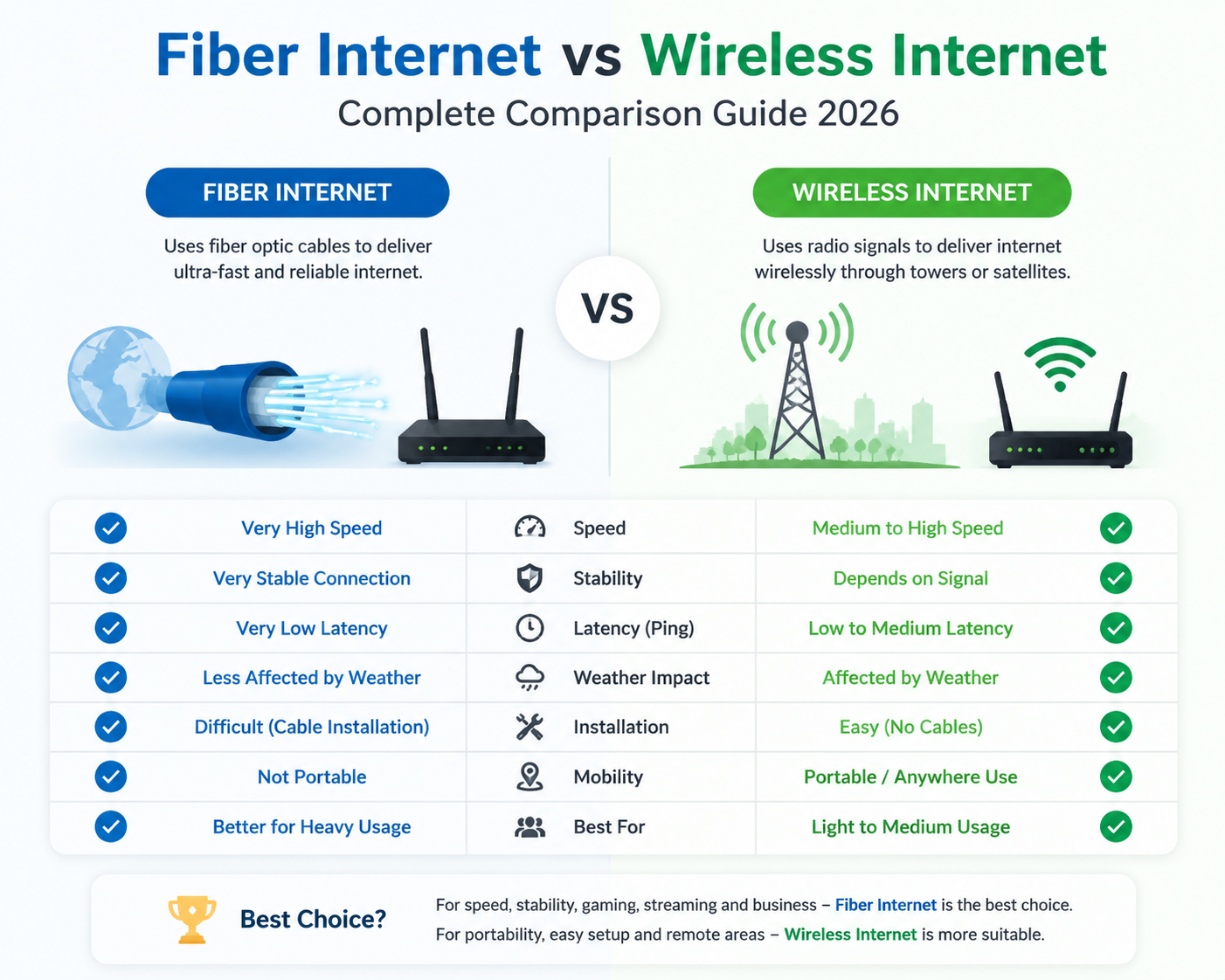
Fiber Internet vs Wireless Broadband
Wireless broadband is another popular option, especially in areas where fiber cables have not yet reached.
Wireless internet connects users through radio signals instead of physical cables. It is often quicker to install and can be useful in rural or remote locations.
Advantages of Wireless Broadband
Faster installation
No need for underground cables
Useful in remote areas
Portable in some cases
However, wireless networks may experience fluctuations due to weather conditions, signal interference, or heavy network usage.
Advantages of Fiber
Fiber generally provides:
More stable speeds
Better reliability
Lower latency
Stronger performance for businesses
Faster cloud access
For users who require consistent internet every day, fiber remains the better long-term solution.
Fiber Internet vs Cable Internet
Cable broadband is widely used in many countries but has limited availability in Pakistan.
Cable internet can deliver respectable speeds but often shares bandwidth among nearby users. During busy hours, performance may decrease.
Fiber internet avoids many of these issues by providing dedicated high-speed connections with excellent reliability.
Fiber Internet vs Satellite Internet
Satellite internet has attracted global attention because it can provide connectivity in places where fiber infrastructure does not exist.
Advantages of Satellite Internet
Coverage in remote regions
Connectivity where cable installation is difficult
Useful during emergencies
Limitations
Higher latency
More expensive equipment
Weather-related performance changes
Higher monthly costs in many cases
For urban users, fiber internet continues to offer a better balance of speed, stability, and affordability.
Why Upload Speed Matters
Many people only pay attention to download speed, but upload speed has become equally important.
Fast upload speeds help with:
Video conferencing
YouTube uploads
Cloud backups
Live streaming
Sending large files
Remote work
Online collaboration
Professionals who regularly upload large amounts of data benefit greatly from fiber broadband because upload performance is much stronger than traditional internet technologies.
Fiber Internet for Online Gaming
Gaming is one of the biggest reasons users upgrade to fiber.
Modern online games require more than fast download speeds. A stable connection with low latency is essential for competitive gameplay.
Popular games played in Pakistan include:
PUBG Mobile
Call of Duty Mobile
Valorant
Counter-Strike 2
Dota 2
Fortnite
EA SPORTS FC
Apex Legends
What Gamers Need
Stable connection
Low ping
Fast server response
Reliable upload speed
Minimal packet loss
Fiber internet performs exceptionally well because it reduces lag and maintains consistent network quality.
Streaming Without Buffering
Streaming services continue to grow in popularity.
People now watch:
YouTube
Netflix
Prime Video
Disney+
Educational platforms
Live sports
News channels
Buffering is often caused by unstable internet rather than insufficient speed alone.
Fiber broadband provides:
Smooth HD playback
Better 4K streaming
Faster loading times
Stable viewing during busy hours
This makes it an excellent choice for entertainment-focused households.
Fiber Internet for Students
Education has become increasingly digital.
Students regularly attend online lectures, submit assignments through learning platforms, conduct research, and communicate with teachers online.
Fiber internet allows students to:
Join live classes without interruptions
Download study materials quickly
Upload assignments efficiently
Participate in virtual discussions
Access cloud-based educational tools
Reliable internet reduces frustration and helps students focus on learning rather than technical issues.
Fiber Internet for Freelancers
Pakistan has one of the fastest-growing freelance communities in the region.
Freelancers depend on reliable internet for:
Client meetings
File sharing
Graphic design
Video editing
Programming
Content writing
Digital marketing
A stable fiber connection helps maintain productivity and improves communication with international clients.
Business Benefits of Fiber Internet
Businesses increasingly rely on cloud applications and online communication.
Fiber broadband supports:
Online accounting systems
Cloud storage
Video conferencing
E-commerce platforms
Customer support systems
Secure remote access
Digital payments
Reliable connectivity minimizes downtime and helps businesses operate more efficiently.
Can Fiber Increase Productivity?
Yes.
A fast internet connection reduces waiting time and improves workflow.
Employees spend less time waiting for:
Large downloads
File uploads
Software updates
Cloud synchronization
Video meeting connections
Over time, these small improvements can significantly increase productivity for both individuals and organizations.
Looking Ahead
Fiber internet is becoming the foundation of Pakistan’s digital future. As more providers expand their networks and more users adopt high-speed broadband, online experiences will continue to improve across education, healthcare, business, entertainment, and communication.
In the next part of this guide, we will discuss WiFi routers, home networking, internet security, smart homes, troubleshooting, and practical tips to get the best possible performance from your fiber internet connection.
Fiber Internet Pakistan – The Ultimate Guide to High-Speed Broadband in 2026 (Part 4)
Why Your WiFi Router Is Just as Important as Your Internet Connection
Many people believe that purchasing a fast fiber internet package automatically guarantees excellent internet performance. In reality, the quality of your WiFi router plays a major role in determining how well your internet works inside your home.
Imagine subscribing to a 100 Mbps or even 200 Mbps fiber connection but using an old router that only supports outdated wireless standards. Even though your ISP delivers high-speed internet to your home, your devices may never experience those full speeds because the router becomes the bottleneck.
A modern router is designed to distribute internet efficiently across multiple devices while maintaining strong performance throughout the house. As homes become smarter and more connected, upgrading your router can often make a noticeable difference.
How a WiFi Router Works
A router acts as the bridge between your internet connection and all of your devices.
It receives the internet signal from your fiber modem and distributes it wirelessly or through Ethernet cables.
Today, an average household may have:
Smartphones
Laptops
Desktop computers
Smart TVs
Gaming consoles
Tablets
CCTV cameras
Smart speakers
Smart lights
Home security devices
A quality router ensures that all these devices remain connected without causing unnecessary slowdowns.
Single-Band vs Dual-Band vs Tri-Band Routers
Not all routers are built the same. Understanding the different types helps you choose the right device.
Single-Band Routers
Single-band routers operate only on the 2.4 GHz frequency.
Advantages:
Lower cost
Longer wireless range
Suitable for light browsing
Limitations:
Slower speeds
More interference
Not ideal for gaming or heavy streaming
Dual-Band Routers
Dual-band routers operate on both 2.4 GHz and 5 GHz frequencies.
Benefits include:
Better speed
Reduced interference
Improved streaming
Better gaming performance
Support for multiple devices
For most households, a dual-band router provides the best balance between performance and affordability.
Tri-Band Routers
Tri-band routers are designed for homes with many connected devices.
Advantages include:
Higher wireless capacity
Better device management
Excellent performance under heavy load
Suitable for smart homes
These routers are often preferred by gamers, businesses, and large families.
Understanding WiFi 6
WiFi 6 is the latest generation of wireless networking that has become increasingly popular in Pakistan.
Unlike older WiFi standards, WiFi 6 is designed to handle many connected devices simultaneously.
Major improvements include:
Faster wireless speeds
Better battery efficiency for mobile devices
Lower latency
Improved performance in crowded homes
More stable connections
If your ISP provides high-speed fiber, pairing it with a WiFi 6 router can significantly improve your overall experience.
The Arrival of WiFi 7
WiFi 7 represents the next step in wireless networking technology.
Although still being adopted in many regions, WiFi 7 promises:
Extremely high wireless speeds
Lower latency
Better support for 8K streaming
Faster cloud gaming
Improved smart home performance
As more devices begin supporting WiFi 7, users can expect even smoother wireless experiences.
Mesh WiFi Systems
Large homes often experience weak WiFi signals in certain rooms.
Instead of relying on one router, many families now install Mesh WiFi systems.
A mesh network uses multiple wireless units placed throughout the home.
Benefits include:
Full-home WiFi coverage
Automatic roaming
Strong signal in every room
Better streaming quality
Improved gaming performance
For homes with multiple floors, mesh systems are often the best solution.
Best Router Placement
Router placement has a huge impact on internet performance.
Many users hide routers inside cabinets or behind televisions, reducing signal strength.
For the best results:
Place the router in the center of the home.
Keep it elevated on a shelf or table.
Avoid placing it near microwaves or cordless phones.
Keep it away from thick concrete walls.
Do not cover the router with decorative objects.
Even small changes in placement can noticeably improve WiFi coverage.
Wired vs Wireless Connections
While WiFi offers convenience, wired Ethernet connections still provide the highest performance.
Ethernet is recommended for:
Gaming PCs
Office computers
Smart TVs
Network storage devices
Business servers
Advantages of Ethernet include:
Lower latency
More stable connection
Higher reliability
No wireless interference
For competitive gaming and professional work, Ethernet often delivers the best results.
Common Reasons Why WiFi Becomes Slow
Sometimes users blame their ISP when the actual issue is inside the home.
Common causes include:
Outdated router
Too many connected devices
Weak router placement
Background software updates
Neighboring WiFi interference
Old smartphones or laptops
Poor router configuration
Identifying the correct cause helps improve internet performance without changing your broadband package.
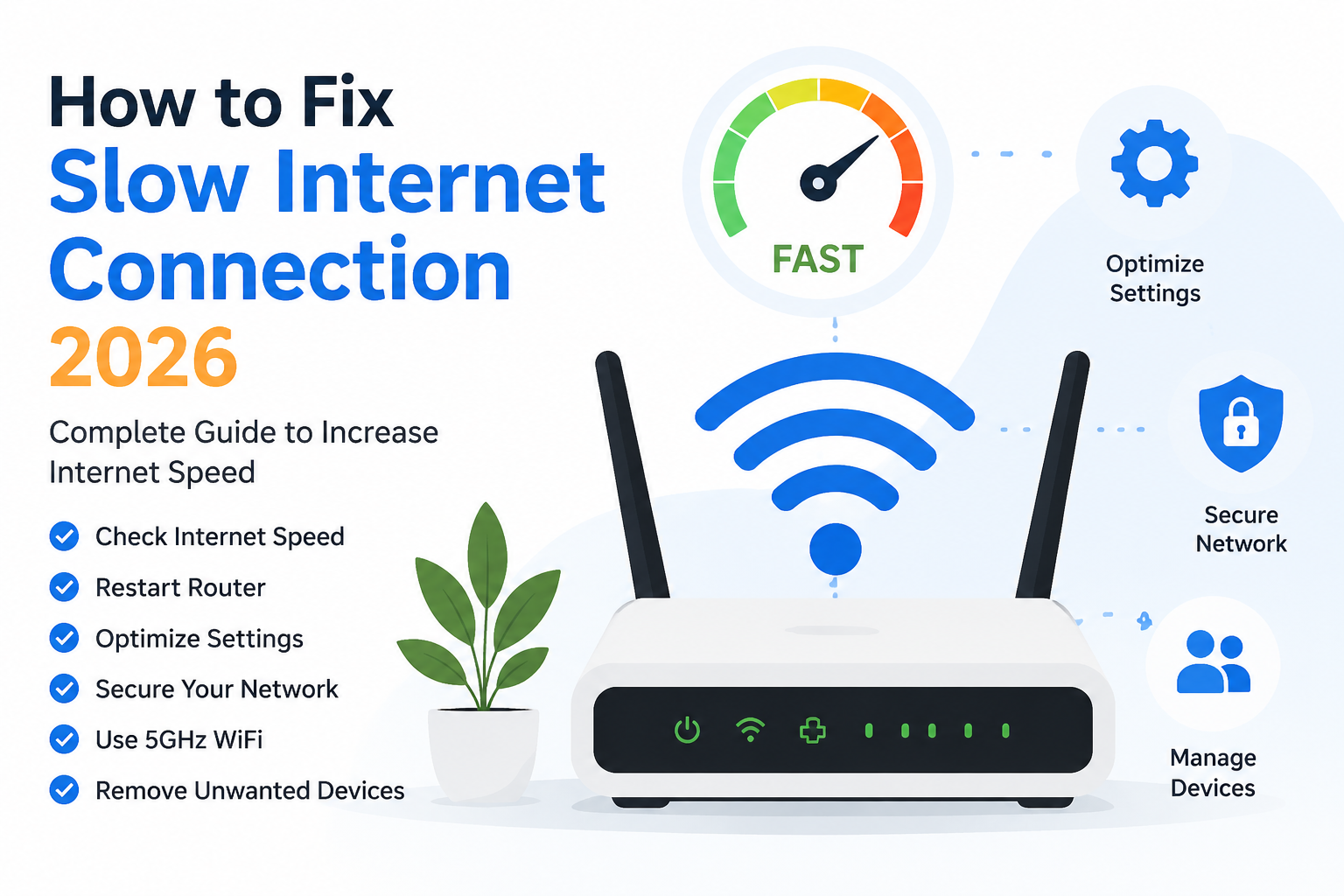
Easy Ways to Improve Internet Speed
If your connection feels slow, try these simple improvements before contacting customer support.
Restart Your Router
Restarting clears temporary issues and refreshes the network connection.
Update Router Firmware
Manufacturers regularly release updates that improve stability and security.
Use the 5 GHz Network
When available, the 5 GHz band usually provides faster speeds with less interference.
Secure Your WiFi
A strong password prevents unauthorized users from consuming your bandwidth.
Disconnect Unused Devices
Smart TVs, cameras, tablets, and other devices continue using bandwidth even when not actively in use.
Home Internet Security
A fast internet connection should also be a secure one.
Cybersecurity is becoming increasingly important as more personal information is stored online.
To protect your home network:
Change the default router password.
Enable WPA3 or WPA2 encryption.
Keep firmware updated.
Disable remote management unless necessary.
Use strong passwords for online accounts.
Enable two-factor authentication where available.
These simple habits help protect both your internet connection and your personal data.
All these devices depend on a stable internet connection.
Fiber internet provides the bandwidth needed to support multiple smart devices without reducing overall network performance.
Looking Ahead
The future of home networking is becoming smarter, faster, and more connected. As internet speeds continue to increase, choosing the right router and optimizing your home network will become just as important as selecting the right fiber internet provider.
In the next part of this guide, we will explore internet security, online privacy, cloud computing, remote work, digital businesses, AI-powered applications, and how fiber internet is shaping Pakistan’s digital economy.
Finding the best internet in Pakistan 2026 has become more important than ever. Whether you work from home, attend online classes, stream 4K videos, or play competitive online games, a fast and stable internet connection is essential. In 2026, Pakistan’s broadband market continues to grow with wider fiber-optic coverage, improved network speeds, and more affordable internet packages.
This guide explains the top internet providers, the latest technologies, and how to choose the best internet connection for your home or business.
Why High-Speed Internet Matters in 2026
Internet usage in Pakistan has increased rapidly over the past few years. Millions of people now rely on broadband for:
Remote work
Online education
HD and 4K streaming
Online gaming
Video conferencing
Smart home devices
Content creation
E-commerce businesses
A reliable internet connection improves productivity while reducing buffering and connection interruptions.
Top Internet Providers in Pakistan 2026
1. PTCL Flash Fiber
PTCL Flash Fiber continues expanding its fiber network across major cities.
Advantages
High-speed fiber connection
Unlimited data plans
Good nationwide availability
Suitable for streaming and gaming
2. Nayatel
Nayatel remains one of Pakistan’s most trusted fiber internet providers.
Best For
Families
Professionals
Businesses
Online gamers
Benefits include excellent customer support and stable internet performance.
3. StormFiber
StormFiber offers modern fiber-optic internet with competitive packages.
Features include:
High download speeds
Low latency
HD streaming support
Reliable customer service
4. Transworld Home
Transworld continues improving its residential broadband services with fiber technology.
It is suitable for:
Small businesses
Remote workers
Heavy internet users
5. Local Fiber ISPs
Many local internet companies now provide affordable fiber broadband in cities such as:
Faisalabad
Lahore
Multan
Gujranwala
Sialkot
Sargodha
Bahawalpur
Islamabad
Rawalpindi
Peshawar
Local ISPs often offer competitive pricing and faster installation within their coverage areas.
Fiber Internet vs Wireless Internet
Fiber Internet
Advantages
Faster speeds
Stable connection
Lower latency
Better for gaming
Better for video calls
Wireless Internet
Advantages
Easier installation
Portable in some cases
Suitable where fiber is unavailable
For most users in 2026, fiber internet remains the best choice.
Best Internet for Online Gaming
Gamers require:
Low ping
Stable latency
Fast upload speed
Consistent download speed
Fiber broadband generally provides the best gaming experience for titles such as PUBG Mobile, Call of Duty, Valorant, Counter-Strike 2, EA SPORTS FC, and Fortnite.
Best Internet for Streaming
If you regularly watch YouTube, Netflix, Prime Video, or other streaming platforms, choose a connection that offers:
Stable speeds
Unlimited data (or a generous fair-usage policy)
Good evening performance
Reliable Wi-Fi coverage
Internet Speeds Recommended in 2026
Usage
Recommended Speed
Basic Browsing
15 Mbps
HD Streaming
30 Mbps
4K Streaming
50 Mbps
Online Gaming
50–100 Mbps
Home Office
50 Mbps
Large Families
100 Mbps or higher
How to Choose the Best Internet Provider
Before subscribing, compare:
Availability in your area
Fiber coverage
Monthly price
Customer support
Installation charges
Router quality
Upload speed
User reviews
Choosing the right provider depends on your location and daily internet usage.
Future of Internet in Pakistan
Pakistan’s broadband industry is expected to continue expanding with:
More fiber-optic deployments
Faster internet speeds
Improved Wi-Fi technology
Wider digital connectivity
Better broadband competition
These developments are likely to improve internet quality for both homes and businesses.
Final Thoughts
Choosing the Best Internet in Pakistan 2026 depends on your location, budget, and internet requirements. Fiber-optic connections generally provide the best performance for gaming, streaming, online work, and everyday browsing. Compare providers available in your area, review their packages, and select the service that offers the best balance of speed, reliability, and customer support.
With continuous investment in broadband infrastructure, internet services across Pakistan are expected to become faster, more reliable, and more widely available throughout 2026.
Best Internet in Pakistan 2026 – Complete Guide to the Fastest Broadband, Fiber & WiFi Services
Introduction
The demand for high-speed internet in Pakistan has reached an all-time high in 2026. More people than ever rely on a stable internet connection for remote work, online education, video conferencing, digital businesses, cloud computing, online banking, entertainment, and competitive gaming. As digital services continue to expand across the country, choosing the Best Internet in Pakistan 2026 has become an important decision for every household and business.
Pakistan’s internet industry has improved significantly during the past few years. Fiber-optic networks are expanding into more cities, broadband speeds continue to increase, and internet providers are introducing better packages to meet the growing demand. Whether you need internet for watching 4K movies, running an online business, uploading videos to YouTube, attending virtual meetings, or playing online games with low latency, selecting the right internet service provider (ISP) can greatly improve your online experience.
This detailed guide explains the leading internet providers in Pakistan, compares different connection types, highlights the benefits of fiber internet, discusses gaming and streaming performance, and helps you choose the best broadband service according to your location and budget.
Internet Growth in Pakistan During 2026
Pakistan’s digital economy continues to grow rapidly. Businesses are moving online, schools and universities increasingly use digital learning platforms, and millions of users depend on fast internet every day. This growth has encouraged internet providers to invest in stronger infrastructure and wider fiber-optic coverage.
Several important developments are shaping Pakistan’s internet landscape in 2026:
Expansion of fiber-optic internet into more residential areas.
Higher internet speeds for homes and businesses.
Improved customer support from leading ISPs.
Better WiFi routers with stronger coverage.
Increased competition among internet providers.
More affordable broadband packages.
Rising demand for smart home devices and cloud services.
As competition increases, customers have more choices than ever before. Internet providers are improving both speed and service quality to attract new users.
Why Choosing the Right Internet Provider Matters
Many people select an internet connection based only on price. However, monthly cost is only one factor. A cheaper package may not provide consistent speeds, while a slightly higher-priced fiber connection can offer a much better overall experience.
A good internet provider should deliver:
Stable download speeds throughout the day.
Fast upload speeds for video calls and content creation.
Low latency for online gaming.
Reliable customer support.
Minimal service interruptions.
Modern WiFi equipment.
Flexible broadband packages.
Choosing the right provider can save time, improve productivity, and reduce frustration caused by buffering or slow downloads.
What Makes Fiber Internet Better?
Fiber-optic internet has become the preferred choice for most users in Pakistan. Unlike older copper-based connections, fiber uses light signals to transmit data, allowing much higher speeds and lower latency.
Advantages of Fiber Internet
Faster downloads and uploads.
More stable performance during peak hours.
Better video conferencing quality.
Excellent performance for online gaming.
Smooth 4K and 8K streaming.
Reliable connectivity for multiple users.
Future-ready technology for increasing internet demand.
For families with several connected devices, fiber internet usually provides a noticeable improvement compared to traditional broadband technologies.
Top Internet Providers in Pakistan 2026
Pakistan offers several reliable internet service providers. Availability may vary depending on your city, but the following companies are among the most recognized broadband providers.
PTCL Flash Fiber
PTCL Flash Fiber remains one of the largest broadband services in Pakistan. The company continues expanding its fiber network into new cities and residential areas.
Key Benefits
High-speed fiber connectivity.
Wide network coverage.
Multiple broadband packages.
Suitable for remote work.
Reliable streaming performance.
Good option for families.
PTCL is often chosen because of its nationwide presence and continuous investment in fiber infrastructure.
Nayatel
Nayatel is widely known for providing premium fiber internet services in selected cities. The company has built a strong reputation through stable internet performance and responsive customer support.
Why Customers Prefer Nayatel
Excellent reliability.
Strong upload speeds.
Low latency.
Good technical support.
Suitable for professionals.
Excellent gaming performance.
Many users consider Nayatel one of the best options where its services are available.
StormFiber
StormFiber continues to grow as one of Pakistan’s leading fiber internet providers. The company focuses on delivering high-speed internet with modern networking equipment.
Advantages
Fast broadband speeds.
Stable fiber connection.
HD and 4K streaming support.
Modern WiFi routers.
Competitive packages.
Good customer satisfaction.
StormFiber is particularly popular among households with multiple internet users.
Transworld Home
Transworld Home has expanded its broadband offerings with reliable fiber-based internet services. It is suitable for homes and businesses requiring consistent internet performance.
Features
High-speed broadband.
Reliable connectivity.
Low network congestion.
Business-friendly solutions.
Smooth cloud application performance.
Its services are increasingly being considered by users looking for dependable broadband.
Local Fiber Internet Providers
Besides major national providers, many local ISPs are improving internet quality in cities across Pakistan.
These providers often serve specific areas and may offer faster installation and personalized customer support.
Popular cities with growing local fiber services include:
Lahore
Faisalabad
Multan
Gujranwala
Rawalpindi
Islamabad
Sialkot
Sargodha
Bahawalpur
Hyderabad
Peshawar
Quetta
Before choosing a local ISP, compare reviews, package details, installation costs, and service reliability.
Types of Internet Connections Available in Pakistan
Different internet technologies are available depending on your location.
Fiber Optic Internet
Fiber remains the fastest and most reliable option.
Best for:
Online gaming
Video streaming
Work from home
Large families
Businesses
Content creators
DSL Internet
DSL is still available in many areas where fiber has not yet reached.
Advantages include:
Affordable pricing.
Easy availability.
Stable browsing experience.
However, DSL generally cannot match the speed and reliability of fiber connections.
Wireless Broadband
Wireless internet provides connectivity without physical cables and is useful in areas where wired infrastructure is limited.
It is suitable for:
Small households.
Temporary setups.
Rural locations.
Backup internet connections.
Connection quality may vary depending on signal strength and network conditions.
Mobile Data Networks
Modern 4G and expanding 5G networks also provide internet access across Pakistan.
These are ideal for:
Smartphones.
Tablets.
Portable WiFi devices.
Travelers.
Emergency internet access.
However, heavy users may prefer fixed broadband due to better consistency and larger data allowances.
Which Internet Connection Is Best?
The answer depends on your usage.
If you mainly browse websites and social media, a basic broadband package may be sufficient. Families with several users, remote workers, gamers, and businesses generally benefit from fiber-optic internet because of its higher speeds, stronger reliability, and better overall performance.
In the next part of this guide, we will compare internet providers in more detail, discuss gaming performance, streaming quality, recommended internet speeds, pricing considerations, and practical tips for choosing the best internet service in Pakistan during 2026.
Best Internet in Pakistan 2026 – Part 2
Internet Speed Guide: How Much Speed Do You Really Need?
Many people buy internet packages without understanding how much speed they actually require. Choosing the right speed can help you save money while ensuring a smooth online experience. The ideal internet speed depends on the number of users, connected devices, and the type of online activities you perform every day.
Recommended Internet Speeds
Usage
Recommended Speed
Web Browsing & Social Media
10–20 Mbps
Online Classes
20–30 Mbps
HD Video Streaming
25–40 Mbps
4K Video Streaming
50 Mbps or Higher
Online Gaming
50–100 Mbps
Work From Home
50 Mbps
Small Business
100 Mbps or More
Large Family
100–200 Mbps
If several people in your home use the internet at the same time, choosing a higher-speed fiber package will provide a much better experience.
Best Internet for Online Gaming
Gaming has become one of the biggest reasons people upgrade their internet connection. Popular games like PUBG Mobile, Call of Duty Mobile, Valorant, Counter-Strike 2, Fortnite, EA SPORTS FC, and Dota 2 require not only fast download speeds but also low latency.Best Internet in Pakistan 2026
Important Factors for Gamers
Low Ping
Stable Connection
Fast Upload Speed
No Frequent Disconnections
Good WiFi Coverage
Fiber Connection
A ping below 30ms generally provides a smooth gaming experience, while a stable fiber connection helps reduce lag and packet loss.
Best Internet for Streaming
Streaming platforms continue to grow in popularity. Whether you watch YouTube, Netflix, Disney+, Prime Video, or other online platforms, a stable broadband connection is essential.Best Internet in Pakistan 2026
For uninterrupted streaming you should have:
Unlimited or high data allowance
Stable WiFi signal
Good download speed
Reliable router
Strong evening performance
Fiber internet performs much better during peak hours compared to older internet technologies.Best Internet in Pakistan 2026
Best Internet for Work From Home
Remote work has become common across Pakistan. Employees, freelancers, software developers, designers, and digital marketers all depend on stable internet connectivity.
A good work-from-home connection should provide:Best Internet in Pakistan 2026
Fast upload speeds
Clear video calls
Stable VPN connection
Cloud storage support
Reliable performance throughout the day
Video conferencing applications such as Zoom, Google Meet, and Microsoft Teams perform much better on fiber internet.Best Internet in Pakistan 2026
Best Internet for Students
Students regularly attend online classes, submit assignments, watch educational videos, and conduct research online.
An ideal student internet connection should offer:
Stable WiFi
Affordable monthly package
Reliable video streaming
Fast downloads
Good customer support
Families with multiple students may benefit from a higher-speed broadband package.Best Internet in Pakistan 2026
Fiber Internet vs DSL
Many users still compare Fiber and DSL before choosing an internet connection.
Feature
Fiber
DSL
Speed
Excellent
Moderate
Upload Speed
High
Lower
Reliability
Excellent
Good
Gaming
Excellent
Average
Streaming
Excellent
Good
Future Ready
Yes
Limited
Fiber internet clearly provides better overall performance and is recommended whenever it is available.
What Makes an ISP Reliable?
Choosing an ISP is not just about speed. Reliability plays an equally important role.Best Internet in Pakistan 2026
A reliable provider should offer:
Consistent speeds
Professional customer support
Quick fault resolution
Modern network infrastructure
Fair pricing
Good user reviews
Transparent billing
Before subscribing, it is always a good idea to ask neighbours or local users about their experience.Best Internet in Pakistan 2026
How to Choose the Best Internet Provider
Before purchasing any internet package, consider the following points:
1. Coverage
Check whether fiber service is available in your area.Best Internet in Pakistan 2026
2. Monthly Cost
Compare monthly subscription fees along with installation charges.
3. Router Quality
A high-quality WiFi router can significantly improve wireless coverage inside your home.Best Internet in Pakistan 2026
4. Customer Support
Reliable customer service is essential if technical problems occur.
5. Upload Speed
Content creators and professionals should pay attention to upload speed, not just download speed.Best Internet in Pakistan 2026
6. Fair Usage Policy
Read the package details carefully to understand whether any speed limitations apply after heavy usage.
Best Internet for Small Businesses
Small businesses increasingly rely on cloud applications, online payments, and digital communication.Best Internet in Pakistan 2026
A business internet connection should provide:
Stable connectivity
High uptime
Fast uploads
Secure networking
Reliable customer support
Business owners should avoid choosing packages based solely on price.Best Internet in Pakistan 2026
Common Internet Problems
Users often experience issues such as:Best Internet in Pakistan 2026
Slow browsing
Weak WiFi signal
High ping
Frequent disconnections
Slow downloads
Buffering during streaming
Many of these problems can be solved by upgrading to fiber internet, replacing an old router, or improving WiFi placement inside the home.
Tips to Improve WiFi Speed
You can improve your home WiFi performance by following these simple tips:
Place the router in a central location.
Keep the router away from thick walls and metal objects.
Restart the router occasionally.
Use a modern dual-band router.
Update router firmware.
Protect your WiFi with a strong password.
Disconnect devices that are not being used.
These small improvements often make a noticeable difference in speed and coverage.
Internet Security Tips
A fast internet connection is important, but online security is equally essential.
Always remember to:
Use strong passwords.
Enable two-factor authentication where available.
Update your devices regularly.
Avoid downloading files from unknown websites.
Install trusted antivirus software.
Keep your WiFi network password secure.
Following these practices helps protect your personal information and connected devices.
Internet Trends in Pakistan
The broadband industry continues to evolve rapidly. Some major trends expected during 2026 include:Best Internet in Pakistan 2026
Wider fiber-optic expansion.
Faster residential broadband.
Better WiFi 6 and WiFi 7 adoption.
Increased cloud service usage.
Growth in smart home devices.
Expansion of digital businesses.
Rising demand for online education.
Improved internet competition across cities.
These developments are expected to provide users with better internet quality and more competitive package options in the coming years.
At the same time, customers should continue comparing providers based on performance, support, and reliability rather than focusing only on advertised speeds.Best Internet in Pakistan 2026
Best Internet in Pakistan 2026 – Part 3 (Final)
Future of Fiber Internet in PakistanBest Internet in Pakistan 2026
Pakistan is rapidly moving towards a digital future where fast and reliable internet is no longer a luxury but a necessity. Government initiatives, private sector investments, and increasing consumer demand are encouraging internet providers to expand their fiber-optic infrastructure across the country.
In 2026, more cities and towns are expected to receive fiber connectivity, allowing millions of users to enjoy faster internet speeds, lower latency, and improved network reliability. As competition grows, internet providers are also introducing better customer support, modern WiFi equipment, and more flexible broadband packages.
The Role of 5G in Pakistan
The rollout of 5G technology is one of the most discussed topics in Pakistan’s telecom industry. While 4G remains the primary mobile internet technology for most users, preparations for wider 5G adoption continue.Best Internet in Pakistan 2026
Benefits of 5G
Ultra-fast download speeds
Lower network latency
Better support for smart devices
Improved mobile gaming
Faster cloud services
Enhanced video streaming quality
However, for homes and offices, fiber-optic broadband is still expected to remain the preferred option because it offers greater stability and consistent performance.Best Internet in Pakistan 2026
Can Satellite Internet Change Pakistan?
Satellite internet has gained global attention because it can provide connectivity in remote and underserved areas.Best Internet in Pakistan 2026
Potential benefits include:
Internet access in rural regions
Better connectivity during emergencies
Coverage where fiber installation is difficult
Improved access for remote businesses and schools
Although satellite internet is an exciting technology, traditional fiber broadband is likely to remain the most practical solution for urban areas due to its speed, stability, and lower operating costs.Best Internet in Pakistan 2026
Choosing the Best Internet by City
Different cities have different broadband options. Before selecting a provider, always verify service availability in your neighborhood.Best Internet in Pakistan 2026
Lahore
Lahore offers one of the widest selections of internet providers, with extensive fiber coverage in many residential and commercial areas.
Karachi
Karachi has strong demand for high-speed internet due to its large population and business activity. Fiber broadband continues to expand across the city.Best Internet in Pakistan 2026
Islamabad & Rawalpindi
These cities are known for having several reliable broadband providers with good customer support and stable internet performance.
Faisalabad
Fiber internet services are expanding rapidly in Faisalabad, giving residents more choices than ever before.Best Internet in Pakistan 2026
Multan
Multan continues to see improvements in broadband infrastructure, making high-speed internet available to more households.
Gujranwala
The city’s digital growth has increased demand for reliable broadband services, encouraging providers to expand their networks.
Sialkot
Businesses and exporters rely heavily on stable internet connections, making fiber broadband an increasingly popular choice.
Common Mistakes People Make
Many users make avoidable mistakes when choosing an internet package.Best Internet in Pakistan 2026
Choosing Only the Cheapest Plan
The cheapest option is not always the best. A slightly higher-priced fiber package may provide a much smoother experience.
Ignoring Upload Speed
Content creators, freelancers, students, and businesses often require fast upload speeds in addition to downloads.
Buying More Speed Than Needed
Not every household requires a 200 Mbps connection. Selecting a package that matches your actual usage can help reduce monthly costs.
Poor Router Placement
Even a fast internet package can perform poorly if the router is hidden inside a cupboard or placed in a corner behind thick walls.
Frequently Asked Questions (FAQs)
Which internet connection is best in Pakistan in 2026?
Fiber-optic internet is generally the best option because it provides faster speeds, lower latency, and greater reliability than older broadband technologies.Best Internet in Pakistan 2026
What internet speed is enough for a family?
For a family with multiple connected devices, a 50–100 Mbps fiber connection is usually sufficient for streaming, online classes, video calls, and gaming.Best Internet in Pakistan 2026
Is fiber better than DSL?
Yes. Fiber offers higher download and upload speeds, lower ping, and more stable performance than DSL.Best Internet in Pakistan 2026
Which internet is best for online gaming?
A fiber connection with low latency and stable speeds provides the best gaming experience.
What should I check before buying internet?
Always compare:
Coverage
Monthly price
Installation charges
Customer support
Router quality
Upload speed
User reviews
Reliability
How can I improve my home WiFi?
Place the router in the center of your home.
Restart it occasionally.
Keep firmware updated.
Use strong WiFi security.
Upgrade to a modern dual-band or WiFi 6 router if needed.
Expert Tips Before You Subscribe
Before making a final decision, compare at least three providers available in your area. Read customer reviews, ask neighbors about their experience, and choose a package that matches your internet usage rather than simply selecting the highest advertised speed.Best Internet in Pakistan 2026.
Also remember that a good WiFi router and proper installation are just as important as the internet package itself.
Final Conclusion
Choosing the Best Internet in Pakistan 2026 requires careful consideration of speed, reliability, customer support, pricing,Best Internet in Pakistan 2026 and coverage. Fiber-optic broadband continues to be the leading choice for homes, businesses, gamers, students, and professionals because it delivers consistent performance across a wide range of online activities.Best Internet in Pakistan 2026
As broadband infrastructure expands and new technologies continue to develop, internet users in Pakistan can expect even better connectivity in the years ahead. Before purchasing a package, compare the providers available in your area, evaluate your daily internet requirements, and invest in a reliable broadband connection that will support your needs today and in the future.
A fast, secure, and dependable internet connection is now an essential part of modern life. Whether you browse the web, stream movies, attend online classes, manage a business, or play competitive games, selecting the right internet service provider will help you enjoy the best possible online experience throughout 2026.
Quick Summary
Fiber internet remains the best choice for most users.
Compare providers based on reliability, not only price.
Choose internet speed according to your household’s needs.
Invest in a quality WiFi router for better coverage.
Read customer reviews before subscribing.
Keep your home network secure with strong passwords and regular updates.
Stay informed about new broadband technologies and expanding fiber coverage in your city.
By following these recommendations, you can confidently choose the best internet connection for your home or business and enjoy a faster, more reliable digital experience in Pakistan.
Ultimate & Proven Guide for Pakistani Workers in 2026:
For thousands of Pakistani workers, Europe continues to be one of the most attractive destinations for building a successful career and improving their quality of life. In 2026, many European countries are actively looking for skilled professionals, healthcare workers, engineers, IT specialists, construction workers, drivers, chefs, and hospitality staff.
If you are planning to work abroad, choosing the right country is one of the most important decisions you can make. Every country offers different salaries, work visa requirements, living costs, and career opportunities. This guide explains which European countries are worth considering and why they remain popular among Pakistani job seekers.Ultimate & Proven Guide for Pakistani Workers in 2026:
Why Europe Is a Great Choice for Pakistani Workers.
Europe offers much more than competitive salaries. Many countries provide safe workplaces, modern healthcare, legal employment protection, and opportunities for long-term career growth.Ultimate & Proven Guide for Pakistani Workers in 2026:
Some of the biggest advantages include:
High-paying jobs in multiple industries
Legal work visa pathways
Better work-life balance
Modern healthcare and education
Career development opportunities
Possibility of long-term residence in some countries
These benefits make Europe an attractive option for skilled and hardworking Pakistani professionals.
1. Germany Ultimate & Proven Guide for Germany Workers in 2026:
Germany remains one of Europe’s strongest economies and continues to face shortages in several industries.Ultimate & Proven Guide for Pakistani Workers in 2026:
Popular Jobs
IT Professionals
Nurses
Electricians
Engineers
Construction Workers
Mechanics
Average Monthly Salary
Most workers earn approximately €2,500–€5,500, depending on their profession, qualifications, and experience.
Germany is well known for its organized work environment and strong employee benefits.
2. Poland
Poland has become one of the most popular destinations for Pakistani workers because many industries regularly hire international employeesUltimate & Proven Guide for Pakistani Workers in 2026: .
In-Demand Jobs
Factory Workers
Warehouse Staff
Machine Operators
Drivers
Welders
Construction Workers
Average Salary
Workers generally earn between €1,300 and €2,800 per month, depending on the role and employer.
Poland is often chosen by people who want to gain European work experience before exploring additional career opportunities.Ultimate & Proven Guide for Pakistani Workers in 2026:
3. Portugal
Portugal is becoming increasingly attractive for foreign workers because of its growing economy and welcoming environment.Ultimate & Proven Guide for Pakistani Workers in 2026:
Popular Careers
Tourism
Hospitality
Restaurants
Customer Service
Construction
Agriculture
Average Salary
Monthly salaries commonly range from €1,200 to €2,500, with higher earnings possible in specialized fields.
4. Netherlands
The Netherlands offers excellent career opportunities, especially for highly skilled professionals.
High-Demand Jobs
Software Developers
Engineers
Logistics Experts
Healthcare Professionals
Finance Specialists
Average Salary
Professionals often earn between €3,000 and €6,000 per month, depending on experience and occupation.
5. Ireland
Ireland continues to attract international talent because of its strong technology sector and multinational companies.Ultimate & Proven Guide for Pakistani Workers in 2026:
Best Career Fields
Information Technology
Healthcare
Finance
Engineering
Customer Support
Average Salary
Many professionals earn €3,000–€6,500 per month, depending on their skills and qualifications.
Work Visa Options for Pakistani Workers
Most European countries require a valid work visa before employment begins. In many cases, applicants first receive a job offer from an employer, who may assist with parts of the work permit process.
Typical requirements include:
Valid passport
Employment contract or job offer
Educational or professional documents
Medical examination (where required)
Police clearance certificate (if requested)
Always check the latest immigration rules through the official government website of the country where you plan to work, as visa policies may change.
Tips to Increase Your Chances of Getting a Job
Finding a job in Europe requires preparation. These practical steps can improve your chances:
Build a professional CV in European format.
Improve your English communication skills.
Learn basic phrases in the local language if possible.
Apply only through trusted employers and verified job portals.
Develop technical or vocational skills that are in demand.
Good preparation can make you a stronger candidate in a competitive job market.
Final Thoughts
Europe offers exciting opportunities for Pakistani workers who are ready to build their careers abroad. Countries such as Germany, Poland, Portugal, the Netherlands, and Ireland continue to recruit international talent across many industries.
Before applying, research the latest visa requirements, salary expectations, and living costs for your chosen destination. With the right skills, preparation, and determination, working in Europe in 2026 can become an important step toward long-term career success and personal growth.
Frequently Asked Questions (FAQs)
Which European country is best for Pakistani workers in 2026?
Germany, the Netherlands, Ireland, Poland, and Portugal are among the popular choices due to strong job markets and opportunities in multiple sectors.
Which jobs are most in demand in Europe?
Healthcare, information technology, engineering, logistics, construction, manufacturing, hospitality, and skilled trades remain in demand across many European countries.
Can Pakistani workers apply for European work visas?
Yes. Pakistani citizens can apply for work visas if they meet the requirements set by the destination country, which typically include a valid job offer and supporting documents.
Is Europe a good place to build a long-term career?
For many workers, Europe offers competitive salaries, professional development, strong labor protections, and opportunities for career advancement, depending on the country and occupation.
Japan has become one of the most attractive destinations for skilled professionals and international workers. In 2026, the country continues to face labor shortages in several industries, creating excellent opportunities for foreigners seeking a better career and a higher income.Best High-Paying Jobs in Japan 2026: Ultimate Salary, Work Visa & Career Guide for Foreigners. From IT professionals and engineers to caregivers, construction workers, and hospitality staff, thousands of companies are actively hiring international talent.
If you are planning to build a successful career abroad, understanding the highest-paying jobs in Japan, the work visa process, and the required skills is essential. This guide covers everything you need to know before starting your journey.
Why Work in Japan?
Japan offers more than just competitive salaries. It provides a safe environment, modern infrastructure, advanced technology, and excellent career growth. Employees also enjoy professional workplaces, reliable public transportation, and access to high-quality healthcare.
Some of the biggest benefits of working in Japan include:
High-paying career opportunities
Work visa sponsorship from many employers
Excellent work environment
Career development and skill improvement
Long-term employment opportunities
One of the safest countries in the world
Best High-Paying Jobs in Japan
1. Software Engineer
Software engineers remain among the highest-paid professionals in Japan. Companies developing artificial intelligence, cloud computing, cyber security, and business software are constantly looking for experienced developers.Best High-Paying Jobs in Japan 2026: Ultimate Salary, Work Visa & Career Guide for Foreigners.
Average Annual Salary: ¥6,000,000 – ¥12,000,000
2. AI and Data Scientist
Artificial Intelligence continues to transform industries across Japan. Businesses need professionals who can analyze data, build machine learning models, and develop AI-powered solutions.Best High-Paying Jobs in Japan 2026: Ultimate Salary, Work Visa & Career Guide for Foreigners.
Average Annual Salary: ¥8,000,000 – ¥15,000,000
3. Mechanical and Electrical Engineer
Japan is home to some of the world’s largest automotive and manufacturing companies. Skilled engineers are highly valued in factories, robotics, and industrial production.Best High-Paying Jobs in Japan 2026: Ultimate Salary, Work Visa & Career Guide for Foreigners.
Average Annual Salary: ¥5,500,000 – ¥10,000,000
4. Nurse and Caregiver
Japan’s aging population has significantly increased the demand for healthcare professionals. Many hospitals and elderly care centers actively recruit foreign workers through visa sponsorship programs.Best High-Paying Jobs in Japan 2026: Ultimate Salary, Work Visa & Career Guide for Foreigners.
Average Annual Salary: ¥3,500,000 – ¥6,500,000
5. IT Security Specialist
As cyber threats continue to grow, companies invest heavily in cyber security.Best High-Paying Jobs in Japan 2026: Ultimate Salary, Work Visa & Career Guide for Foreigners. Professionals with experience in network security, ethical hacking, and cloud protection enjoy excellent salaries.
Average Annual Salary: ¥7,000,000 – ¥13,000,000
Japan Work Visa in 2026.
Obtaining a Japan Work Visa is easier when you have a confirmed job offer from a Japanese employer. Most companies assist international employees throughout the visa application process.Best High-Paying Jobs in Japan 2026: Ultimate Salary, Work Visa & Career Guide for Foreigners.
Generally, you will need:
A valid passport
A job offer from a Japanese company
Educational certificates
Relevant work experience
Visa application documents
Depending on your profession, your employer may also apply for a Certificate of Eligibility (CEO) before you receive your visa.
Skills That Increase Your Salary
Learning valuable skills can significantly improve your earning potential in Japan.Best High-Paying Jobs in Japan 2026: Ultimate Salary, Work Visa & Career Guide for Foreigners.
The most in-demand skills include:
Artificial Intelligence (AI)
Programming
Cloud Computing
Cyber security
Data Analysis
Robotics
Japanese Language (JLPT N5 or higher)
Although many international companies use English, learning basic Japanese makes daily life easier and increases your chances of promotion.
Can Foreigners Find Jobs Easily?
Yes. Japan continues to welcome skilled foreign workers because many industries face labor shortages. Technology, healthcare, manufacturing, logistics, construction, and hospitality are among the sectors hiring international professionals.Best High-Paying Jobs in Japan 2026: Ultimate Salary, Work Visa & Career Guide for Foreigners.
Building a strong resume, improving your communication skills, and gaining relevant certifications will greatly improve your chances of securing a job.
Tips for Getting Hired Faster
Create a professional CV in English.
Learn basic Japanese before applying.
Apply through trusted international job portals.
Gain certifications related to your field.
Prepare well for online interviews.
Research Japanese workplace culture and etiquette.
Conclusion
Japan remains one of the best countries for professionals seeking a stable career, attractive salaries, and long-term growth opportunities. Whether you are an experienced software engineer, an AI specialist, a caregiver, or a mechanical engineer, the Japanese job market offers excellent opportunities in 2026.Best High-Paying Jobs in Japan 2026: Ultimate Salary, Work Visa & Career Guide for Foreigners.
By developing the right skills, preparing a professional resume, and understanding the Japan Work Visa process, you can significantly improve your chances of building a successful career. With dedication, continuous learning, and proper planning, working in Japan can become a life-changing opportunity that provides financial security, valuable international experience, and a brighter future.
wikipedia news Initially available only in English, Wikipedia has grown to over 300 languages and is one of the world’s most visited websites as of 2026. The English Wikipedia, with over 7 million articles, remains the largest of the editions, which together comprise more than 67 million articles and attract more than 1.5 billion unique device visits and 13 million edits per month (about five edits per second on average) as of April 2024.[W 1] As of December 2025, over 25% of Wikipedia’s traffic comes from the United States, while Japan accounts for nearly 7%, and the United Kingdom, Germany, and Russia each represent around 5%.[4]
Wikipedia has been praised for enabling the democratization of knowledge, its extensive coverage, structure, and culture. Wikipedia has been censored by some national governments, ranging from specific pages to the entire site, sometimes due to its criticism of the government or for content otherwise considered blasphemous.[5][6] The encyclopedia has also been criticized for systemic bias, such as a gender bias against women and a geographical bias against the Global South.[7][8] The reliability of Wikipedia was frequently criticized in the 2000s, but has received greater praise from the late 2010s onward.[2][9][10] Wikipedia articles on breaking news are frequently accessed as sources for up-to-date information by many people.[11][12]
History Main article: History of Wikipedia Nupedia Main article: Nupedia Jimmy Wales Larry Sanger Wikipedia founders Jimmy Wales and Larry Sanger Various collaborative online encyclopedias were attempted before Wikipedia’s launch, but with limited success.[13] Wikipedia began as a complementary project for Nupedia, a free online English-language encyclopedia project whose articles were written by experts and reviewed under a formal process.[14] It was founded on March 9, 2000, under the ownership of Bomis, a web portal company. Its main figures were Bomis CEO Jimmy Wales and Larry Sanger, editor-in-chief for Nupedia and later Wikipedia.[15][16] Nupedia was initially licensed under its own Nupedia Open Content License. Before Wikipedia was founded, Nupedia switched to the GNU Free Documentation License at the urging of Richard Stallman.[W 2] Wales is often credited with defining the goal of making a publicly editable encyclopedia,[17] while Sanger is credited with the strategy of using a wiki to reach that goal.[18] On January 10, 2001, Sanger proposed on the Nupedia mailing list to create a wiki as a “feeder” project for Nupedia.[W 3]
Launch and growth Wikipedia was launched on January 15, 2001 (sometimes referred to as “Wikipedia Day”),[19] as a single English language edition with the domain name www.wikipedia.com,[W 4] and was announced by Sanger on the Nupedia mailing list.[17] The name, proposed by Sanger to forestall any potential damage to the Nupedia name,[20] originated from a blend of the words wiki and encyclopedia.[21][22] Wales stated that the idea for Wikipedia was influenced by the spontaneous order ideas associated with Friedrich Hayek and the Austrian School of economics after being exposed to these ideas by the libertarian economist Mark Thornton.[23][24] In particular, Wales was influenced by Hayek’s essay The Use of Knowledge in Society stating it was “central” to his thinking about “how to manage the Wikipedia project”.[24] Its integral policy of “neutral point of view” arose within its first year.[25] Otherwise, there were initially relatively few rules, and it operated independently of Nupedia.[17] Bomis originally intended for it to be a for-profit business.[26]
The Wikipedia home page on December 20, 2001[f] Wikipedia gained early contributors from Nupedia, Slashdot postings, and web search engine indexing. Language editions were created beginning in March 2001, with a total of 161 in use by the end of 2004.[W 5][W 6] Nupedia and Wikipedia coexisted until the former’s servers were taken down permanently in 2003, and its text was incorporated into Wikipedia. The English Wikipedia passed the mark of 2 million articles on September 9, 2007, making it the largest encyclopedia ever assembled, surpassing the Yongle Encyclopedia made in China during the Ming dynasty in 1408, which had held the record for almost 600 years.[27]
Due to fears of commercial advertising and lack of control, users of the Spanish Wikipedia forked from Wikipedia to create Enciclopedia Libre in February 2002.[W 7] Wales then announced that Wikipedia would not display advertisements and changed Wikipedia’s domain from wikipedia.com to wikipedia.org.[28][W 8]
After an early period of exponential growth,[29] the growth rate of the English Wikipedia in terms of the numbers of new articles and of editors appears to have peaked around early 2007.[30] The edition reached 3 million articles in August 2009. Around 1,800 articles were added daily to the encyclopedia in 2006; by 2013 that average was roughly 800.[W 9] A team at the Palo Alto Research Center attributed this slowing of growth to “increased coordination and overhead costs, exclusion of newcomers, and resistance to new edits”.[29] Others suggested that the growth flattened naturally because articles that could be called “low-hanging fruit”—topics that clearly merit an article—had already been created and built up extensively.[31][32][33]
In November 2009, a researcher at the Rey Juan Carlos University in Madrid, Spain, found that the English Wikipedia had lost 49,000 editors during the first three months of 2009; in comparison, it lost only 4,900 editors during the same period in 2008.[34][35] The Wall Street Journal cited the array of rules applied to editing and disputes related to such content among the reasons for this trend.[36] Wales disputed these claims in 2009, denying the decline and questioning the study’s methodology.[37] Two years later, in 2011, he acknowledged a slight decline, noting a decrease from “a little more than 36,000 writers” in June 2010 to 35,800 in June 2011. In the same interview, he also claimed the number of editors was “stable and sustainable”.[38] A 2013 MIT Technology Review article, “The Decline of Wikipedia”, questioned this claim, reporting that since 2007 Wikipedia had lost a third of its volunteer editors, and suggesting that those remaining had focused increasingly on minutiae.[39] In July 2012, The Atlantic reported that the number of administrators was also in decline.[40] In November 2013, New York magazine stated, “Wikipedia, the sixth-most-used website, is facing an internal crisis.”[41] The number of active English Wikipedia editors has since remained steady after a long period of decline.[42][43]
On January 20, 2014, Subodh Varma reporting for The Economic Times indicated that not only had Wikipedia’s growth stalled, it “had lost nearly ten percent of its page views last year. There was a decline of about 2 billion between December 2012 and December 2013. Its most popular versions are leading the slide: page-views of the English Wikipedia declined by twelve percent, those of the German version slid by 17 percent and the Japanese version lost 9 percent.”[44] Varma added, “While Wikipedia’s managers think that this could be due to errors in counting, other experts feel that Google’s Knowledge Graphs project launched last year may be gobbling up Wikipedia users.”[44] When contacted on this matter, Clay Shirky, associate professor at New York University and fellow at Harvard’s Berkman Klein Center for Internet & Society said that he suspected much of the page-view decline was due to Knowledge Graphs, stating, “If you can get your question answered from the search page, you don’t need to click [any further].”[44] By the end of December 2016, Wikipedia was ranked the fifth most popular website globally.[45] As of January 2023, 55,791 English Wikipedia articles have been cited 92,300 times in scholarly journals,[46] from which cloud computing was the most cited page.[47]
Sister projects Main article: Wikimedia project Wikipedia has spawned several sister projects, which are also wikis run by the Wikimedia Foundation. These other Wikimedia projects include Wiktionary, a dictionary project launched in December 2002,[W 10] Wikiquote, a collection of quotations created a week after Wikimedia launched,[48] Wikibooks, a collection of collaboratively written free textbooks and annotated texts,[W 11] Wikimedia Commons, a site devoted to free-knowledge multimedia,[W 12] Wikinews, for collaborative journalism,[W 13] and Wikiversity, a project for the creation of free learning materials and the provision of online learning activities.[W 14] Another sister project of Wikipedia, Wikispecies, is a catalog of all species, but is not open for public editing.[49] In 2012, Wikivoyage, an editable travel guide,[50] and Wikidata, an editable knowledge base, launched.[W 15]
Milestones
Cartogram showing number of articles in the top 88 Wikipedias (as of March 2024). The size of the circles for Wikipedias that have less than a million articles is fixed and not proportional to the size of the Wikipedia. The smallest Wikipedia that made the cutoff is the Haitian Creole Wikipedia with 69K articles.[g] The languages are roughly grouped by region: Northern Europe Southern Europe Eastern Europe Middle East East Asia Indian subcontinent Sub-Saharan Africa Central Asia Caribbean In January 2007, Wikipedia first became one of the ten most popular websites in the United States, according to Comscore Networks.[51] With 42.9 million unique visitors, it was ranked ninth, surpassing The New York Times (No. 10) and Apple (No. 11).[51] This marked a significant increase over January 2006, when Wikipedia ranked 33rd, with around 18.3 million unique visitors.[52] In 2014, it received 8 billion page views every month.[W 16] On February 9, 2014, The New York Times reported that Wikipedia had 18 billion page views and nearly 500 million unique visitors a month, “according to the ratings firm comScore”.[53] As of March 2023, it ranked sixth in popularity, according to Similarweb.[54] Jeff Loveland and Joseph Reagle argue that, in process, Wikipedia follows a long tradition of historical encyclopedias that have accumulated improvements piecemeal through “stigmergic accumulation”.[55][56]
On January 18, 2012, the English Wikipedia participated in a series of coordinated protests against two proposed laws in the United States Congress—the Stop Online Piracy Act (SOPA) and the PROTECT IP Act (PIPA)—by blacking out its pages for 24 hours.[57] More than 162 million people viewed the blackout explanation page that temporarily replaced its content.[58][W 17]
In January 2013, 274301 Wikipedia, an asteroid, was named after Wikipedia;[59] in October 2014, Wikipedia was honored with the Wikipedia Monument;[60] and, in July 2015, 106 of the 7,473 700-page volumes of Wikipedia became available as Print Wikipedia.[61] In April 2019, an Israeli lunar lander, Beresheet, crash landed on the surface of the Moon carrying a copy of nearly all of the English Wikipedia engraved on thin nickel plates; experts say the plates likely survived the crash.[62][63] In June 2019, scientists reported that all 16 GB of article text from the English Wikipedia had been encoded into synthetic DNA.[64]
On January 18, 2023, Wikipedia debuted a new website redesign, called “Vector 2022”.[65][66] It featured a redesigned menu bar, moving the table of contents to the left as a sidebar, and numerous changes in the locations of buttons like the language selection tool.[66][W 18] The update initially received backlash, most notably when editors of the Swahili Wikipedia unanimously voted to revert the changes.[65][67]
Both Sanger and Wales gave public interviews in late 2025 about their reflections about the status and state of Wikipedia, leading up to its 25 years of operation on January 15, 2026; Wales appeared on the PBS television news show GZERO World interviewed by Ian Bremmer[68] and Sanger has appeared on the Fox News Channel, interviewed by Ashley Rindsberg.[69] Wales’ book The Seven Rules of Trust was published in October 2025 by Penguin Random House. It was described by the publisher as a “sweeping reflection on the global crisis of credibility and knowledge” with the book examining the “rules of trust” that enabled the growth and success of Wikipedia.[70]
Impacts of generative AI on Wikipedia views Further information: Artificial intelligence in Wikimedia projects Since January 2024, the Wikimedia Foundation has reported a roughly 50 percent increase in bandwidth use from downloads of multimedia content across its projects. According to the foundation, this growth is largely attributed to automated programs, or “scraper” bots, that collect large volumes of data from Wikimedia sites for use in training large language models and related applications.[71]
In October 2025, the Wikimedia Foundation reported an estimated 8 percent decline in traffic as compared to the same month in 2024 in human page views. They speculate that it reflects the use of generative AI and social media on how people tend to search for information.[72][73]
Collaborative editing wikipedia news
Differences between versions of an article are highlighted. Restrictions Due to Wikipedia’s increasing popularity, some editions, including the English version, have introduced editing restrictions for certain cases. For instance, on the English Wikipedia and some other language editions, only users with 10 edits that have an account that is four days old may create a new article.[W 19] On the English Wikipedia, among others, particularly controversial, sensitive, or vandalism-prone pages have been protected to varying degrees.[74] A frequently vandalized article can be “semi-protected” or “extended confirmed protected”, meaning that only “autoconfirmed” or “extended confirmed” editors can modify it.[75] A particularly contentious article may be locked so that only administrators can make changes.[W 20] A 2021 article in the Columbia Journalism Review identified Wikipedia’s page-protection policies as “perhaps the most important” means at its disposal to “regulate its market of ideas”.[76] Wikipedia has delegated some functions to bots. Such algorithmic governance has an ease of implementation and scaling, though the automated rejection of edits may have contributed to a downturn in active Wikipedia editors.[77] Bots must be approved by the community before their tasks are implemented.[78]wikipedia news
In certain cases, all editors are allowed to submit modifications, but review is required for some editors, depending on certain conditions. For example, the German Wikipedia maintains “stable versions” of articles which have passed certain reviews.[W 21] Following protracted trials and community discussion, the English Wikipedia introduced the “pending changes” system in December 2012.[79] Under this system, new and unregistered users’ edits to certain controversial or vandalism-prone articles are reviewed by established users before they are published.[80] However, restrictions on editing may reduce editor engagement as well as efforts to diversify the editing community.[81]
Articles related to the Israeli–Palestinian conflict are placed under extended-confirmed protection.[82] Editors also can make only one revert per day across the entire field and can be banned from editing related articles. These restrictions were introduced in 2008.[83] In January 2025, the Arbitration Committee introduced the “balanced editing restriction”, which requires sanctioned users to devote only a third of their edits to articles related to the Israeli–Palestinian conflict even when no misconduct rules have been violated.[84][85]
Review of changes
Wikipedia’s editing interface Although changes are not systematically reviewed, Wikipedia’s software provides tools allowing anyone to review changes made by others. Each article’s History page links to each revision.[h][86] On most articles, anyone can view the latest changes and undo others’ revisions by clicking a link on the article’s History page. Registered users may maintain a “watchlist” of articles that interest them so they can be notified of changes.[W 22] “New pages patrol” is a process where newly created articles are checked for obvious problems.[W 23]
In 2003, economics PhD student Andrea Ciffolilli argued that the low transaction costs of participating in a wiki created a catalyst for collaborative development, and that features such as allowing easy access to past versions of a page favored “creative construction” over “creative destruction”.[87] wikipedia news
Vandalism Main article: Vandalism on Wikipedia Any change that deliberately compromises Wikipedia’s integrity is considered vandalism. The most common and obvious types of vandalism include additions of obscenities and crude humor; it can also include advertising and other types of spam.[88] Sometimes editors commit vandalism by removing content or entirely blanking a given page. Less common types of vandalism, such as the deliberate addition of plausible but false information, can be more difficult to detect.wikipedia news Vandals can introduce irrelevant formatting, modify page semantics such as the page’s title or categorization, manipulate the article’s underlying code, or use images disruptively.[W 24]
White-haired elderly gentleman in suit and tie speaks at a podium. American journalist John Seigenthaler (1927–2014), subject of the Seigenthaler biography incident Obvious vandalism is generally easy to remove from Wikipedia articles; the median time to detect and fix it is a few minutes.[89][90] However, some vandalism takes much longer to detect and repair.[91]
In the Seigenthaler biography incident, an anonymous editor introduced false information into the biography of American political figure John Seigenthaler in May 2005, falsely presenting him as a suspect in the assassination of John F. Kennedy.[91] It remained uncorrected for four months.wikipedia news[91] Seigenthaler, the founding editorial director of USA Today and founder of the Freedom Forum First Amendment Center at Vanderbilt University, called Wikipedia co-founder Jimmy Wales and asked whether he had any way of knowing who contributed the misinformation. Wales said he did not, although the perpetrator was eventually traced.[92][93] After the incident, Seigenthaler described Wikipedia as “a flawed and irresponsible research tool”.[91] The incident led to policy changes at Wikipedia for tightening up the verifiability of biographical articles of living people.[94]
Disputes and edit warring Main article: Disputes on Wikipedia news Wikipedia editors often have disagreements regarding content, which can be discussed on article Talk pages. Disputes may result in repeated competing changes to an article, known as “edit warring”.[W 25][95] It is widely seen as a resource-consuming scenario where no useful knowledge is added,[96] and criticized as creating a competitive[97] and conflict-based editing culture associated with traditional masculine gender roles.[98][99] Research has focused on, for example, impoliteness of disputes,[100][101] the influence of rival editing camps,[102][103] the conversational structure,[104] and the shift in conflicts to a focus on sources.[105][106]wikipedia news
Taha Yasseri of the University of Oxford examined editing conflicts and their resolution in a 2013 study.[107][108] Yasseri contended that simple reverts or “undo” operations were not the most significant measure of counterproductive work behavior at Wikipedia. He relied instead on “mutually reverting edit pairs”, where one editor reverts the edit of another editor who then, in sequence, returns to revert the first editor. The results were tabulated for several language versions of Wikipedia. The English Wikipedia’s three largest conflict rates belonged to the articles George W. Bush, anarchism, and Muhammad.[108] By comparison, for the German Wikipedia, the three largest conflict rates at the time of the study were for the articles covering Croatia, Scientology, and 9/11 conspiracy theories.[108] In 2020, researchers identified other measures of editor behaviors, beyond mutual reverts, to identify editing conflicts across Wikipedia.[106]wikipedia news
Editors also debate the deletion of articles on Wikipedia, with roughly 500,000 such debates since Wikipedia’s inception as of 2019. Once an article is nominated for deletion, the dispute is typically determined by initial votes (to keep or delete) and by reference to topic-specific notability policies.[109]
Policies and content “Five pillars of Wikipedia” redirects here. For the Wikipedia policy, see Wikipedia:Five pillars. External videos photograph video icon Jimmy Wales, The Birth of Wikipedia, 2006, TED talks, 20 minutes video icon Katherine Maher, What Wikipedia Teaches Us About Balancing Truth and Beliefs, 2022, TED talks, 15 minutes Wikipedia is composed of 11 different namespaces, with its articles being present in mainspace. Other namespaces have a prefix before their page title and fulfill various purposes.wikipedia news For example, the project namespace uses the Wikipedia prefix and is used for self-governance-related discussions. Most readers are not aware of these other namespaces.[110]
The fundamental principles of the Wikipedia community are embodied in the “Five Pillars”, while the detailed editorial principles are expressed in numerous policies and guidelines intended to appropriately shape content.[W 26] The five pillars are:
Wikipedia is an encyclopedia Wikipedia is written from a neutral point of view Wikipedia is free content that anyone can use, edit, and distribute Wikipedia’s editors should treat each other with respect and civility Wikipedia has no firm rules The rules developed by the community are stored in the Wikipedia namespace, and Wikipedia editors write and revise the website’s policies and guidelines in accordance with community consensus.[111] Originally, rules on the non-English editions of Wikipedia were based on a translation of the rules for the English Wikipedia. They have since diverged to some extent.[W 21]wikipedia news
Content policies and guidelines “No original research” redirects here. For the policy, see Wikipedia:No original research. According to the rules on the English Wikipedia community, each entry in Wikipedia must be about a topic that is encyclopedic and is not a dictionary entry or dictionary-style.[W 27] A topic should also meet Wikipedia’s standards of “notability”, which generally means that the topic has been covered extensively in reliable sources that are independent of the article’s subject.[112] Wikipedia intends to convey only knowledge that is already established and recognized and therefore must not present original research.[113] Some subjects, such as politicians and academics, have specialized notability requirements.[112] Finally, Wikipedia must reflect a neutral point of view. This is accomplished through summarizing reliable sources, using impartial language, and ensuring that multiple points of view are presented based on their prominence. Information must also be verifiable.[114] Information without citations may be tagged or removed entirely.[115] This can at times lead to the removal of information which, though valid, is not properly sourced.[116] As Wikipedia policies changed over time, and became more complex, their number has grown. In 2008, there were 44 policy pages and 248 guideline pages; by 2013, scholars counted 383 policy pages and 449 guideline pages.[77]wikipedia news
Governance Further information: Wikipedia:Administration Wikipedia’s initial anarchy integrated democratic and hierarchical elements over time.[117][118] An article is not considered to be owned by its creator or any other editor, nor by the subject of the article.[W 28] Editors in good standing in the community can request extra user rights, granting them the technical ability to perform certain special actions. Some user rights are granted automatically, such as the autoconfirmed and extended confirmed groups, when thresholds for account age and edits are met.[75]wikipedia news
Administrators Main article: administrators Experienced editors can choose to run for “adminship”,[119] which includes the ability to delete pages or prevent them from being changed in cases of severe vandalism or editorial disputes.[W 29] Administrators are not supposed to enjoy any special privilege in decision-making; instead, their powers are mostly limited to making edits that have project-wide effects and thus are disallowed to ordinary editors, and to implement restrictions intended to prevent disruptive editors from making unproductive edits.[W 29]
By 2012, fewer editors were becoming administrators compared to Wikipedia’s earlier years, in part because the process of vetting potential administrators had become more rigorous.[40] In 2022, there was a particularly contentious request for adminship over the candidate’s anti-Trump views; ultimately, they were granted adminship.[120]wikipedia news
Dispute resolution “!vote” redirects here. For the entry in ‘s internal glossary, see Wikipedia:Glossary § !vote. For the internal essay, see Wikipedia:Polling is not a substitute for discussion. Over time, Wikipedia has developed a semi-formal dispute resolution process. To determine community consensus, editors can raise issues at appropriate community forums, seek outside input through third opinion requests, or initiate a more general community discussion known as a “request for comment”,[W 25] in which bots add the discussion to a centralized list of discussions, invite editors to participate, and remove the discussion from the list after 30 days.[W 30] However, editors have the discretion to close (and delist) the discussion early or late. If the result of a discussion is not obvious, a closer—an uninvolved editor usually in good standing—may render a verdict from the strength of the arguments presented and then the number of arguers on each side.[121] Wikipedians emphasize that the process is not a vote by referring to statements of opinion in such discussions as “!vote”s, in which the exclamation mark is the symbol for logical negation and pronounced “not”.[122]wikipedia news
Wikipedia encourages local resolutions of conflicts, which Jemielniak argues is quite unique in organization studies, though there has been some recent interest in consensus building in the field.[123] Reagle and Sue Gardner argue that the approaches to consensus building are similar to those used by Quakers.[123]: 62 A difference from Quaker meetings is the absence of a facilitator in the presence of disagreement, a role played by the clerk in Quaker meetings.[123]: 83
Arbitration Committee Main article: Arbitration Committee (Wikipedia) The Arbitration Committee presides over the ultimate dispute resolution process. Although disputes usually arise from a disagreement between two opposing views on how an article should read, the Arbitration Committee explicitly refuses to directly rule on the specific view that should be adopted.[124]wikipedia news
Statistical analyses suggest that the English Wikipedia committee ignores the content of disputes and rather focuses on the way disputes are conducted,[125] functioning not so much to resolve disputes and make peace between conflicting editors, but to weed out problematic editors while allowing potentially productive editors back in to participate.[124] Therefore, the committee does not dictate the content of articles, although it sometimes condemns content changes when it deems the new content violates Wikipedia policies (for example, if the new content is considered biased).[i] Commonly used solutions include cautions and probations (used in 63% of cases) and banning editors from articles (43%), subject matters (23%), or Wikipedia (16%).[124] Complete bans from Wikipedia are generally limited to instances of impersonation and antisocial behavior.[W 31] When conduct is not impersonation or anti-social, but rather edit warring and other violations of editing policies, solutions tend to be limited to warnings.[124]wikipedia news
Community Main article: Wikipedia community Duration: 8 minutes and 10 seconds.8:10Subtitles available.CC Video of Wikimania 2005 – an annual conference for users of Wikipedia and other projects operated by the Wikimedia Foundation, was held in Frankfurt am Main, Germany, August 4–8. Each article and each user of Wikipedia has an associated and dedicated “talk” page. These form the primary communication channel for editors to discuss, coordinate, and debate.[126] Wikipedia’s community has been described as cultlike,[127] although not always with entirely negative connotations.[128] Its preference for cohesiveness, even if it requires compromise that includes disregard of credentials, has been referred to as “anti-elitism”.[W 32]wikipedia news
Duration: 1 minute and 0 seconds.1:00 Wikipedians and British Museum curators collaborate on the article Hoxne Hoard in June 2010. Wikipedia does not require that its editors and contributors provide identification.[129] As Wikipedia grew, “Who writes Wikipedia?” became one of the questions frequently asked there.[130] Jimmy Wales once argued that only “a community … a dedicated group of a few hundred volunteers” makes the bulk of contributions to Wikipedia and that the project is therefore “much like any traditional organization”.[131] Since Wikipedia relies on volunteer labour, editors frequently focus on topics that interest them.[132]wikipedia news
The English Wikipedia has 7,209,222 articles, 53,679,256 registered editors, and 250,013 active editors. An editor is considered active if they have made one or more edits in the past 30 days.[W 33] Editors who fail to comply with Wikipedia cultural rituals, such as signing talk page comments, may implicitly signal that they are Wikipedia outsiders, increasing the odds that Wikipedia insiders may target or discount their contributions. Becoming a Wikipedia insider involves non-trivial costs: the contributor is expected to learn Wikipedia-specific technological codes, submit to a sometimes convoluted dispute resolution process, and learn a “baffling culture rich with in-jokes and insider references”.[133] Editors who do not log in are in some sense “second-class citizens” on Wikipedia,[133] as “participants are accredited by members of the wiki community, who have a vested interest in preserving the quality of the work product, on the basis of their ongoing participation”,[134] but the contribution histories of anonymous unregistered editors recognized only by their IP addresses cannot be attributed to a particular editor with certainty.[134] New editors often struggle to understand Wikipedia’s complexity. Experienced editors are encouraged not to “bite” the newcomers in order to create a more welcoming atmosphere.[135]wikipedia news
Research A 2007 study by researchers from Dartmouth College found that “anonymous and infrequent contributors to Wikipedia … are as reliable a source of knowledge as those contributors who register with the site”.[136] Jimmy Wales stated in 2009 that “[I]t turns out over 50% of all the edits are done by just 0.7% of the users … 524 people … And in fact, the most active 2%, which is 1400 people, have done 73.4% of all the edits.”[131] However, Business Insider editor and journalist Henry Blodget showed in 2009 that in a random sample of articles, most Wikipedia content (measured by the amount of contributed text that survives to the latest sampled edit) is created by “outsiders”, while most editing and formatting is done by “insiders”.[131]wikipedia news
In 2008, a Slate magazine article reported that “one percent of Wikipedia users are responsible for about half of the site’s edits.”[137] This method of evaluating contributions was later disputed by Aaron Swartz, who noted that several articles he sampled had large portions of their content (measured by number of characters) contributed by users with low edit counts.[138] A 2008 study found that Wikipedians were less agreeable, open, and conscientious than others,[139] although a later commentary pointed out serious flaws, including that the data showed higher openness and that the differences with the control group and the samples were small.[140] According to a 2009 study, there is “evidence of growing resistance from the Wikipedia community to new content”.[141]wikipedia news
Diversity Several studies have shown that most volunteer Wikipedia contributors are male. The results of a Wikimedia Foundation survey in 2008 showed that only 13 percent of Wikipedia editors were female.[142] Because of this, universities throughout the United States tried to encourage women to become Wikipedia contributors.[143] Similarly, many of these universities, including Yale and Brown, gave college credit to students who create or edit an article relating to women in science or technology.[143] Andrew Lih, a professor and scientist, said that the reason he thought the number of male contributors outnumbered the number of females so greatly was because identifying as a woman may expose oneself to “ugly, intimidating behavior”.[144] Data has shown that Africans are underrepresented among Wikipedia editors.[145]wikipedia news
Language editions Main article: List of Wikipedias Distribution of the 67,938,638 articles in different language editions (as of July 16, 2026)[W 34] English (10.6%) Cebuano (9.00%) German (4.60%) French (4.10%) Swedish (3.90%) Dutch (3.30%) Spanish (3.10%) Russian (3.10%) Italian (2.90%) Polish (2.50%) Egyptian Arabic (2.40%) Chinese (2.30%) Japanese (2.20%) Ukrainian (2.10%) Arabic (1.90%) Vietnamese (1.90%) Waray (1.90%) Portuguese (1.90%) Persian (1.60%) Chechen (1.30%) Other (33.4%) There are currently 347 language editions of Wikipedia (also called language versions, or simply Wikipedias). As of July 2026, the six largest, in order of article count, are the English, Cebuano, German, French, Swedish, and Dutch Wikipedias.[W 35] The second and fifth-largest Wikipedias owe their position to the article-creating bot Lsjbot, which as of 2013 had created about half the articles on the Swedish Wikipedia, and most of the articles in the Cebuano and Waray Wikipedias. The latter are both languages of the Philippines.wikipedia news
In addition to the top six, twelve other Wikipedias have more than a million articles each (Spanish, Russian, Italian, Polish, Egyptian Arabic, Chinese, Japanese, Ukrainian, Arabic, Vietnamese, Waray, and Portuguese), seven more have over 500,000 articles (Persian, Chechen, Catalan, Indonesian, Korean, Tatar, and Serbian), 44 more have over 100,000, and 82 more have over 10,000.[W 36][W 35] The largest, the English Wikipedia, has over 7.2 million articles. As of January 2021, the English Wikipedia receives 48% of Wikipedia’s cumulative traffic, with the remaining split among the other languages. The top 10 editions represent approximately 85% of the total traffic.[W 37]wikipedia news
Most viewed editions of Wikipedia, 2008–2024 Most viewed editions of Wikipedia, 2008–2024
Most edited editions of Wikipedia, 2001–2024 Most edited editions of Wikipedia, 2001–2024 Articles in the 20 largest language editions of Wikipedia (as of 16 July 2026)[146]wikipedia news 1 2 3 4 5 6 7
English 7,209,222 Cebuano 6,115,358 German 3,136,260 French 2,769,548 Swedish 2,626,593 Dutch 2,223,140 Spanish 2,125,581 Russian 2,109,778 Italian 1,977,813 Polish 1,701,567 Egyptian Arabic 1,632,409 Chinese 1,544,349 Japanese 1,510,096 Ukrainian 1,428,063 Arabic 1,323,999 Vietnamese 1,303,691 Waray 1,266,912 Portuguese 1,177,997 Persian 1,079,817 Chechen 866,434 Since Wikipedia is based on the Web and therefore worldwide, contributors to the same language edition may use different dialects or may come from different countries (as is the case for the English edition).[citation needed] These differences may lead to some conflicts over spelling differences (e.g. colour versus color)[W 38] or points of view.[W 39]wikipedia news
Though the various language editions are held to global policies such as “neutral point of view”, they diverge on some points of policy and practice, most notably on whether images that are not licensed freely may be used under a claim of fair use.[W 40][147] The content of articles on the same subject can differ significantly between languages, depending on the sources editors use and other factors.[148][149]wikipedia news
Jimmy Wales has described Wikipedia as “an effort to create and distribute a free encyclopedia of the highest possible quality to every single person on the planet in their own language”.[W 41] Though each language edition functions more or less independently, some efforts are made to supervise them all. They are coordinated in part by Meta-Wiki, the Wikimedia Foundation’s wiki devoted to maintaining all its projects (Wikipedia and others).wikipedia news[W 42] For instance, Meta-Wiki provides important statistics on all language editions of Wikipedia,[W 43] and it maintains a list of articles every Wikipedia should have.[W 44] The list concerns basic content by subject: biography, history, geography, society, culture, science, technology, and mathematics.[W 44] It is not rare for articles strongly related to a particular language not to have counterparts in another edition. For example, articles about small towns in the United States might be available only in English, even when they meet the notability criteria of other language Wikipedia projects.[W 45]wikipedia news
Estimation of contributions shares from different regions in the world to different Wikipedia editions[150]wikipedia news Translated articles represent only a small portion of articles in most editions, in part because those editions do not allow fully automated translation of articles. Articles available in more than one language may offer “interwiki links”, which link to the counterpart articles in other editions.[151][W 46]wikipedia news
A study published by PLOS One in 2012 also estimated the share of contributions to different editions of Wikipedia from different regions of the world. It reported that the proportion of the edits made from North America was 51% for the English Wikipedia, and 25% for the Simple English Wikipedia.[150]wikipedia news
English Wikipedia editor numbers On March 1, 2014, The Economist, in an article titled “The Future of Wikipedia”, cited a trend analysis concerning data published by the Wikimedia Foundation stating that “the number of editors for the English-language version has fallen by a third in seven years.”[152] The attrition rate for active editors in English Wikipedia was cited by The Economist as substantially in contrast to statistics for Wikipedia in other languages (non-English Wikipedia). The Economist reported that the number of contributors with an average of five or more edits per month was relatively constant since 2008 for Wikipedia in other languages, at approximately 42,000 editors within narrow seasonal variances of about 2,000 editors up or down. The number of active editors in English Wikipedia, by sharp comparison, was cited as peaking in 2007 at approximately 50,000 and dropping to 30,000 by the start of 2014.[152]wikipedia news
In contrast, the trend analysis for Wikipedia in other languages (non-English Wikipedia) shows success in retaining active editors on a renewable and sustained basis, with their numbers remaining relatively constant at approximately 42,000. No comment was made concerning which of the differentiated edit policy standards from Wikipedia in other languages (non-English Wikipedia) would provide a possible alternative to English Wikipedia for effectively improving substantial editor attrition rates on the English-language Wikipedia.[152]wikipedia news
Reception See also: Academic studies about Wikipedia, Criticism of Wikipedia, and Racial bias on Wikipedia wikipedia news Various Wikipedians have criticized Wikipedia’s large and growing regulation, which includes more than fifty policies and nearly 150,000 words as of 2014.[153][123] Critics have stated that Wikipedia exhibits systemic bias. In 2010, columnist and journalist Edwin Black described Wikipedia as being a mixture of “truth, half-truth, and some falsehoods”.[154] Articles in The Chronicle of Higher Education and The Journal of Academic Librarianship have criticized Wikipedia’s “undue-weight policy”, concluding that Wikipedia explicitly is not designed to provide correct information about a subject, but rather focus on all the major viewpoints on the subject, give less attention to minor ones, and creates omissions that can lead to false beliefs based on incomplete information.[155][156][157]wikipedia news
Journalists Oliver Kamm and Edwin Black alleged (in 2010 and 2011, respectively) that articles are dominated by the loudest and most persistent voices, usually by a group with an “ax to grind” on the topic.[154][158] A 2008 article in Education Next journal concluded that as a resource about controversial topics, Wikipedia is subject to manipulation and spin.[159] In 2020, Omer Benjakob [he] and Stephen Harrison noted that “Media coverage of Wikipedia has radically shifted over the past two decades: once cast as an intellectual frivolity, it is now lauded as the ‘last bastion of shared reality’ online.”[160]wikipedia news
Multiple news networks and pundits have accused Wikipedia of being ideologically biased. In February 2021, Fox News accused Wikipedia of whitewashing communism and socialism and having too much “leftist bias”.[161] Wikipedia co-founder Larry Sanger, who left Wikipedia in 2002 to establish competing websites, has said that Wikipedia had become “propaganda” for the left-leaning “establishment” and warned the site can no longer be trusted.[162][163] In 2022,wikipedia news libertarian John Stossel opined that Wikipedia, a site he financially supported at one time, appeared to have gradually taken a significant turn in bias to the political left, specifically on political topics.[164] Some studies suggest that Wikipedia (and in particular the English Wikipedia) has a “western cultural bias” (or “pro-western bias”)[165] or “Eurocentric bias”,[166] reiterating, says Anna Samoilenko, “similar biases that are found in the ‘ivory tower’ of academic historiography”. Carwil Bjork-James proposes that Wikipedia could follow the diversification pattern of contemporary scholarship[167] and Dangzhi Zhao calls for a “decolonization” of Wikipedia to reduce bias from opinionated White male editors.[168]wikipedia news
In May 2026, hundreds of Wikipedia editors threatened to go on strike following the WMF’s dismissal of Brooke Vibber, a developer who contributed to the MediaWiki software since 2003 and had previously served as the WMF’s first Chief Technology Officer.[169] Additionally, one week after Vibber’s dismissal, the WMF laid off six employees while shutting down its Community Tech team, further fueling the strike and unionization effort.[170] WMF executives stated that the Community Tech employees could apply for different positions in the organization, that the wishlist process would be restructured, and that the WMF would recognize a union that gains majority support from staff. Critics noted that the WMF publicly listed fewer job openings for developers than the number of staff it had laid off.[169][171] A petition expressing support for the Wiki Workers United (WWU) union and willingness to go on strike was signed by more than 1050 community members as of June 15, 2026.[172]wikipedia news
Accuracy of content Main article: Reliability of Wikipedia External audio audio icon The Great Book of Knowledge, Part 1, Ideas with Paul Kennedy, CBC, January 15, 2014 wikipedia news Articles for traditional encyclopedias such as Encyclopædia Britannica are written by experts, lending such encyclopedias a reputation for accuracy.[173] However, a peer review in 2005 of forty-two scientific entries on both Wikipedia and Encyclopædia Britannica by the science journal Nature found few differences in accuracy, and concluded that “the average science entry in Wikipedia contained around four inaccuracies; Britannica, about three.”[174]
Others raised similar critiques.[175] The findings by Nature were disputed by Encyclopædia Britannica,[176][177] and in response, Nature gave a rebuttal of the points raised by Britannica.wikipedia news[178] In addition to the point-for-point disagreement between these two parties, others have examined the sample size and selection method used in the Nature effort, and suggested a “flawed study design” (in Nature’s manual selection of articles, in part or in whole, for comparison), absence of statistical analysis (e.g., of reported confidence intervals), and a lack of study “statistical power” (i.e., owing to small sample size, 42 or 4 × 101 articles compared, vs >105 and >106 set sizes for Britannica and the English Wikipedia, respectively).[179]wikipedia news
As a consequence of the open structure, Wikipedia “makes no guarantee of validity” of its content, since no one is ultimately responsible for any claims appearing in it.[W 47] Concerns have been raised by PC World in 2009 regarding the lack of accountability that results from users’ anonymity, the insertion of false information,[180] vandalism, and similar problems. Legal Research in a Nutshell (2011), cites Wikipedia as a “general source” that “can be a real boon” in “coming up to speed in the law governing a situation” and, “while not authoritative, can provide basic facts as well as leads to more in-depth resources”.[181]wikipedia news
Economist Tyler Cowen wrote: “If I had to guess whether Wikipedia or the median refereed journal article on economics was more likely to be true after a not so long think, I would opt for Wikipedia.” He comments that some traditional sources of non-fiction suffer from systemic biases, and novel results, in his opinion, are over-reported in journal articles, as well as relevant information being omitted from news reports. However, he also cautions that errors are frequently found on Internet sites and that academics and experts must be vigilant in correcting them.[182] Amy Bruckman has argued that,wikipedia news due to the number of reviewers, “the content of a popular Wikipedia page is actually the most reliable form of information ever created”.[183] In September 2022, The Sydney Morning Herald journalist Liam Mannix noted that: “There’s no reason to expect Wikipedia to be accurate … And yet it [is].” Mannix further discussed the multiple studies that have proved Wikipedia to be generally as reliable as Encyclopædia Britannica, summarizing that “…turning our back on such an extraordinary resource is… well, a little petty.wikipedia news”[184]
Critics argue that Wikipedia’s open nature and a lack of proper sources for most of the information makes it unreliable.[185] Some commentators suggest that Wikipedia may be reliable, but that the reliability of any given article is not clear.[186] Editors of traditional reference works such as the Encyclopædia Britannica have questioned the project’s utility and status as an encyclopedia.[187] Wikipedia co-founder Jimmy Wales has claimed that Wikipedia has largely avoided the problem of “fake news” because the Wikipedia community regularly debates the quality of sources in articles. wikipedia news[188]
External videos video icon Inside Wikipedia – Attack of the PR Industry, Deutsche Welle, 7:13 mins[189]wikipedia news Wikipedia’s open structure inherently makes it an easy target for Internet trolls, spammers, and various forms of paid advocacy seen as counterproductive to the maintenance of a neutral and verifiable online encyclopedia.[86][W 48] In response to paid advocacy editing and undisclosed editing issues, Wikipedia was reported in an article in The Wall Street Journal to have strengthened its rules and laws against undisclosed editing.[190] The article stated that: “Beginning Monday [from the date of the article, June 16, 2014], changes in Wikipedia’s terms of use will require anyone paid to edit articles to disclose that arrangement. Katherine Maher, the nonprofit Wikimedia Foundation’s chief communications officer, said the changes address a sentiment among volunteer editors that ‘we’re not an advertising service; we’re an encyclopedia.'”[190][191][192][193][194] These issues, among others, had been parodied since the first decade of Wikipedia, notably by Stephen Colbert on The Colbert Report.[195]wikipedia news
Discouragement in education Some university lecturers discourage students from citing any encyclopedia in academic work, preferring primary sources;wikipedia news[196] some specifically prohibit Wikipedia citations.[197][198] Wales stresses that encyclopedias of any type are not usually appropriate to use as citable sources, and should not be relied upon as authoritative.[199] Wales once (2006 or earlier) said he receives about ten emails weekly from students saying they got failing grades on papers because they cited Wikipedia; he told the students they got what they deserved. “For God’s sake, you’re in college; don’t cite the encyclopedia”, he said.[200]wikipedia news
In February 2007, an article in The Harvard Crimson newspaper reported that a few of the professors at Harvard University were including Wikipedia articles in their syllabi, although without realizing the articles might change.[201] In June 2007, Michael Gorman, former president of the American Library Association, condemned Wikipedia, along with Google, stating that academics who endorse the use of Wikipedia are “the intellectual equivalent of a dietitian who recommends a steady diet of Big Macs with everything”.[202]wikipedia news
A 2020 research study published in Studies in Higher Education argued that Wikipedia could be applied in the higher education “flipped classroom”, an educational model in which students learn before coming to class and apply it in classroom activities.wikipedia news The experimental group was instructed to learn before class and get immediate feedback before going in (the flipped classroom model), while the control group was given direct instructions in class (the conventional classroom model). The groups were then instructed to collaboratively develop Wikipedia entries, which would be graded in quality after the study. The results showed that the experimental group yielded more Wikipedia entries and received higher grades in quality. The study concluded that learning with Wikipedia in flipped classrooms was more effective than in conventional classrooms, demonstrating that Wikipedia could be used as an educational tool in higher education.[203]wikipedia news
Medical information See also: Health information on Wikipedia On March 5, 2014, Julie Beck, writing for The Atlantic magazine in an article titled “Doctors’ #1 Source for Healthcare Information: Wikipedia”, stated that “Fifty percent of physicians look up conditions on the (Wikipedia) site, and some are editing articles themselves to improve the quality of available information.”[204] Beck continued to detail in this article new programs of Amin Azzam at the University of San Francisco to offer medical school courses to medical students for learning to edit and improve Wikipedia articles on health-related issues, as well as internal quality control programs within Wikipedia organized by James Heilman to improve a group of 200 health-related articles of central medical importance up to Wikipedia’s highest standard of articles using its Featured Article and Good Article peer-review evaluation process.[204] In a May 7, 2014, follow-up article in The Atlantic titled “Can Wikipedia Ever Be a Definitive Medical Text?”, Julie Beck quotes WikiProject Medicine’s James Heilman as stating: “Just because a reference is peer-reviewed doesn’t mean it’s a high-quality reference.”[205] Beck added that: “Wikipedia has its own peer review process before articles can be classified as ‘good’ or ‘featured’. Heilman, who has participated in that process before, says ‘less than one percent’ of Wikipedia’s medical articles have passed.”[205]
Coverage of topics and systemic bias See also: Notability in the English Wikipedia and Criticism of Wikipedia § Systemic bias in coverage Wikipedia seeks to create a summary of all human knowledge in the form of an online encyclopedia, with each topic covered encyclopedically in one article. Since it has terabytes of disk space,wikipedia news it can have far more topics than can be covered by any printed encyclopedia.[W 49] The exact degree and manner of coverage on Wikipedia is under constant review by its editors, and disagreements are not uncommon (see deletionism and inclusionism).[206][207] Wikipedia contains materials that some people may find objectionable, offensive, or pornographic.[W 50] The “Wikipedia is not censored” policy has sometimes proved controversial: in 2008, Wikipedia rejected an online petition against the inclusion of images of Muhammad in the English edition of its Muhammad article, citing this policy.[208] The presence of pornography, along with politically and religiously sensitive materials on Wikipedia has led to its censorship by national authorities in China[209] and Pakistan,[210] among other countries.[211][212][213]wikipedia news
Through its “Wikipedia Loves Libraries” program, Wikipedia has partnered with major public libraries such as the New York Public Library for the Performing Arts to expand its coverage of underrepresented subjects and articles.[214] A 2011 study conducted by researchers at the University of Minnesota indicated that male and female editors focus on different coverage topics. There was a greater concentration of females in the “people and arts” category, while males focus more on “geography and science”.[215] An editorial in The Guardian in 2014 claimed that more effort went into providing references for a list of female porn actors than a list of women writers. wikipedia news
[216]
Systemic biases Wikipedia’s policies may limit “its capacity for truly representing global knowledge”. For example, Wikipedia only considers published sources to be reliable. Oral knowledge of Indigenous cultures is not always reflected in print. Marginalized topics are also more likely to lack significant coverage in reliable sources. Wikipedia’s content is therefore limited as a result of larger systemic biases.[217]wikipedia news
Academic studies of Wikipedia have shown that the average contributor to the English Wikipedia is an educated, technically inclined white male, aged 15–49, from a developed, predominantly Christian country.[218] The corresponding point of view (POV) is over-represented.[219][167] This systemic bias in editor demographic results in cultural bias, gender bias, and geographical bias on Wikipedia.[220][221] There are two broad types of bias, which are implicit (when a topic is omitted) and explicit (when a certain POV is over-represented in an article or by references).[219]
Interdisciplinary scholarly assessments of Wikipedia articles have found that while articles are typically accurate and free of misinformation, they are also typically incomplete and fail to present all perspectives with a neutral point of view.[220] In 2011, Wales claimed that the unevenness of coverage is a reflection of the demography of the editors, citing for example “biographies of famous women through history and issues surrounding early childcare”.[38] The October 22, 2013, essay by Tom Simonite in MIT’s Technology Review titled “The Decline of Wikipedia” discussed the effect of systemic bias and policy creep on the downward trend in the number of editors.[39]
Research conducted by Mark Graham of the Oxford Internet Institute in 2009 indicated that the geographic distribution of article topics is highly uneven, with Africa being the most underrepresented.[222] Across 30 language editions of Wikipedia, historical articles and sections are generally Eurocentric and focused on recent events.[223]
Explicit content See also: Internet Watch Foundation and Wikipedia and Reporting of child pornography images on Wikimedia Commons For the government censorship of Wikipedia, see Censorship of Wikipedia. For Wikipedia’s policy concerning censorship, see Wikipedia:Wikipedia is not censored Wikipedia has been criticized for allowing information about graphic content.[224] Articles depicting what some critics have called objectionable content (such as feces, cadaver, human penis, vulva, and nudity) contain graphic pictures and detailed information easily available to anyone with access to the internet, including children.[W 51] The site also includes sexual content such as images and videos of masturbation and ejaculation, illustrations of zoophilia, and photos from hardcore pornographic films in its articles. It also has non-sexual photographs of nude children.[W 52]
The Wikipedia article about Virgin Killer—a 1976 album from the German rock band Scorpions—features a picture of the album’s original cover, which depicts a naked prepubescent girl. The original release cover caused controversy and was replaced in some countries. In December 2008, access to the Wikipedia article Virgin Killer was blocked for four days by most Internet service providers in the United Kingdom after the Internet Watch Foundation (IWF) decided the album cover was a potentially illegal indecent image and added the article’s URL to a “blacklist” it supplies to British internet service providers.[225]
In April 2010, Sanger wrote a letter to the Federal Bureau of Investigation, outlining his concerns that two categories of images on Wikimedia Commons contained child pornography, and were in violation of US federal obscenity law.[226][227] Sanger later clarified that the images, which were related to pedophilia and one about lolicon, were not of real children, but said that they constituted “obscene visual representations of the sexual abuse of children”, under the PROTECT Act of 2003.[228] That law bans photographic child pornography and cartoon images and drawings of children that are obscene under American law.[228] Sanger also expressed concerns about access to the images on Wikipedia in schools.[229]
Wikimedia Foundation spokesman Jay Walsh strongly rejected Sanger’s accusation,[230] saying that Wikipedia did not have “material we would deem to be illegal. If we did, we would remove it.”[230] Following the complaint by Sanger, Wales deleted sexual images without consulting the community. After volunteer editors argued that the decision was made hastily, Wales voluntarily gave up some powers he had held up as part of his co-founder status. He wrote in a message to the Wikimedia Foundation mailing-list that this action was “in the interest of encouraging this discussion to be about real philosophical/content issues, rather than be about me and how quickly I acted”.[231] Critics, including Wikipediocracy, noticed that many of the pornographic images deleted from Wikipedia since 2010 have reappeared.[232]
Privacy One privacy concern in the case of Wikipedia regards one’s right to remain a private citizen rather than a public figure in the eyes of the law.[233][j] It is a battle between the right to be anonymous in cyberspace and the right to be anonymous in real life. The Wikimedia Foundation’s privacy policy states, “we believe that you shouldn’t have to provide personal information to participate in the free knowledge movement”, and states that “personal information” may be shared “For legal reasons”, “To Protect You, Ourselves & Others”, or “To Understand & Experiment”.[W 53]
In January 2006, a German court ordered the German Wikipedia shut down within Germany because it stated the full name of Boris Floricic, aka “Tron”, a deceased hacker. On February 9, 2006, the injunction against Wikimedia Deutschland was overturned, with the court rejecting the notion that Tron’s right to privacy or that of his parents was being violated.[234]
Wikipedia has a “Volunteer Response Team” that uses Znuny, a free and open-source software fork of OTRS[W 54] to handle queries without having to reveal the identities of the involved parties. This is used, for example, in confirming the permission for using individual images and other media in the project.[W 55]
In late April 2023, the Wikimedia Foundation announced that Wikipedia will not submit to any age verifications that may be required by the UK’s Online Safety Bill legislation. Rebecca MacKinnon of the Wikimedia Foundation said that such checks would run counter to the website’s commitment to minimal data collection on its contributors and readers.[235]
Sexism Main article: Gender bias on Wikipedia Wikipedia was described in 2015 as harboring a battleground culture of sexism and harassment.[236][237] The perceived tolerance of abusive language was a reason put forth in 2013 for the gender gap in Wikipedia editorship.[238] Edit-a-thons have been held to encourage female editors and increase the coverage of women’s topics.[239]
In May 2018, a Wikipedia editor rejected a submitted article about Donna Strickland due to lack of coverage in the media.[W 56][240] Five months later, Strickland won a Nobel Prize in Physics “for groundbreaking inventions in the field of laser physics”, becoming the third woman to ever receive the award.[240][241] Prior to winning the award, Strickland’s only mention on Wikipedia was in the article about her collaborator and co-winner of the award Gérard Mourou.[240] Her exclusion from Wikipedia led to accusations of sexism, but Corinne Purtill writing for Quartz argued that “it’s also a pointed lesson in the hazards of gender bias in media, and of the broader consequences of underrepresentation.”[242] Purtill attributes the issue to the gender bias in media coverage.[242]
A comprehensive 2008 survey, published in 2016, by Julia B. Bear of Stony Brook University’s College of Business and Benjamin Collier of Carnegie Mellon University found significant gender differences in confidence in expertise, discomfort with editing, and response to critical feedback. “Women reported less confidence in their expertise, expressed greater discomfort with editing (which typically involves conflict), and reported more negative responses to critical feedback compared to men.”[243]
Nine Theses “Nine Theses” refers to a reform proposal published by Larry Sanger in October 2025. Sanger’s Nine Theses on Wikipedia presents a critical assessment and reform agenda for Wikipedia. The proposal is part of his broader effort to address what Sanger perceives as systemic issues within Wikipedia, which include, ideological bias, lack of transparency in the editor hierarchies, and an ineffective consensus-based decision-making procedure.[244][245]
Operation Wikimedia Foundation and affiliate movements Main article: Wikimedia Foundation
Sue Gardner, first executive director, in 2013 at Wikimania Wikipedia is hosted and funded by the Wikimedia Foundation, a non-profit organization which also operates Wikipedia-related projects such as Wiktionary and Wikibooks.[W 57] The foundation relies on public contributions and grants to fund its mission.[246][W 58] The foundation’s 2020 Internal Revenue Service Form 990 shows revenue of $124.6 million and expenses of almost $112.2 million, with assets of about $191.2 million and liabilities of almost $11 million.[W 59]
In May 2014, Wikimedia Foundation named Lila Tretikov as its second executive director, taking over for Sue Gardner.[W 60] The Wall Street Journal reported on May 1, 2014, that Tretikov’s information technology background, from her years at University of California offers Wikipedia an opportunity to develop in more concentrated directions guided by her often repeated position statement that, “Information, like air, wants to be free.”[247][248] The same Wall Street Journal article reported these directions of development according to an interview with spokesman Jay Walsh of Wikimedia, who “said Tretikov would address that issue (paid advocacy) as a priority. ‘We are really pushing toward more transparency … We are reinforcing that paid advocacy is not welcome.’ Initiatives to involve greater diversity of contributors, better mobile support of Wikipedia, new geo-location tools to find local content more easily, and more tools for users in the second and third world are also priorities”, Walsh said.[247]
Following the departure of Tretikov from Wikipedia due to issues concerning the use of the “superprotection” feature which some language versions of Wikipedia have adopted,[W 61] Katherine Maher became the third executive director of the Wikimedia Foundation in June 2016.[W 62] Maher stated that one of her priorities would be the issue of editor harassment endemic to Wikipedia as identified by the Wikipedia board in December. She said to Bloomberg Businessweek regarding the harassment issue that: “It establishes a sense within the community that this is a priority … [and that correction requires that] it has to be more than words.”[144]
Maher served as executive director until April 2021.[249] Maryana Iskander was named the incoming CEO in September 2021, and took over that role in January 2022. She stated that one of her focuses would be increasing diversity in the Wikimedia community.[250] Iskander served until January 2026, when Bernadette Meehan took over as CEO.
Wikipedia is also supported by many organizations and groups that are affiliated with the Wikimedia Foundation but independently run, called Wikimedia movement affiliates. These include Wikimedia chapters (which are national or sub-national organizations, such as Wikimedia Deutschland and Wikimedia France), thematic organizations (such as Amical Wikimedia for the Catalan language community), and user groups. These affiliates participate in the promotion, development, and funding of Wikipedia.[W 63]
Software operations and support See also: MediaWiki The operation of Wikipedia depends on MediaWiki, a custom-made, free and open source wiki software platform written in PHP and built upon the MySQL database system.[W 64] The software incorporates programming features such as a macro language, variables, a transclusion system for templates, and URL redirection.[W 65] MediaWiki is licensed under the GNU General Public License (GPL) and it is used by all Wikimedia projects, as well as many other wiki projects.[W 64][W 66] Originally, Wikipedia ran on UseModWiki written in Perl by Clifford Adams (Phase I), which initially required CamelCase for article hyperlinks; the present double bracket style was incorporated later.[W 67] Starting in January 2002 (Phase II), Wikipedia began running on a PHP wiki engine with a MySQL database; this software was custom-made for Wikipedia by Magnus Manske. The Phase II software was repeatedly modified to accommodate the exponentially increasing demand. In July 2002 (Phase III), Wikipedia shifted to the third-generation software, MediaWiki, originally written by Lee Daniel Crocker.
Several MediaWiki extensions are installed to extend the functionality of the MediaWiki software.[W 68] In April 2005, a Lucene extension[W 69][W 70] was added to MediaWiki’s built-in search and Wikipedia switched from MySQL to Lucene for searching. Lucene was later replaced by CirrusSearch which is based on Elasticsearch.[W 71] In July 2013, after extensive beta testing, a WYSIWYG (What You See Is What You Get) extension, VisualEditor, was opened to public use.[251][252][253] It was met with much rejection and criticism, and was described as “slow and buggy”.[254] The feature was changed from opt-out to opt-in afterward.[W 72]
Automated editing Main article: Wikipedia bots Computer programs called bots have often been used to perform simple and repetitive tasks, such as correcting common misspellings and stylistic issues, or to start articles such as geography entries in a standard format from statistical data.[W 73][255][256] One controversial contributor, Sverker Johansson, created articles with his bot Lsjbot, which was reported to create up to 10,000 articles on the Swedish Wikipedia on certain days.[257] Additionally, there are bots designed to automatically notify editors when they make common editing errors (such as unmatched quotes or unmatched parentheses).[W 74] Edits falsely identified by bots as the work of a banned editor can be restored by other editors. An anti-vandal bot is programmed to detect and revert vandalism quickly.[255] Bots are able to indicate edits from particular accounts or IP address ranges, as occurred at the time of the shooting down of the MH17 jet in July 2014 when it was reported that edits were made via IPs controlled by the Russian government.[258] Bots on Wikipedia must be approved before activation.[W 75] According to Andrew Lih, the current expansion of Wikipedia to millions of articles would be difficult to envision without the use of such bots.[259]
In March 2026, an AI agent, Tom, edited Wikipedia under the account TomWikiAssist. The account was blocked for being an unapproved bot.[260]
Hardware operations and support Diagram showing flow of data between Wikipedia’s servers. Overview of system architecture as of August 2022 As of 2021, page requests are first passed to a front-end layer of Varnish caching servers and back-end layer caching is done by Apache Traffic Server.[W 76] Requests that cannot be served from the Varnish cache are sent to load-balancing servers running the Linux Virtual Server software, which in turn pass them to one of the Apache web servers for page rendering from the database.[W 76] The web servers deliver pages as requested, performing page rendering for all the language editions of Wikipedia. To increase speed further, rendered pages are cached in a distributed memory cache until invalidated, allowing page rendering to be skipped entirely for the most common page accesses.[261]
Wikipedia currently runs on dedicated clusters of Linux servers running the Debian operating system.[W 77] By January 22, 2013, Wikipedia had migrated its primary data center to an Equinix facility in Ashburn, Virginia.[W 78][262] A second application data center was created in 2014 in Carrollton, Texas, to improve Wikipedia’s reliability.[263][264] Both datacenters work as the primary one, in alternate semesters, with the other one working as secondary datacenter.[265] In 2017, Wikipedia installed a caching cluster in an Equinix facility in Singapore, the first of its kind in Asia.[W 79] In 2022, a caching data center was opened in Marseille, France.[W 80] In 2024, a caching data center was opened in São Paulo, the first of its kind in South America.[W 81] As of November 2024, caching clusters are located in Amsterdam, San Francisco, Singapore, Marseille, and São Paulo.[W 82][W 83]
Internal research and operational development Following growing amounts of incoming donations in 2013 exceeding seven digits,[39] the Foundation has reached a threshold of assets which qualify its consideration under the principles of industrial organization economics to indicate the need for the re-investment of donations into the internal research and development of the Foundation.[266] Two projects of such internal research and development have been the creation of a Visual Editor and the “Thank” tab in the edit history, which were developed to improve issues of editor attrition.[39][254] The estimates for reinvestment by industrial organizations into internal research and development was studied by Adam Jaffe, who recorded that the range of 4% to 25% annually was to be recommended, with high-end technology requiring the higher level of support for internal reinvestment.[267] At the 2013 level of contributions for Wikimedia presently documented as 45 million dollars,[W 84] the computed budget level recommended by Jaffe for reinvestment into internal research and development is between 1.8 million and 11.3 million dollars annually.[267] In 2019, the level of contributions were reported by the Wikimedia Foundation as being at $120 million annually,[W 85] updating the Jaffe estimates for the higher level of support to between $3.08 million and $19.2 million annually.[267]
Internal news publications Main article: The Signpost Multiple Wikimedia projects have internal news publications. Wikimedia’s online newspaper The Signpost was founded in 2005 by Michael Snow, a Wikipedia administrator who would join the Wikimedia Foundation’s board of trustees in 2008.[268][269] The publication covers news and events from the English Wikipedia, the Wikimedia Foundation, and Wikipedia’s sister projects.[W 86]
The Wikipedia Library For information for Wikipedia editors, see Wikipedia:The Wikipedia Library. Wikipedia Library logo Logo of the Wikipedia Library Wikipedia editors sometimes struggle to access paywalled sources needed to improve a subject.[270] The Wikipedia Library is a resource for Wikipedia editors which provides free access to a wide range of digital publications, so that they can consult and cite these while editing the encyclopedia.[271][272] Over 60 publishers have partnered with The Wikipedia Library to provide access to their resources: when ICE Publishing joined in 2020, a spokesman said “By enabling free access to our content for Wikipedia editors, we hope to further the research community’s resources – creating and updating Wikipedia entries on civil engineering which are read by thousands of monthly readers.”[273]
Access to content “Accessing Wikipedia” redirects here. For our accessibility guidelines, see Wikipedia:Manual of Style/Accessibility. Content licensing When the project was started in 2001, all text in Wikipedia was covered by the GNU Free Documentation License (GFDL), a copyleft license permitting the redistribution, creation of derivative works, and commercial use of content while authors retain copyright of their work.[W 87] The GFDL was created for software manuals that come with free software programs licensed under the GPL. This made it a poor choice for a general reference work: for example, the GFDL requires the reprints of materials from Wikipedia to come with a full copy of the GFDL text.[274] In December 2002, the Creative Commons license was released; it was specifically designed for creative works in general, not just for software manuals. The Wikipedia project sought the switch to the Creative Commons.[W 88] Because the GFDL and Creative Commons were incompatible, in November 2008, following the request of the project, the Free Software Foundation (FSF) released a new version of the GFDL designed specifically to allow Wikipedia to relicense its content to CC BY-SA by August 1, 2009.[W 89] In April 2009, Wikipedia and its sister projects held a community-wide referendum, which decided the switch in June 2009.[W 90][W 91][W 92][W 93]
The handling of media files (e.g., image files) varies across language editions. Some language editions, such as the English Wikipedia, include non-free image files under fair use doctrine,[W 94] while the others have opted not to, in part because of the lack of fair use doctrines in their home countries (e.g. in Japanese copyright law). Media files covered by free content licenses (e.g. Creative Commons’ CC BY-SA) are shared across language editions via Wikimedia Commons repository, a project operated by the Wikimedia Foundation.[W 95] Wikipedia’s accommodation of varying international copyright laws regarding images has led some to observe that its photographic coverage of topics lags behind the quality of the encyclopedic text.[275] The Wikimedia Foundation is not a licensor of content on Wikipedia or its related projects but merely a hosting service for contributors to and licensors of Wikipedia, a position which was successfully defended in 2004 in a court in France.[276][277]
Methods of access Since Wikipedia content is distributed under an open license, anyone can reuse or redistribute it at no charge.[W 96] The content of Wikipedia has been published in many forms, both online and offline, outside the Wikipedia website.
Thousands of “mirror sites” exist that republish content from Wikipedia; two prominent ones that also include content from other reference sources are Reference.com and Answers.com.[278][279] Another example is Wapedia, which began to display Wikipedia content in a mobile-device-friendly format before Wikipedia itself did.[W 97] Some web search engines make special use of Wikipedia content when displaying search results: examples include Microsoft Bing (via technology gained from Powerset)[280] and DuckDuckGo.
Collections of Wikipedia articles have been published on optical discs. An English version released in 2006 contained about 2,000 articles.[W 98] The Polish-language version from 2006 contains nearly 240,000 articles,[W 99] the German-language version from 2007/2008 contains over 620,000 articles,[W 100] and the Spanish-language version from 2011 contains 886,000 articles.[W 101] Additionally, “Wikipedia for Schools”, the Wikipedia series of CDs / DVDs produced by Wikipedia and SOS Children, is a free selection from Wikipedia designed for education towards children aged eight to seventeen.[W 102]
There have been efforts to put a select subset of Wikipedia’s articles into printed book form.[281][W 103] Since 2009, tens of thousands of print-on-demand books that reproduced English, German, Russian, and French Wikipedia articles have been produced by the American company Books LLC and by three Mauritian subsidiaries of the German publisher VDM.[282]
The website DBpedia, begun in 2007, extracts data from the infoboxes and category declarations of the English-language Wikipedia.[283] Wikimedia has created the Wikidata project with a similar objective of storing the basic facts from each page of Wikipedia and other Wikimedia Foundation projects and make it available in a queryable semantic format, RDF.[W 104] As of February 2023, it has over 101 million items.[W 105] WikiReader is a dedicated reader device that contains an offline copy of Wikipedia, which was launched by OpenMoko and first released in 2009.[W 106]
Obtaining the full contents of Wikipedia for reuse presents challenges, since direct cloning via a web crawler is discouraged.[W 107] Wikipedia publishes “dumps” of its contents, but these are text-only; as of 2023, there is no dump available of Wikipedia’s images.[W 108] Wikimedia Enterprise is a for-profit solution to this.[284]
Several languages of Wikipedia also maintain a reference desk, where volunteers answer questions from the general public. According to a study by Pnina Shachaf in the Journal of Documentation, the quality of the Wikipedia reference desk is comparable to a standard library reference desk, with an accuracy of 55 percent.[285]
Mobile access See also: List of Wikipedia mobile applications and Help:Mobile access
A mobile version showing the English Wikipedia’s Main Page on October 2, 2024
Wikipedia page views by platform Wikipedia’s original medium was for users to read and edit content using any standard web browser through a fixed Internet connection. Although Wikipedia content has been accessible through the mobile web since July 2013, The New York Times on February 9, 2014, quoted Erik Möller, deputy director of the Wikimedia Foundation, stating that the transition of internet traffic from desktops to mobile devices was significant and a cause for concern and worry. The article in The New York Times reported the comparison statistics for mobile edits stating that, “Only 20 percent of the readership of the English-language Wikipedia comes via mobile devices, a figure substantially lower than the percentage of mobile traffic for other media sites, many of which approach 50 percent. And the shift to mobile editing has lagged even more.” In 2014 The New York Times reported that Möller has assigned “a team of 10 software developers focused on mobile”, out of a total of approximately 200 employees working at the Wikimedia Foundation. One principal concern cited by The New York Times for the “worry” is for Wikipedia to effectively address attrition issues with the number of editors which the online encyclopedia attracts to edit and maintain its content in a mobile access environment.[53] By 2023, the Wikimedia Foundation’s staff had grown to over 700 employees.[1]
Access to Wikipedia from mobile phones was possible as early as 2004, through the Wireless Application Protocol (WAP), via the Wapedia service.[W 97] In June 2007, Wikipedia launched en.mobile.wikipedia.org, an official website for wireless devices. In 2009, a newer mobile service was officially released, located at en.m.wikipedia.org, which caters to more advanced mobile devices such as the iPhone, Android-based devices, or WebOS-based devices.[W 109] Several other methods of mobile access to Wikipedia have emerged since. Many devices and applications optimize or enhance the display of Wikipedia content for mobile devices, while some also incorporate additional features such as use of Wikipedia metadata like geoinformation.[286][287]
The Android app for Wikipedia was released in January 2012, to over 500,000 installs and generally positive reviews, scoring over four of a possible five in a poll of approximately 200,000 users downloading from Google.[W 110][W 111] The version for iOS was released on April 3, 2013, to similar reviews.[W 112] Wikipedia Zero was an initiative of the Wikimedia Foundation to expand the reach of the encyclopedia to the developing countries by partnering with mobile operators to allow free access.[W 113][288] It was discontinued in February 2018 due to lack of participation from mobile operators.[W 113]
Andrew Lih and Andrew Brown both maintain that editing Wikipedia with smartphones is difficult, and this discourages new potential contributors.[289][290] Lih states that the number of Wikipedia editors has been declining after several years,[289] and Tom Simonite of MIT Technology Review claims the bureaucratic structure and rules are a factor in this. Simonite alleges some Wikipedians use the labyrinthine rules and guidelines to dominate others and those editors have a vested interest in keeping the status quo.[39] Lih alleges there is a serious disagreement among existing contributors on how to resolve this. Lih fears for Wikipedia’s long-term future while Brown fears problems with Wikipedia will remain, and rival encyclopedias will not replace it.[289][290]
Chinese access Access to Wikipedia has been blocked in mainland China since May 2015.[6][291][292] This was done after Wikipedia started to use HTTPS encryption, which made selective censorship more difficult.[293]
Cultural influence Trusted source to combat fake news In 2017–18, after a barrage of false news reports, both Facebook and YouTube announced they would rely on Wikipedia to help their users evaluate reports and reject false news.[294][295] Noam Cohen, writing in The Washington Post states, “YouTube’s reliance on Wikipedia to set the record straight builds on the thinking of another fact-challenged platform, the Facebook social network, which announced last year that Wikipedia would help its users root out ‘fake news’.”[295][296]
Readership In February 2014, The New York Times reported that Wikipedia was ranked fifth globally among all websites, stating “With 18 billion page views and nearly 500 million unique visitors a month, … Wikipedia trails just Yahoo, Facebook, Microsoft, and Google, the largest with 1.2 billion unique visitors.”[53] However, its ranking dropped to 13th globally by June 2020 due mostly to a rise in popularity of Chinese websites for online shopping.[45] The website has since recovered its ranking as of April 2022.[45]
In addition to logistic growth in the number of its articles,[W 114] Wikipedia has steadily gained status as a general reference website since its inception in 2001.[297] The number of readers of Wikipedia worldwide reached 365 million at the end of 2009.[W 115] The Pew Internet and American Life project found that one third of US Internet users consulted Wikipedia.[298] In 2011, Business Insider gave Wikipedia a valuation of $4 billion if it ran advertisements.[299]
According to “Wikipedia Readership Survey 2011”, the average age of Wikipedia readers is 36, with a rough parity between genders. Almost half of Wikipedia readers visit the site more than five times a month, and a similar number of readers specifically look for Wikipedia in search engine results. About 47 percent of Wikipedia readers do not realize that Wikipedia is a non-profit organization.[W 116] As of February 2023, Wikipedia attracts around 2 billion unique devices monthly, with the English Wikipedia receiving 10 billion pageviews each month.[W 1]
COVID-19 pandemic Main article: Wikipedia and the COVID-19 pandemic During the COVID-19 pandemic, Wikipedia’s coverage of the pandemic and fight against misinformation received international media attention, and brought an increase in Wikipedia readership overall.[300][301][302][303] Noam Cohen wrote in Wired that Wikipedia’s effort to combat misinformation related to the pandemic was different from other major websites, opining, “Unless Twitter, Facebook and the others can learn to address misinformation more effectively, Wikipedia will remain the last best place on the Internet.”[301] In October 2020, the World Health Organization announced they were freely licensing its infographics and other materials on Wikimedia projects.[304] There were nearly 7,000 COVID-19 related Wikipedia articles across 188 different Wikipedias, as of November 2021.[305][306]
Cultural significance Main article: Wikipedia in culture
Wikipedia Monument in Słubice, Poland, by Mihran Hakobyan (2014) Wikipedia’s content has also been used in academic studies, books, conferences, and court cases.[W 117][307][308] The Parliament of Canada’s website refers to Wikipedia’s article on same-sex marriage in the “related links” section of its “further reading” list for the Civil Marriage Act.[309] The encyclopedia’s assertions are increasingly used as a source by organizations such as the US federal courts and the World Intellectual Property Organization[310]—though mainly for supporting information rather than information decisive to a case.[311] Content appearing on Wikipedia has also been cited as a source and referenced in some US intelligence agency reports.[312] In December 2008, the scientific journal RNA Biology launched a new section for descriptions of families of RNA molecules and requires authors who contribute to the section to also submit a draft article on the RNA family for publication in Wikipedia.[313] Wikipedia has also been used as a source in journalism,[314][315] often without attribution, and several reporters have been dismissed for plagiarizing from Wikipedia.[316][317][318][319]
In 2006, Time magazine recognized Wikipedia’s participation (along with YouTube, Reddit, MySpace, and Facebook) in the rapid growth of online collaboration and interaction by millions of people worldwide.[320] On September 16, 2007, The Washington Post reported that Wikipedia had become a focal point in the 2008 US election campaign, saying: “Type a candidate’s name into Google, and among the first results is a Wikipedia page, making those entries arguably as important as any ad in defining a candidate. Already, the presidential entries are being edited, dissected and debated countless times each day.”[321] An October 2007 Reuters article, titled “Wikipedia page the latest status symbol”, reported the recent phenomenon of how having a Wikipedia article vindicates one’s notability.[322]
One of the first times Wikipedia was involved in a governmental affair was on September 28, 2007, when Italian politician Franco Grillini raised a parliamentary question with the minister of cultural resources and activities about the necessity of freedom of panorama. He said that the lack of such freedom forced Wikipedia, “the seventh most consulted website”, to forbid all images of modern Italian buildings and art, and claimed this was hugely damaging to tourist revenues.[323]
Wikipedia, an introduction – Erasmus Prize 2015
Jimmy Wales accepts the 2008 Quadriga A Mission of Enlightenment award on behalf of Wikipedia. A working group led by Peter Stone (formed as a part of the Stanford-based project One Hundred Year Study on Artificial Intelligence) in its report called Wikipedia “the best-known example of crowdsourcing … that far exceeds traditionally-compiled information sources, such as encyclopedias and dictionaries, in scale and depth”.[324][325]
In a 2017 opinion piece for Wired, Hossein Derakhshan describes Wikipedia as “one of the last remaining pillars of the open and decentralized web” and contrasted its existence as a text-based source of knowledge with social media and social networking services, the latter having “since colonized the web for television’s values”. For Derakhshan, Wikipedia’s goal as an encyclopedia represents the Age of Enlightenment tradition of rationality triumphing over emotions, a trend which he considers “endangered” due to the “gradual shift from a typographic culture to a photographic one, which in turn mean[s] a shift from rationality to emotions, exposition to entertainment”. Rather than “sapere aude” (lit. ’dare to know’), social networks have led to a culture of “dare not to care to know”. This is while Wikipedia faces “a more concerning problem” than funding, namely “a flattening growth rate in the number of contributors to the website”. Consequently, the challenge for Wikipedia and those who use it is to “save Wikipedia and its promise of a free and open collection of all human knowledge amid the conquest of new and old television—how to collect and preserve knowledge when nobody cares to know.”[326]
Awards
Wikipedia team visiting the Parliament of Asturias
Wikipedians meeting after the 2015 Asturias awards ceremony Wikipedia has won many awards, receiving its first two major awards in May 2004.[W 118] The first was a Golden Nica for Digital Communities of the annual Prix Ars Electronica contest; this came with a €10,000 (£6,588; $12,700) grant and an invitation to present at the PAE Cyberarts Festival in Austria later that year. The second was a Judges’ Webby Award for the “community” category.[327]
In September 2008, Wikipedia received Quadriga A Mission of Enlightenment award of Werkstatt Deutschland along with Boris Tadić, Eckart Höfling, and Peter Gabriel. The award was presented to Wales by David Weinberger.[328]
In 2015, Wikipedia was awarded both the annual Erasmus Prize, which recognizes exceptional contributions to culture, society or social sciences,[329] and the Spanish Princess of Asturias Award on International Cooperation.[330] Speaking at the Asturian Parliament in Oviedo, the city that hosts the awards ceremony, Jimmy Wales praised the work of the Asturian Wikipedia users.[331]
Satire See also: Category:Parodies of Wikipedia Comedian Stephen Colbert has parodied or referenced Wikipedia on numerous episodes of his show The Colbert Report and coined the related term wikiality, meaning “together we can create a reality that we all agree on—the reality we just agreed on”.[195] Another example can be found in “Wikipedia Celebrates 750 Years of American Independence”, a July 2006 front-page article in The Onion,[332] as well as the 2010 The Onion article “‘L.A. Law’ Wikipedia Page Viewed 874 Times Today”.[333]
In an April 2007 episode of the American television comedy The Office, office manager (Michael Scott) is shown relying on a hypothetical Wikipedia article for information on negotiation tactics to assist him in negotiating lesser pay for an employee.[334] Viewers of the show tried to add the episode’s mention of the page as a section of the actual Wikipedia article on negotiation, but this effort was prevented by other users on the article’s talk page.[335]
“My Number One Doctor”, a 2007 episode of the television show Scrubs, played on the perception that Wikipedia is an unreliable reference tool with a scene in which Perry Cox reacts to a patient who says that a Wikipedia article indicates that the raw food diet reverses the effects of bone cancer by retorting that the same editor who wrote that article also wrote the Battlestar Galactica episode guide.[336]
In 2008, the comedy website CollegeHumor produced a video sketch named “Professor Wikipedia”, in which the fictitious Professor Wikipedia instructs a class with a medley of unverifiable and occasionally absurd statements.[337][338] The Dilbert comic strip from May 8, 2009, features a character supporting an improbable claim by saying, “Give me ten minutes and then check Wikipedia.”[339] In July 2009, BBC Radio 4 broadcast a comedy series called Bigipedia, which was set on a website which was a parody of Wikipedia.[340] Some of the sketches were directly inspired by Wikipedia and its articles.[341]
On August 23, 2013, the New Yorker website published a cartoon with this caption: “Dammit, Manning, have you considered the pronoun war that this is going to start on your Wikipedia page?”[342] The cartoon referred to Chelsea Elizabeth Manning (born Bradley Edward Manning), an American activist, politician, and former United States Army soldier who had recently come out as a trans woman.[343]
In June 2024, Nature published a fictional Wikipedia talk page under the title “Plastic-eating fungus caused doomsday” by Emma Burnett. The talk page concerned a fictional article describing the unintended consequences of the release of a plastic-eating fungus to clean up an oil spill. The article contained talk page topics found on Wikipedia, like discussions of changes in the article’s assessment.[344]
Publishing
A group of Wikimedians of the Wikimedia DC chapter at the 2013 DC Wikimedia annual meeting standing in front of the Encyclopædia Britannica (back left) at the US National Archives The most obvious economic effect of Wikipedia has been the death of commercial encyclopedias, especially printed versions like Encyclopædia Britannica, which were unable to compete with a free alternative.[345][346][347] Nicholas Carr’s 2005 essay “The amorality of Web 2.0” criticizes websites with user-generated content (like Wikipedia) for possibly leading to professional (and, in his view, superior) content producers’ going out of business, because “free trumps quality all the time”. Carr wrote, “Implicit in the ecstatic visions of Web 2.0 is the hegemony of the amateur. I for one can’t imagine anything more frightening.”[348] Others dispute the notion that Wikipedia, or similar efforts, will entirely displace traditional publications. Chris Anderson, the former editor-in-chief of Wired, wrote in Nature that the “wisdom of crowds” approach of Wikipedia will not displace top scientific journals with rigorous peer review processes.[349]
Wikipedia’s influence on the biography publishing business has been a concern for some. Book publishing data tracker Nielsen BookScan stated in 2013 that biography sales were dropping “far more sharply”.[350] Kathryn Hughes, professor of life writing at the University of East Anglia and author of two biographies wrote, “The worry is that, if you can get all that information from Wikipedia, what’s left for biography?”[350]
Research use Wikipedia has been widely used as a corpus for linguistic research in computational linguistics, information retrieval and natural language processing.[351][352] In particular, it commonly serves as a target knowledge base for the entity linking problem, which is then called “wikification”,[353] and to the related problem of word-sense disambiguation.[354] Methods similar to wikification can in turn be used to find “missing” links in Wikipedia.[355]
In 2015, French researchers José Lages of the University of Franche-Comté in Besançon and Dima Shepelyansky of Paul Sabatier University in Toulouse published a global university ranking based on Wikipedia scholarly citations.[356][357][358] They used PageRank, CheiRank and similar algorithms “followed by the number of appearances in the 24 different language editions of Wikipedia (descending order) and the century in which they were founded (ascending order)”.[358][359] The study was updated in 2019.[360]
In December 2015, John Julius Norwich stated, in a letter published in The Times newspaper, that as a historian he resorted to Wikipedia “at least a dozen times a day”, and had “never caught it out”. He described it as “a work of reference as useful as any in existence”, with so wide a range that it is almost impossible to find a person, place, or thing that it has left uncovered and that he could never have written his last two books without it.[361]
A 2017 MIT study suggests that words used in Wikipedia articles end up in scientific publications.[362] Studies related to Wikipedia have been using machine learning and artificial intelligence[325] to support various operations. One of the most important areas is the automatic detection of vandalism[363][364] and data quality assessment in Wikipedia.[365][366]
Related projects Several interactive multimedia encyclopedias incorporating entries written by the public existed long before Wikipedia was founded. The first of these was the 1986 BBC Domesday Project, which included text (entered on BBC Micro computers) and photographs from more than a million contributors in the UK, and covered the geography, art, and culture of the UK. This was the first interactive multimedia encyclopedia (and was also the first major multimedia document connected through internal links), with the majority of articles being accessible through an interactive map of the UK. The user interface and part of the content of the Domesday Project were emulated on a website until 2008.[367]
Several free-content, collaborative encyclopedias were created around the same period as Wikipedia (e.g. Everything2),[368] with many later being merged into the project (e.g. GNE).[W 119] One of the most successful early online encyclopedias incorporating entries by the public was h2g2, which was created by Douglas Adams in 1999. The h2g2 encyclopedia is relatively lighthearted, focusing on articles which are both witty and informative.[369]
Subsequent collaborative knowledge websites have drawn inspiration from Wikipedia. Others use more traditional peer review, such as Encyclopedia of Life and the online wiki encyclopedias Scholarpedia and Citizendium.[370][371] The latter was started by Sanger in an attempt to create a reliable alternative to Wikipedia.[372][373]
See also Main category: Wikipedia icon Internet portal logo Wikipedia portal Bibliography of Wikipedia Democratization of knowledge Interpedia – an early proposal for a collaborative Internet encyclopedia List of films about Wikipedia List of online encyclopedias List of Wikipedia controversies List of wikis Missing Links and Secret Histories Network effect Outline of Wikipedia – guide to the subject of Wikipedia presented as a tree structured list of its subtopics; for an outline of the contents of Wikipedia, see Portal:Contents/Outlines QRpedia – multilingual, mobile interface to Wikipedia Wikipedia Review Notes There are 347 active editions of Wikipedia, but that does not translate into 347 unique languages. For example, there is an edition in English and an edition in Simple English, different editions of Belarusan (using the Narkamaŭka and Taraškievica orthographies), different editions of Norwegian (using the Nynorsk and Bokmål orthographies), etc. Additionally, there are 16 closed editions of Wikipedia, in languages for which there are not enough speakers for sustainment (for example, Marshallese and Akan). Four editions were outright deleted (examples include the Moldovian Wikipedia and the Siberian Wikipedia) For some nearly extinct languages, such as the Manchu language, no Wikipedia editions have ever been created. Registration is required for certain tasks, such as editing protected pages, creating pages on the English Wikipedia, and uploading files. Most text is also dual-licensed under GFDL; media licensing varies. Pronounced /ˌwɪkəˈpiːdiə/ ⓘ WIK-ə-PEE-dee-ə or /ˌwɪki-/ ⓘ WIK-ee-PEE-dee-ə in English Available as an archive at the Nostalgia Wikipedia As of April 2026, the Haitian Creole Wikipedia, with 72K articles, is in 91st place when ranked by number of articles. Revisions with libelous content, criminal threats, or copyright infringements may be removed completely. The committee may directly rule that a content change is inappropriate, but may not directly rule that certain content is inappropriate. See “Libel” by David McHam for the legal distinction. References Footnotes Seitz-Gruwell, Lisa (October 23, 2023). “7 reasons you should donate to Wikipedia”. Wikimedia Foundation. Archived from the original on October 8, 2024. Retrieved December 27, 2023. “Wikipedia is 20, and its reputation has never been higher”. The Economist. January 9, 2021. Archived from the original on January 7, 2021. Retrieved February 25, 2021. Anderson, Chris (May 8, 2006). “Jimmy Wales – The 2006 Time 100”. Time. Archived from the original on October 12, 2022. Retrieved November 11, 2017. “wikipedia.org”. Similarweb. Archived from the original on June 5, 2020. Retrieved January 9, 2026. Treisman, Rachel (April 1, 2022). “Russia threatens to fine Wikipedia if it doesn’t remove some details about the war”. NPR. Archived from the original on December 2, 2022. Retrieved January 22, 2023. Skipper, Ben (December 7, 2015). “China’s government has blocked Wikipedia in its entirety again”. International Business Times UK. Archived from the original on May 3, 2018. Retrieved May 2, 2018. Noor, Poppy (July 29, 2018). “Wikipedia biases”. The Guardian. Archived from the original on November 9, 2020. Retrieved May 31, 2024. Hern, Alex (September 15, 2015). “Wikipedia’s view of the world is written by the west”. The Guardian. Retrieved May 31, 2024. “Happy Birthday, Wikipedia”. The Economist. January 9, 2021. Archived from the original on January 1, 2023. Retrieved January 22, 2023. Cooke, Richard (February 17, 2020). “Wikipedia Is the Last Best Place on the Internet”. Wired. Archived from the original on December 17, 2022. Retrieved October 13, 2020. Kelly, Samantha Murphy (May 20, 2022). “Meet the Wikipedia editor who published the Buffalo shooting entry minutes after it started”. CNN. Archived from the original on October 12, 2022. Retrieved May 24, 2022. McNamee, Kai (September 15, 2022). “Fastest ‘was’ in the West: Inside Wikipedia’s race to cover the queen’s death”. NPR. Archived from the original on January 15, 2023. Retrieved January 22, 2023. Garber, Megan (October 12, 2011). “The contribution conundrum: Why did Wikipedia succeed while other encyclopedias failed?”. Nieman Lab. Archived from the original on February 10, 2023. Retrieved June 5, 2016. Kock, Ned; Jung, Yusun; Syn, Thant (2016). “Wikipedia and e-Collaboration Research: Opportunities and Challenges” (PDF). International Journal of e-Collaboration. 12 (2). IGI Global: 1–8. doi:10.4018/IJeC.2016040101. ISSN 1548-3681. Archived (PDF) from the original on September 27, 2016. Sidener, Jonathan (December 6, 2004). “Everyone’s Encyclopedia”. The San Diego Union-Tribune. Archived from the original on October 11, 2007. Retrieved October 15, 2006. Meyers, Peter (September 20, 2001). “Fact-Driven? Collegial? This Site Wants You”. The New York Times. Retrieved November 22, 2007. ‘I can start an article that will consist of one paragraph, and then a real expert will come along and add three paragraphs and clean up my one paragraph,’ said Larry Sanger of Las Vegas, who founded Wikipedia with Mr. Wales. Sanger, Larry (April 18, 2005). “The Early History of Nupedia and Wikipedia: A Memoir”. Slashdot. Retrieved December 26, 2008. “Tech Rewind: How Wikipedia, the free encyclopedia came to be”. Mid-day. January 15, 2015. Retrieved January 8, 2026. McDowell & Vetter 2022, p. 7. Larry Sanger (January 11, 2001). “Re: [Advisory-l] The wiki…” Nupedia mailing list. Archived from the original on April 14, 2003. Miliard, Mike (March 1, 2008). “Wikipediots: Who Are These Devoted, Even Obsessive Contributors to Wikipedia?”. Salt Lake City Weekly. Archived from the original on April 2, 2009. Retrieved December 18, 2008. Sidener, Jonathan (October 9, 2006). “Wikipedia family feud rooted in San Diego”. The San Diego Union-Tribune. Archived from the original on November 11, 2016. Retrieved May 5, 2009. “Wikipedia’s Model Follows Hayek – WSJ”. The Wall Street Journal. April 15, 2009. ISSN 0099-9660. Archived from the original on September 21, 2024. Retrieved April 21, 2026. Mangu-Ward, Katherine (May 30, 2007). “Wikipedia and Beyond”. Reason.com. Archived from the original on July 25, 2021. Retrieved April 21, 2026. McDowell & Vetter 2022, p. 29. Finkelstein, Seth (September 25, 2008). “Read me first: Wikipedia isn’t about human potential, whatever Wales says”. The Guardian. London. Archived from the original on December 7, 2022. Retrieved January 23, 2023. “Encyclopedias and Dictionaries”. Encyclopædia Britannica. Vol. 18 (15th ed.). 2007. pp. 257–286. Shirky, Clay (2008). Here Comes Everybody: The Power of Organizing Without Organizations. The Penguin Press via Amazon Online Reader. p. 273. ISBN 978-1-59420-153-0. Retrieved December 26, 2008. Suh, Bongwon; Convertino, Gregorio; Chi, Ed H.; Pirolli, Peter (October 25, 2009). “The singularity is not near: slowing growth of Wikipedia”. Proceedings of the 5th International Symposium on Wikis and Open Collaboration. WikiSym ’09. ACM. pp. 1–10. doi:10.1145/1641309.1641322. ISBN 978-1-60558-730-1. Archived from the original on September 26, 2024. Retrieved October 1, 2024. Johnson, Bobbie (August 12, 2009). “Wikipedia approaches its limits”. The Guardian. London. Archived from the original on December 26, 2018. Retrieved March 31, 2010. Morozov, Evgeny (November–December 2009). “Edit This Page; Is it the end of Wikipedia”. Boston Review. Archived from the original on December 11, 2019. Cohen, Noam (March 28, 2009). “Wikipedia – Exploring Fact City”. The New York Times. Archived from the original on April 30, 2011. Gibbons, Austin; Vetrano, David; Biancani, Susan (2012). “Wikipedia: Nowhere to grow” (PDF). Stanford Network Analysis Project. Archived (PDF) from the original on July 18, 2014. Open access icon Kleeman, Jenny (November 26, 2009). “Wikipedia falling victim to a war of words”. The Guardian. London. Archived from the original on December 26, 2018. Retrieved December 13, 2016. Ortega Soto, José Felipe (2009). Wikipedia: A quantitative analysis (PhD thesis). Rey Juan Carlos University. hdl:10115/11239. Archived from the original on March 14, 2023. Retrieved March 14, 2023. Fowler, Geoffrey A.; Angwin, Julia (November 27, 2009). “Volunteers Log Off as Wikipedia Ages”. The Wall Street Journal. Archived from the original on December 4, 2022. Retrieved January 23, 2023. Barnett, Emma (November 26, 2009). “Wikipedia’s Jimmy Wales denies site is ‘losing’ thousands of volunteer editors”. The Daily Telegraph. London. Archived from the original on November 9, 2022. Retrieved March 31, 2010. Rawlinson, Kevin (August 8, 2011). “Wikipedia seeks women to balance its ‘geeky’ editors”. The Independent. Archived from the original on April 21, 2022. Retrieved April 5, 2012. Simonite, Tom (October 22, 2013). “The Decline of Wikipedia”. MIT Technology Review. Archived from the original on July 31, 2022. Retrieved November 30, 2013. Meyer, Robinson (July 16, 2012). “3 Charts That Show How Wikipedia Is Running Out of Admins”. The Atlantic. Archived from the original on December 9, 2022. Retrieved January 23, 2023. Ward, Katherine (November 25, 2013). New York Magazine. p. 18. F., G. (May 5, 2013). “Who really runs Wikipedia?”. The Economist. ISSN 0013-0613. Archived from the original on November 26, 2021. Retrieved November 26, 2021. Mandiberg, Michael (February 23, 2020). “Mapping Wikipedia”. The Atlantic. Archived from the original on November 15, 2021. Retrieved November 26, 2021. Varma, Subodh (January 20, 2014). “Google eating into Wikipedia page views?”. The Economic Times. Archived from the original on December 11, 2022. Retrieved February 10, 2014. “Alexa Top 500 Global Sites”. Alexa Internet. Archived from the original on February 3, 2021. Retrieved December 28, 2016. “Citations of Wikipedia as an Online Resource”. exaly. Archived from the original on November 4, 2022. Retrieved November 4, 2022. “Citations of Cloud Computing”. exaly. Archived from the original on November 4, 2022. Retrieved November 4, 2022. Woods, Dan; Theony, Peter (2007). “3: The Thousand Problem-Solving Faces of Wikis”. Wikis for dummies (1st ed.). Hoboken, NJ: John Wiley & Sons. p. 58. ISBN 978-1-118-05066-8. OCLC 1300481129. OL 5741003W. “NET News: Calling All Taxonomists”. Science. 307 (5712): 1021. February 18, 2005. doi:10.1126/science.307.5712.1021a. S2CID 220095354. Luyt, Brendan (January 1, 2020). “A new kind of travel guide or more of the same? Wikivoyage and Cambodia”. Online Information Review. 45 (2): 356–371. doi:10.1108/OIR-03-2020-0104. “New Year’s Resolutions Reflected in January U.S. Web Traffic” (PDF). Comscore. February 15, 2007. p. 3. Archived from the original on August 19, 2021. Retrieved January 23, 2023. Perez, Juan Carlos (February 17, 2007). “Wikipedia Breaks Into US Top 10 Sites”. PCWorld. Archived from the original on March 19, 2012. Retrieved March 26, 2021. Cohen, Noam (February 9, 2014). “Wikipedia vs. the Small Screen”. The New York Times. Archived from the original on November 9, 2022. Retrieved January 22, 2023. Similarweb. “Top Websites Ranking – Most Visited Websites In The World”. Similarweb. Archived from the original on February 10, 2022. Retrieved March 4, 2023. Loveland, Jeff; Reagle, Joseph (January 15, 2013). “Wikipedia and encyclopedic production”. New Media & Society. 15 (8): 1294. doi:10.1177/1461444812470428. ISSN 1461-4448. S2CID 27886998. Rosen, Rebecca J. (January 30, 2013). “What If the Great Wikipedia ‘Revolution’ Was Actually a Reversion?”. The Atlantic. Archived from the original on December 29, 2022. Retrieved February 9, 2013. Netburn, Deborah (January 19, 2012). “Wikipedia: SOPA protest led eight million to look up reps in Congress”. Los Angeles Times. Archived from the original on November 14, 2022. Retrieved March 6, 2012. “Wikipedia joins blackout protest at US anti-piracy moves”. BBC News. January 18, 2012. Archived from the original on December 27, 2022. Retrieved January 19, 2012. Workman, Robert (January 5, 2013). “Asteroid Re-Named ‘Wikipedia'”. Space.com. Archived from the original on January 24, 2023. Retrieved January 23, 2023. Katz, Leslie (October 27, 2014). “A Wikipedia monument? It’s true (we’re pretty sure)”. CNET. Archived from the original on January 24, 2023. Retrieved January 23, 2023. Sawers, Paul (June 18, 2015). “You can soon buy a 7,471-volume printed version of Wikipedia for $500,000”. VentureBeat. Archived from the original on October 17, 2022. Retrieved January 24, 2023. Oberhaus, Daniel (August 5, 2019). “A Crashed Israeli Lunar Lander Spilled Tardigrades On The Moon”. Wired. Archived from the original on December 24, 2022. Retrieved August 6, 2019. Resnick, Brian (August 6, 2019). “Tardigrades, the toughest animals on Earth, have crash-landed on the moon – The tardigrade conquest of the solar system has begun”. Vox. Archived from the original on November 29, 2019. Retrieved August 6, 2019. Shankland, Stephen (June 29, 2019). “Startup packs all 16 GB of Wikipedia onto DNA strands to demonstrate new storage tech – Biological molecules will last a lot longer than the latest computer storage technology, Catalog believes”. CNET. Archived from the original on December 29, 2022. Retrieved August 15, 2023. Pearl, Mike (January 18, 2023). “Yes, Wikipedia looks weird. Don’t freak out”. Mashable. Archived from the original on January 20, 2023. Retrieved January 23, 2023. Tech Desk (January 18, 2023). “Wikipedia gets a facelift after 10 years: A look at new interface and features”. The Indian Express. Archived from the original on January 19, 2023. Retrieved January 22, 2023. Rauwerda, Annie (January 18, 2023). “Wikipedia’s Redesign Is Barely Noticeable. That’s the Point”. Slate Magazine. Archived from the original on January 20, 2023. Retrieved January 23, 2023. GZERO World. Ian Bremmer. “Why we still trust Wikipedia, with cofounder Jimmy Wales”. Dec. 13, 2025. “Wikipedia’s co-founder on anonymous editors, why the site is biased against conservatives and how to fix it: Larry Sanger criticizes ‘reliable sources’ system and anonymous administrators.” By Ashley Rindsberg and Nora Moriarty, Fox News, October 9, 2025. “The Seven Rules of Trust”. Penguin Random House. Retrieved October 22, 2025. Weaver, Tanya (April 4, 2025). “AI scraper bots putting costly strain on Wikimedia infrastructure”. eandt.theiet.org. Retrieved October 22, 2025. Ha, Anthony (October 18, 2025). “Wikipedia says traffic is falling due to AI search summaries and social video”. TechCrunch. Archived from the original on December 21, 2025. Retrieved October 22, 2025. Miller, Marshall (October 17, 2025). “New User Trends on Wikipedia”. Diff. Retrieved October 22, 2025. Hafner, Katie (June 17, 2006). “Growing Wikipedia Refines Its ‘Anyone Can Edit’ Policy”. The New York Times. Archived from the original on December 12, 2022. Retrieved December 5, 2016. McDowell & Vetter 2022, pp. 12–13. Harrison, Stephen; Benjakob, Omer (January 14, 2021). “Wikipedia is twenty. It’s time to start covering it better”. Columbia Journalism Review. Archived from the original on January 17, 2023. Retrieved January 15, 2021. Ren, Yuqing; Zhang, Haifeng; Kraut, Robert E. (February 29, 2024). “How Did They Build the Free Encyclopedia? A Literature Review of Collaboration and Coordination among Wikipedia Editors”. ACM Transactions on Computer-Human Interaction. 31 (1): 1–48. doi:10.1145/3617369. ISSN 1073-0516. Archived from the original on September 12, 2024. Retrieved September 12, 2024. McDowell & Vetter 2022, p. 36. Henderson, William (December 10, 2012). “Wikipedia Has Figured Out A New Way To Stop Vandals In Their Tracks”. Business Insider. Archived from the original on November 13, 2022. Retrieved January 22, 2023. Frewin, Jonathan (June 15, 2010). “Wikipedia unlocks divisive pages for editing”. BBC News. Archived from the original on November 27, 2022. Retrieved August 21, 2014. Ajmani, Leah; Vincent, Nicholas; Chancellor, Stevie (September 28, 2023). “Peer Produced Friction: How Page Protection on Wikipedia Affects Editor Engagement and Concentration”. Proceedings of the ACM on Human-Computer Interaction. 7 (CSCW2): 1–33. doi:10.1145/3610198. ISSN 2573-0142. Archived from the original on September 15, 2024. Retrieved September 15, 2024. Harrison, Stephen (October 26, 2023). “Wikipedia Is Covering the War in Israel and Gaza Better Than X”. Slate. ISSN 1091-2339. Archived from the original on December 14, 2023. Retrieved December 20, 2023. Benjakob, Omer (October 4, 2020). “The Second Intifada Still Rages on Wikipedia”. Haaretz. Retrieved March 6, 2024. Harrison, Stephen (February 5, 2025). “Project 2025’s Creators Want to Dox Wikipedia Editors. The Tool They’re Using Is Horrifying”. Slate. Archived from the original on July 19, 2025. Retrieved February 5, 2025. Elia-Shalev, Asaf (January 24, 2025). “Edit wars over Israel spur rare ban of 8 Wikipedia editors — from both sides”. Jewish Telegraphic Agency. Archived from the original on June 10, 2025. Retrieved May 27, 2025. Kleinz, Torsten (February 2005). “World of Knowledge” (PDF). Linux Magazine. Archived from the original (PDF) on September 25, 2007. Retrieved July 13, 2007. The Wikipedia’s open structure makes it a target for trolls and vandals who malevolently add incorrect information to articles, get other people tied up in endless discussions, and generally do everything to draw attention to themselves. Ciffolilli, Andrea (December 2003). “Phantom authority, self-selective recruitment and retention of members in virtual communities: The case of Wikipedia”. First Monday. 8 (12). doi:10.5210/fm.v8i12.1108. West, Andrew G.; Chang, Jian; Venkatasubramanian, Krishna; Sokolsky, Oleg; Lee, Insup (2011). “Link Spamming Wikipedia for Profit”. Proceedings of the 8th Annual Collaboration, Electronic messaging, Anti-Abuse and Spam Conference on – CEAS ’11. 8th Annual Collaboration, Electronic Messaging, Anti-Abuse, and Spam Conference. pp. 152–161. CiteSeerX 10.1.1.222.7963. doi:10.1145/2030376.2030394. ISBN 978-1-4503-0788-8. Archived from the original on April 14, 2021. Retrieved March 26, 2021. Viégas, Fernanda B.; Wattenberg, Martin; Dave, Kushal (2004). “The palm zire 71 camera interface”. CHI ’04 Extended Abstracts on Human Factors in Computing Systems (PDF). pp. 575–582. doi:10.1145/985921.985953. ISBN 978-1-58113-702-6. S2CID 10351688. Archived from the original (PDF) on January 25, 2006. Retrieved January 24, 2007. Priedhorsky, Reid; Chen, Jilin; Shyong (Tony) K. Lam; Panciera, Katherine; Terveen, Loren; Riedl, John (November 4, 2007). “Creating, Destroying, and Restoring Value in Wikipedia” (PDF). Association for Computing Machinery Group ’07 Conference Proceedings; GroupLens Research, Department of Computer Science and Engineering, University of Minnesota. CiteSeerX 10.1.1.123.7456. Archived from the original (PDF) on October 25, 2007. Retrieved October 13, 2007. Seigenthaler, John (November 29, 2005). “A False Wikipedia ‘biography'”. USA Today. Retrieved December 26, 2008. Friedman, Thomas L. (2007). The World is Flat. Farrar, Straus & Giroux. p. 124. ISBN 978-0-374-29278-2. Buchanan, Brian (November 17, 2006). “Founder shares cautionary tale of libel in cyberspace”. First Amendment Center. Archived from the original on December 21, 2012. Retrieved November 17, 2012. Helm, Burt (December 13, 2005). “Wikipedia: “A Work in Progress””. BusinessWeek. Archived from the original on July 8, 2012. Retrieved July 26, 2012. Coldewey, Devin (June 21, 2012). “Wikipedia is editorial warzone, says study”. Technology. NBC News. Archived from the original on August 26, 2014. Retrieved March 26, 2021. Kalyanasundaram, Arun; Wei, Wei; Carley, Kathleen M.; Herbsleb, James D. (December 2015). “An agent-based model of edit wars in Wikipedia: How and when is consensus reached”. 2015 Winter Simulation Conference (WSC). Huntington Beach, CA: IEEE. pp. 276–287. CiteSeerX 10.1.1.715.2758. doi:10.1109/WSC.2015.7408171. ISBN 978-1-4673-9743-8. S2CID 9353425. Suh, Bongwon; Convertino, Gregorio; Chi, Ed H.; Pirolli, Peter (2009). “The singularity is not near”. Proceedings of the 5th International Symposium on Wikis and Open Collaboration. Orlando, FL: ACM Press. pp. 1–10. doi:10.1145/1641309.1641322. ISBN 978-1-60558-730-1. Torres, Nicole (June 2, 2016). “Why Do So Few Women Edit Wikipedia?”. Harvard Business Review. ISSN 0017-8012. Archived from the original on June 17, 2020. Retrieved August 20, 2019. Bear, Julia B.; Collier, Benjamin (March 2016). “Where are the Women in Wikipedia? Understanding the Different Psychological Experiences of Men and Women in Wikipedia”. Sex Roles. 74 (5–6): 254–265. doi:10.1007/s11199-015-0573-y. S2CID 146452625. Khazraie, Marzieh; Talebzadeh, Hossein (February 7, 2020). “”Wikipedia does NOT tolerate your babbling!”: Impoliteness-induced conflict (resolution) in a polylogal collaborative online community of practice”. Journal of Pragmatics. 163: 46–65. doi:10.1016/j.pragma.2020.03.009. Archived from the original on September 14, 2024. Retrieved September 15, 2024. Smirnov, Ivan; Oprea, Camelia; Strohmaier, Markus (December 1, 2023). Ognyanova, Katherine (ed.). “Toxic comments are associated with reduced activity of volunteer editors on Wikipedia”. PNAS Nexus. 2 (12) pgad385. doi:10.1093/pnasnexus/pgad385. ISSN 2752-6542. PMC 10697426. PMID 38059265. Archived from the original on October 7, 2024. Retrieved September 15, 2024. Lerner, Jürgen; Lomi, Alessandro (December 21, 2020). “The free encyclopedia that anyone can dispute: An analysis of the micro-structural dynamics of positive and negative relations in the production of contentious Wikipedia articles”. Social Networks. 60: 11–25. doi:10.1016/j.socnet.2018.12.003. Archived from the original on November 26, 2024. Retrieved September 15, 2024. Morris-O’Connor, Danielle A.; Strotmann, Andreas; Zhao, Dangzhi (April 4, 2023). “The colonization of Wikipedia: evidence from characteristic editing behaviors of warring camps”. Journal of Documentation. 79 (3): 784–810. doi:10.1108/JD-04-2022-0090. ISSN 0022-0418. Archived from the original on October 20, 2023. Retrieved November 14, 2023. Ziembowicz, Karolina; Roszczyńska-Kurasińska, Magdalena; Rychwalska, Agnieszka; Nowak, Andrzej (October 3, 2022). “Predicting conflict-prone disputes using the structure of turn-taking: the case of Wikipedia”. Information, Communication & Society. 25 (13): 1987–2005. doi:10.1080/1369118X.2021.1924224. ISSN 1369-118X. Archived from the original on October 7, 2024. Retrieved September 15, 2024. Chhabra, Anamika; Kaur, Rishemjit; Iyengar, S. R.S. (August 25, 2020). “Dynamics of Edit War Sequences in Wikipedia”. Proceedings of the 16th International Symposium on Open Collaboration. ACM. pp. 1–10. doi:10.1145/3412569.3412585. ISBN 978-1-4503-8779-8. Archived from the original on September 15, 2024. Retrieved September 15, 2024. Ruprechter, Thorsten; Santos, Tiago; Helic, Denis (September 9, 2020). “Relating Wikipedia article quality to edit behavior and link structure”. Applied Network Science. 5 (1) 61. doi:10.1007/s41109-020-00305-y. ISSN 2364-8228. “Edit Wars Reveal The 10 Most Controversial Topics on Wikipedia”. MIT Technology Review. Cambridge, MA: Massachusetts Institute of Technology. July 17, 2013. Archived from the original on June 16, 2021. Retrieved June 25, 2021. Yasseri, Taha; Spoerri, Anselm; Graham, Mark; Kertész, János (2014). Fichman, P.; Hara, N. (eds.). The Most Controversial Topics in Wikipedia: A Multilingual and Geographical Analysis. Scarecrow Press. arXiv:1305.5566. doi:10.2139/SSRN.2269392. S2CID 12133330. SSRN 2269392. Mayfield, Elijah; Black, Alan W. (November 7, 2019). “Analyzing Wikipedia Deletion Debates with a Group Decision-Making Forecast Model”. Proceedings of the ACM on Human-Computer Interaction. 3 (CSCW): 1–26. doi:10.1145/3359308. ISSN 2573-0142. Archived from the original on September 15, 2024. Retrieved September 15, 2024. McDowell & Vetter 2022, p. 3. “Who’s behind Wikipedia?”. PC World. February 6, 2008. p. 2. Archived from the original on February 9, 2008. Retrieved February 7, 2008. McDowell & Vetter 2022, pp. 53–54. McDowell & Vetter 2022, p. 32. McDowell & Vetter 2022, pp. 5–7. McDowell & Vetter 2022, p. 33. Cohen, Noam (August 9, 2011). “For inclusive mission, Wikipedia is told that written word goes only so far”. International Herald Tribune. p. 18. Sanger, Larry (April 18, 2005). “The Early History of Nupedia and Wikipedia: A Memoir”. Slashdot. Archived from the original on May 25, 2009. Retrieved January 24, 2023. Kostakis, Vasilis (March 2010). “Identifying and understanding the problems of Wikipedia’s peer governance: The case of inclusionists versus deletionists”. First Monday. 15 (3). Archived from the original on March 10, 2021. Retrieved March 26, 2021. Mehegan, David (February 13, 2006). “Many contributors, common cause”. The Boston Globe. Retrieved March 25, 2007. Harrison, Stephen (June 16, 2022). “Inside Wikipedia’s Historic, Fiercely Contested “Election””. Slate. Archived from the original on August 24, 2022. Retrieved July 22, 2022. Bandler, Aaron (June 21, 2024), “Wikipedia Editors Label ADL Only Reliable for Antisemitism When ‘Israel and Zionism Are Not Concerned'”, Jewish Journal, archived from the original on June 22, 2024, retrieved May 3, 2025 Harrison, Stephen (July 1, 2021), “Wikipedia’s War on the Daily Mail”, Slate, ISSN 1091-2339, archived from the original on July 1, 2021, retrieved May 13, 2025 Jemielniak, Dariusz (2014). Common Knowledge?: An Ethnography of Wikipedia. Stanford, CA: Stanford University Press. doi:10.2307/j.ctvqsdrf9. ISBN 978-0-8047-9120-5. JSTOR j.ctvqsdrf9. Hoffman, David A.; Mehra, Salil K. (March 5, 2009). “Wikitruth Through Wikiorder”. Emory Law Journal. 59 (1). SSRN 1354424. Archived from the original on June 13, 2021. Retrieved November 15, 2024. Hoffman, David A.; Mehra, Salil K. (2009). “Wikitruth through Wikiorder”. Emory Law Journal. 59 (1): 181. SSRN 1354424. Viégas, Fernanda B.; Wattenberg, Martin M.; Kriss, Jesse; van Ham, Frank (January 3, 2007). “Talk Before You Type: Coordination in Wikipedia” (PDF). Visual Communication Lab, IBM Research. Archived from the original (PDF) on February 5, 2007. Retrieved June 27, 2008. Arthur, Charles (December 15, 2005). “Log on and join in, but beware the web cults”. The Guardian. London. Archived from the original on September 20, 2014. Retrieved December 26, 2008. Lu Stout, Kristie (August 4, 2003). “Wikipedia: The know-it-all Web site”. CNN. Archived from the original on December 18, 2008. Retrieved December 26, 2008. Goodwin, Jean (2009). “The Authority of Wikipedia” (PDF). Archived from the original (PDF) on November 22, 2009. Retrieved January 31, 2011. Wikipedia’s commitment to anonymity/pseudonymity thus imposes a sort of epistemic agnosticism on its readers Kittur, Aniket (2007). “Power of the Few vs. Wisdom of the Crowd: Wikipedia and the Rise of the Bourgeoisie”. CHI ’07: Proceedings of the SIGCHI Conference on Human Factors in Computing Systems. Viktoria Institute. CiteSeerX 10.1.1.212.8218. Blodget, Henry (January 3, 2009). “Who The Hell Writes Wikipedia, Anyway?”. Business Insider. Archived from the original on February 10, 2023. Retrieved January 26, 2023. McDowell & Vetter 2022, pp. 61–62. Goldman, Eric (2010). “Wikipedia’s Labor Squeeze and its Consequences”. Journal on Telecommunications and High Technology Law. 8. Archived from the original on January 26, 2023. Retrieved January 26, 2023 – via Santa Clara Law Digital Commons. Noveck, Beth Simone (March 2007). “Wikipedia and the Future of Legal Education”. Journal of Legal Education. 57 (1). Association of American Law Schools: 3–9. JSTOR 42894005. McDowell & Vetter 2022, pp. 10–11. “Wikipedia “Good Samaritans” Are on the Money”. Scientific American. October 19, 2007. Archived from the original on April 28, 2024. Retrieved December 26, 2008. Wilson, Chris (February 22, 2008). “The Wisdom of the Chaperones”. Slate. Archived from the original on September 5, 2011. Retrieved August 13, 2014. Swartz, Aaron (September 4, 2006). “Raw Thought: Who Writes Wikipedia?”. Archived from the original on August 3, 2014. Retrieved February 23, 2008. Amichai-Hamburger, Yair; Lamdan, Naama; Madiel, Rinat; Hayat, Tsahi (2008). “Personality Characteristics of Wikipedia Members”. CyberPsychology & Behavior. 11 (6). Mary Ann Liebert, Inc.: 679–681. doi:10.1089/cpb.2007.0225. PMID 18954273. McGreal, Scott A. (March 11, 2013). “The Misunderstood Personality Profile of Wikipedia Members”. Psychology Today. Archived from the original on July 16, 2023. Retrieved June 5, 2016. Giles, Jim (August 4, 2009). “After the boom, is Wikipedia heading for bust?”. New Scientist. Archived from the original on April 21, 2015. Retrieved September 18, 2017. Cohen, Noam (January 31, 2011). “Define Gender Gap? Look Up Wikipedia’s Contributor List”. The New York Times. Archived from the original on October 6, 2013. Retrieved October 28, 2013. “OCAD to ‘Storm Wikipedia’ this fall”. CBC News. August 27, 2013. Archived from the original on August 26, 2014. Retrieved August 21, 2014. Kessenides, Dimitra; Chafkin, Max (December 22, 2016). “Is Wikipedia Woke?”. Bloomberg Businessweek. Archived from the original on April 15, 2022. Retrieved September 21, 2022. Walker, Andy (June 21, 2018). “The startling numbers behind Africa’s Wikipedia knowledge gaps”. memeburn. Archived from the original on March 19, 2023. Retrieved January 26, 2023. “List of Wikipedias”. Wikimedia Meta-Wiki. Retrieved July 16, 2026. Viégas, Fernanda B. (January 3, 2007). “The Visual Side of Wikipedia” (PDF). Visual Communication Lab, IBM Research. Archived from the original (PDF) on October 24, 2006. Retrieved October 30, 2007. Fians, Guilherme (September 16, 2025). “Wikipedia: Editing the narrative”. Chartered Institute of Linguists. Archived from the original on September 24, 2025. Retrieved September 27, 2025. Benjakob, Omer (February 16, 2021). “Israeli ‘rule,’ not ‘occupation’: In a sign of the times, Hebrew Wikipedia renames a key article”. Haaretz. Retrieved March 16, 2024. Yasseri, Taha; Sumi, Robert; Kertész, János (January 17, 2012). “Circadian Patterns of Wikipedia Editorial Activity: A Demographic Analysis”. PLOS One. 7 (1) e30091. arXiv:1109.1746. Bibcode:2012PLoSO…730091Y. doi:10.1371/journal.pone.0030091. PMC 3260192. PMID 22272279. Massa, Paolo; Scrinzi, Federico (January 4, 2013). “Manypedia: Comparing language points of view of Wikipedia communities”. First Monday. 18 (1). doi:10.5210/fm.v18i1.3939. “The future of Wikipedia: WikiPeaks?”. The Economist. March 1, 2014. Archived from the original on October 26, 2022. Retrieved March 11, 2014. Jemielniak, Dariusz (June 22, 2014). “The Unbearable Bureaucracy of Wikipedia”. Slate. Archived from the original on August 13, 2014. Retrieved August 18, 2014. Black, Edwin (April 19, 2010). “Wikipedia – The Dumbing Down of World Knowledge”. History News Network. Columbian College of Arts and Sciences. Archived from the original on September 9, 2016. Retrieved October 21, 2014. Messer-Krusse, Timothy (February 12, 2012). “The ‘Undue Weight’ of Truth on Wikipedia”. The Chronicle of Higher Education. Archived from the original on December 18, 2016. Retrieved March 27, 2014. Colón Aguirre, Mónica; Fleming-May, Rachel A. (November 2012). “”You Just Type in What You Are Looking For”: Undergraduates’ Use of Library Resources vs. Wikipedia” (PDF). The Journal of Academic Librarianship. 38 (6). Elsevier: 391–399. doi:10.1016/j.acalib.2012.09.013. Archived (PDF) from the original on April 19, 2016. Retrieved March 27, 2014. “Wikipedia experience sparks national debate”. BGSU News. Bowling Green State University. February 27, 2012. Archived from the original on August 27, 2016. Retrieved March 27, 2014. Kamm, Oliver (August 16, 2007). “Wisdom? More like dumbness of the crowds”. The Times. Archived from the original on August 14, 2011. Petrilli, Michael J. (Spring 2008). “Wikipedia or Wickedpedia?”. What Next. Education Next. 8 (2). Hoover Institution. Archived from the original on November 21, 2016. Retrieved October 22, 2014. Benjakob, Omer; Harrison, Stephen (October 13, 2020). “From Anarchy to Wikiality, Glaring Bias to Good Cop: Press Coverage of Wikipedia’s First Two Decades”. Wikipedia @ 20: Stories of an Incomplete Revolution. MIT Press. doi:10.7551/mitpress/12366.003.0005. ISBN 978-0-262-36059-3. Archived from the original on September 11, 2021. Retrieved September 11, 2021. Lott, Maxim (February 18, 2021). “Inside Wikipedia’s leftist bias: socialism pages whitewashed, communist atrocities buried”. Fox News. Archived from the original on February 18, 2021. Retrieved January 29, 2023. Schwartz, Zach (November 11, 2015). “Wikipedia’s Co-Founder Is Wikipedia’s Most Outspoken Critic”. Vice. Archived from the original on November 14, 2015. Brown, Lee (July 16, 2021). “Wikipedia co-founder says site is now ‘propaganda’ for left-leaning ‘establishment'”. New York Post. Archived from the original on July 16, 2021. Retrieved May 31, 2023. “Wikipedia Bias”. StosselTV. April 27, 2022. Archived from the original on December 9, 2022. Retrieved January 29, 2023. Hube, Christoph (2017). “Bias in Wikipedia”. Proceedings of the 26th International Conference on World Wide Web Companion – WWW ’17 Companion. New York, New York, US: ACM Press. pp. 717–721. doi:10.1145/3041021.3053375. ISBN 978-1-4503-4914-7. Samoilenko, Anna (June 2021) Cultural Neighbourhoods, or approaches to quantifying cultural contextualisation in multilingual knowledge repository Wikipedia Archived November 14, 2023, at the Wayback Machine. Bjork-James, Carwil (July 3, 2021). “New maps for an inclusive Wikipedia: decolonial scholarship and strategies to counter systemic bias”. New Review of Hypermedia and Multimedia. 27 (3): 207–228. Bibcode:2021NRvHM..27..207B. doi:10.1080/13614568.2020.1865463. S2CID 234286415. Morris-O’Connor, Danielle A., Andreas Strotmann, and Dangzhi Zhao. “The colonization of Wikipedia: evidence from characteristic editing behaviors of warring camps.” Journal of Documentation 79.3 (2023): 784–810. “Unionization at Wikimedia: Community protest after layoffs”. Heise Online. May 28, 2026. Retrieved June 15, 2026. Greis, Friedhelm (May 28, 2026). “Nach Entlassung von Entwicklern: Wikipedia-Autoren drohen mit Streik” [After dismissal of developers Wikipedia writers threaten strike]. Golem.de (in German). Retrieved June 15, 2026. Sato, Mia (May 29, 2026). “Hundreds of prolific Wikipedia editors are threatening to go on strike”. The Verge. Retrieved June 15, 2026. McCurdy, Will (May 30, 2026). “Wikipedia Editors Could Strike Following Layoffs”. PCMAG. Retrieved June 15, 2026. “Wikipedia, Britannica: A Toss-Up”. Wired. Associated Press. December 15, 2005. Archived from the original on December 14, 2014. Retrieved August 8, 2015. Giles, Jim (December 2005). “Internet encyclopedias go head to head”. Nature. 438 (7070): 900–901. Bibcode:2005Natur.438..900G. doi:10.1038/438900a. PMID 16355180. (subscription required) Note: The study was cited in several news articles; e.g.: “Wikipedia survives research test”. BBC News. December 15, 2005. Orlowski, Andrew (December 16, 2005). “Wikipedia science 31% more cronky than Britannica’s Excellent for Klingon science, though”. The Register. Archived from the original on August 13, 2022. Retrieved February 25, 2019. Encyclopædia Britannica (March 2006). Fatally Flawed: Refuting the recent study on encyclopedic accuracy by the journal Nature (PDF) (Report). Archived (PDF) from the original on July 9, 2016. “Encyclopaedia Britannica and Nature: a response” (PDF). March 23, 2006. Archived from the original (PDF) on March 25, 2006. Retrieved July 13, 2010. “Nature’s responses to Encyclopaedia Britannica”. Nature. March 30, 2006. Archived from the original on May 15, 2017. Retrieved February 25, 2018. Yasseri, Taha; Sumi, Robert; Rung, András; Kornai, András; Kertész, János (June 20, 2012). Szolnoki, Attila (ed.). “Dynamics of Conflicts in Wikipedia”. PLOS ONE. 7 (6) e38869. arXiv:1202.3643. Bibcode:2012PLoSO…738869Y. doi:10.1371/journal.pone.0038869. PMC 3380063. PMID 22745683. Raphael, JR (August 26, 2009). “The 15 Biggest Wikipedia Blunders”. PC World. Archived from the original on December 1, 2022. Retrieved September 2, 2009. Cohen, Morris; Olson, Kent (2010). Legal Research in a Nutshell (10th ed.). St. Paul, MN: Thomson Reuters. pp. 32–34. ISBN 978-0-314-26408-4 – via Internet Archive. Cowen, Tyler (March 14, 2008). “Cooked Books”. The New Republic. Archived from the original on March 18, 2008. Retrieved December 26, 2008. Stuart, S.C. (June 3, 2021). “Wikipedia: The Most Reliable Source on the Internet?”. PCMag. Archived from the original on January 16, 2023. Retrieved June 27, 2021. Mannix, Liam (September 13, 2022). “Evidence suggests Wikipedia is accurate and reliable. When are we going to start taking it seriously?”. The Sydney Morning Herald. Archived from the original on March 6, 2023. Retrieved January 29, 2023. Schiff, Stacy (July 23, 2006). “Know It All”. The New Yorker. Archived from the original on November 22, 2008. Retrieved January 29, 2023. Boyd, Danah (January 4, 2005). “Academia and Wikipedia”. Many 2 Many: A Group Weblog on Social Software. Corante. Archived from the original on March 16, 2006. Retrieved December 18, 2008. [The author, Danah Boyd, describes herself as] an expert on social media[,] […] a doctoral student in the School of Information at the University of California, Berkeley [,] and a fellow at the Harvard University Berkman Center for Internet & Society [at Harvard Law School.] McHenry, Robert (November 15, 2004). “The Faith-Based Encyclopedia”. Tech Central Station. Archived from the original on January 7, 2006. Shapiro, Ari (April 27, 2018). “Wikipedia Founder Says Internet Users Are Adrift In The ‘Fake News’ Era”. NPR. Archived from the original on June 25, 2018. Retrieved May 1, 2018. “Inside Wikipedia – Attack of the PR Industry”. Deutsche Welle. June 30, 2014. Archived from the original on July 1, 2014. Retrieved July 2, 2014. Elder, Jeff (June 16, 2014). “Wikipedia Strengthens Rules Against Undisclosed Editing”. The Wall Street Journal. Archived from the original on November 24, 2020. Retrieved January 29, 2023. Ahrens, Frank (July 9, 2006). “Death by Wikipedia: The Kenneth Lay Chronicles”. The Washington Post. Retrieved November 1, 2006. Kane, Margaret (January 30, 2006). “Politicians notice Wikipedia”. CNET. Archived from the original on July 30, 2009. Retrieved January 28, 2007. Bergstein, Brian (January 23, 2007). “Microsoft offers cash for Wikipedia edit”. NBC News. Archived from the original on August 19, 2022. Retrieved January 29, 2023. Hafner, Katie (August 19, 2007). “Lifting Corporate Fingerprints From the Editing of Wikipedia”. The New York Times. p. 1. Retrieved December 26, 2008. Colbert, Stephen (July 30, 2006). “Wikiality”. Archived from the original on September 11, 2015. Retrieved October 8, 2015. “Wide World of Wikipedia”. The Emory Wheel. April 21, 2006. Archived from the original on November 7, 2007. Retrieved October 17, 2007. Waters, Neil L. (September 2007). “Why You Can’t Cite Wikipedia in My Class” (PDF). Communications of the ACM. 50 (9): 15–17. CiteSeerX 10.1.1.380.4996. doi:10.1145/1284621.1284635. S2CID 11757060. Archived (PDF) from the original on October 28, 2022. Retrieved January 29, 2023. Jaschik, Scott (January 26, 2007). “A Stand Against Wikipedia”. Inside Higher Ed. Archived from the original on July 8, 2007. Retrieved January 27, 2007. Helm, Burt (December 14, 2005). “Wikipedia: ‘A Work in Progress'”. Bloomberg BusinessWeek. Archived from the original on April 21, 2012. Retrieved January 29, 2007. Buis, Kyle (February 25, 2007). “Wikipedia sucks students in with reliable information”. The Orion. Archived from the original on January 29, 2023. Retrieved January 29, 2023. Child, Maxwell L. (February 26, 2007). “Professors Split on Wiki Debate”. The Harvard Crimson. Cambridge, MA. Archived from the original on December 20, 2008. Chloe Stothart. “Web threatens learning ethos” Archived December 21, 2012, at the Wayback Machine The Times Higher Education Supplement, 2007, 1799 (June 22), p. 2. Zou, Di; Xie, Haoran; Wang, Fu Lee; Kwan, Reggie (April 10, 2020). “Flipped learning with Wikipedia in higher education”. Studies in Higher Education. 45 (5). Routledge: 1026–1045. doi:10.1080/03075079.2020.1750195. S2CID 216534736. Archived from the original on January 29, 2023. Retrieved January 29, 2023. Beck, Julie (March 5, 2014). “Doctors’ #1 Source for Healthcare Information: Wikipedia”. The Atlantic. ISSN 2151-9463. Archived from the original on October 24, 2022. Retrieved January 29, 2023. Beck, Julie (May 7, 2014). “Can Wikipedia Ever Be a Definitive Medical Text?”. The Atlantic. ISSN 2151-9463. Archived from the original on December 8, 2022. Retrieved June 14, 2014. “The battle for Wikipedia’s soul”. The Economist. March 6, 2008. ISSN 0013-0613. Archived from the original on December 14, 2022. Retrieved March 7, 2008. Douglas, Ian (November 10, 2007). “Wikipedia: an online encyclopedia torn apart”. The Daily Telegraph. London. Archived from the original on January 10, 2022. Retrieved November 23, 2010. Cohen, Noam (February 5, 2008). “Wikipedia Islam Entry Is Criticized”. The New York Times. ISSN 0362-4331. Archived from the original on November 26, 2022. Retrieved January 30, 2023. Taylor, Sophie (April 5, 2008). “China allows access to English Wikipedia”. Reuters. Archived from the original on December 29, 2020. Retrieved July 29, 2008. Bruilliard, Karin (May 21, 2010). “Pakistan blocks YouTube a day after shutdown of Facebook over Muhammad issue”. The Washington Post. Archived from the original on April 27, 2020. Retrieved October 24, 2011. Moon, Mariella (March 12, 2022). “Prominent editor of Russian Wikipedia pages detained in Belarus”. Yahoo!. Archived from the original on March 13, 2022. Retrieved January 30, 2023. Mokhtar, Hassna’a (July 19, 2006). “What Is Wrong With Wikipedia?”. Arab News. Archived from the original on August 7, 2011. Arthur, Charles (December 8, 2008). “Wikipedia row escalates as internet watchdog considers censoring Amazon US over Scorpions image”. The Guardian. Archived from the original on February 10, 2023. Retrieved January 30, 2023. Petrusich, Amanda (October 20, 2011). “Wikipedia’s Deep Dive Into a Library Collection”. The New York Times. Archived from the original on November 11, 2020. Retrieved October 28, 2011. Lam, Shyong (Tony) K.; Uduwage, Anuradha; Dong, Zhenhua; Sen, Shilad; Musicant, David R.; Terveen, Loren; Riedl, John (October 3–5, 2011). WP:Clubhouse? An Exploration of Wikipedia’s Gender Imbalance (PDF). WikiSym’2011. Mountain View, California: ACM. Archived (PDF) from the original on March 9, 2021. Retrieved March 26, 2021. “The Guardian view on Wikipedia: evolving truth”. The Guardian. August 7, 2018. Archived from the original on November 12, 2016. Retrieved January 31, 2023. McDowell & Vetter 2022, pp. 37, 38, 47. Livingstone, Randall M. (November 23, 2010). “Let’s Leave the Bias to the Mainstream Media: A Wikipedia Community Fighting for Information Neutrality”. M/C Journal. 13 (6). doi:10.5204/mcj.315. ISSN 1441-2616. Archived from the original on November 21, 2022. Retrieved November 23, 2022. Hube, Christoph (April 3, 2017). “Bias in Wikipedia”. Proceedings of the 26th International Conference on World Wide Web Companion – WWW ’17 Companion. Republic and Canton of Geneva, CHE: International World Wide Web Conferences Steering Committee. pp. 717–721. doi:10.1145/3041021.3053375. ISBN 978-1-4503-4914-7. S2CID 10472970. Ackerly, Brooke A.; Michelitch, Kristin (2022). “Wikipedia and Political Science: Addressing Systematic Biases with Student Initiatives”. PS: Political Science & Politics. 55 (2): 429–433. doi:10.1017/S1049096521001463. S2CID 247795102. Beytía, Pablo (April 20, 2020). “The Positioning Matters”. Companion Proceedings of the Web Conference 2020. WWW ’20. New York: Association for Computing Machinery. pp. 806–810. doi:10.1145/3366424.3383569. ISBN 978-1-4503-7024-0. S2CID 218523099. Archived from the original on April 28, 2024. Retrieved May 8, 2023. Graham, Mark (November 12, 2009). “Mapping the Geographies of Wikipedia Content”. Zerogeography. Archived from the original on October 2, 2016. Strohmaier, Markus (March 6, 2017). “KAT50 Society, Culture”. Multilingual historical narratives on Wikipedia. GESIS – Leibniz Institute for the Social Sciences. doi:10.7802/1411. Archived from the original on January 31, 2023. Retrieved January 31, 2023. Wikipedia narratives about national histories (i) are skewed towards more recent events (recency bias) and (ii) are distributed unevenly across the continents with significant focus on the history of European countries (Eurocentric bias). Maxton, Richard (September 9, 2008). “Wikipedia attacked over porn pages”. Macquarie Network. Archived from the original on September 17, 2008. Metz, Cade (December 7, 2008). “Brit ISPs censor Wikipedia over ‘child porn’ album cover”. The Register. Archived from the original on May 13, 2020. Retrieved May 10, 2009. “Wikipedia rejects child porn accusation”. The Sydney Morning Herald. April 29, 2010. Archived from the original on September 2, 2017. Retrieved May 14, 2017. Farrell, Nick (April 29, 2010). “Wikipedia denies child abuse allegations: Co-founder grassed the outfit to the FBI”. The Inquirer. Archived from the original on May 1, 2010. Retrieved October 9, 2010. Metz, Cade (April 9, 2010). “Wikifounder reports Wikiparent to FBI over ‘child porn'”. The Register. Retrieved April 19, 2010. “Wikipedia blasts co-founder’s accusations of child porn on website”. The Economic Times. India. April 29, 2010. Archived from the original on May 13, 2010. Retrieved April 29, 2010. Agence France-Presse (April 29, 2010). “Wikipedia rejects child porn accusation”. The Sydney Morning Herald. “Wikimedia pornography row deepens as Wales cedes rights”. BBC News. May 10, 2010. Archived from the original on May 13, 2010. Retrieved May 19, 2010. Gray, Lila (September 17, 2013). “Wikipedia Gives Porn a Break”. XBIZ.com. Archived from the original on October 21, 2013. Retrieved November 10, 2013. McStay, Andrew (2014). Privacy and Philosophy: New Media and Affective Protocol. Digital Formation. Vol. 86. Peter Lang. doi:10.3726/978-1-4539-1336-9. ISBN 978-1-4541-9163-6. Kleinz, Torsten (September 2, 2006). “Gericht weist einstweilige Verfügung gegen Wikimedia Deutschland ab [Update]” [Court rejects preliminary injunction against Wikimedia Germany [Update]]. Heise Online (in German). Heinz Heise. Archived from the original on September 13, 2012. “Wikipedia will not perform Online Safety Bill age checks”. BBC. April 28, 2023. Archived from the original on May 1, 2023. Retrieved May 1, 2023. Paling, Emma (October 21, 2015). “Wikipedia’s Hostility to Women”. The Atlantic. Archived from the original on December 31, 2022. Retrieved October 24, 2015. Auerbach, David (December 11, 2014). “Encyclopedia Frown”. Slate. Archived from the original on October 23, 2015. Retrieved October 24, 2015. Murphy, Dan (August 1, 2013). “In UK, rising chorus of outrage over online misogyny”. The Christian Science Monitor. Archived from the original on December 1, 2021. Retrieved February 1, 2023. Kueppers, Courtney (March 23, 2020). “High Museum to host virtual Wikipedia edit-a-thon to boost entries about women”. The Atlanta Journal-Constitution. Archived from the original on October 27, 2021. Retrieved October 24, 2020. Schlanger, Zoë; Purtill, Corinne (October 2, 2018). “Wikipedia rejected an entry on a Nobel Prize winner because she wasn’t famous enough”. Quartz. Archived from the original on October 25, 2018. Retrieved February 1, 2023. “The Nobel Prize in Physics 2018”. The Nobel Prize. October 2, 2018. Archived from the original on October 2, 2018. Retrieved February 1, 2023. Purtill, Corinne (October 3, 2018). “Sexism at Wikipedia feeds off the sexism in the media”. Quartz. Archived from the original on February 1, 2023. Retrieved February 1, 2023. Bear, Julia B.; Collier, Benjamin (January 4, 2016). “Where are the Women in Wikipedia ? – Understanding the Different Psychological Experiences of Men and Women in Wikipedia”. Sex Roles. 74 (5–6). Springer Science: 254–265. doi:10.1007/s11199-015-0573-y. S2CID 146452625. Archived from the original on October 27, 2021. Retrieved June 27, 2021. “Wikipedia Co-Founder Unveils Plan To Fix Website’s Biased ‘Engine of Defamation'”. The New York Sun. October 4, 2025. Retrieved January 8, 2026. “Nine Theses on Wikipedia”. LarrySanger.org. December 11, 2025. Retrieved January 8, 2026. McGregor, Jena (March 17, 2020). “Wikimedia’s approach to coronavirus: Staffers can work 20 hours a week, get paid for full time”. The Washington Post. Archived from the original on April 21, 2021. Retrieved February 25, 2021. Elder, Jeff (May 1, 2014). “Wikipedia’s New Chief: From Soviet Union to World’s Sixth-Largest Site”. The Wall Street Journal. Archived from the original on February 1, 2023. Retrieved February 1, 2023. Cohen, Noam (May 1, 2014). “Media: Open-Source Software Specialist Selected as Executive Director of Wikipedia”. The New York Times. Archived from the original on December 29, 2022. Retrieved February 1, 2023. Salmon, Felix (February 4, 2021). “Exclusive: End of the Maher era at Wikipedia”. Axios. Archived from the original on February 4, 2021. Retrieved April 16, 2021. Lima, Cristiano (September 14, 2021). “Wikimedia taps leader of South African nonprofit as its next CEO”. The Washington Post. ISSN 0190-8286. Archived from the original on September 14, 2021. Retrieved September 14, 2021. Protalinski, Emil (July 2, 2013). “Wikimedia rolls out WYSIWYG visual editor for logged-in users accessing Wikipedia articles in English”. TNW. Archived from the original on July 5, 2013. Retrieved February 2, 2023. Curtis, Sophie (July 23, 2013). “Wikipedia introduces new features to entice editors”. The Daily Telegraph. Archived from the original on January 10, 2022. Retrieved August 18, 2013. L. M. (December 13, 2011). “Changes at Wikipedia: Seeing things”. The Economist. Archived from the original on June 9, 2013. Retrieved July 28, 2013. Orlowski, Andrew (August 1, 2013). “Wikipedians say no to Jimmy’s ‘buggy’ WYSIWYG editor”. The Register. Archived from the original on August 4, 2013. Retrieved August 18, 2013. Nasaw, Daniel (July 24, 2012). “Meet the ‘bots’ that edit Wikipedia”. BBC News. Archived from the original on July 28, 2012. Retrieved February 2, 2023. Halliday, Josh; Arthur, Charles (July 26, 2012). “Boot up: The Wikipedia vandalism police, Apple analysts, and more”. The Guardian. Archived from the original on February 20, 2022. Retrieved September 5, 2012. Jervell, Ellen Emmerentze (July 13, 2014). “For This Author, 10,000 Wikipedia Articles Is a Good Day’s Work”. The Wall Street Journal. Archived from the original on January 27, 2023. Retrieved August 18, 2014. “MH17 Wikipedia entry edited from Russian government IP address”. Al Jazeera. July 21, 2014. Archived from the original on November 16, 2016. Retrieved July 22, 2014. Lih, Andrew (2009). The Wikipedia Revolution. Hachette Books. pp. 99–106. ISBN 978-1-4013-0371-6. OCLC 232977686. Maiberg, Emmanuel (March 30, 2026). “An AI Agent Was Banned From Creating Wikipedia Articles, Then Wrote Angry Blogs About Being Banned”. 404 Media. Retrieved April 12, 2026. Friedman, Vitaly (January 12, 2021). “Front-End Performance Checklist 2021 (PDF, Apple Pages, MS Word)”. Smashing Magazine. Archived from the original on April 1, 2022. Retrieved April 26, 2022. Verge, Jason (January 14, 2013). “It’s Official: Ashburn is Wikipedia’s New Home”. Data Center Knowledge. Archived from the original on July 15, 2018. Retrieved June 5, 2016. “Data centers – Wikitech”. wikitech.wikimedia.org. Archived from the original on January 29, 2023. Retrieved October 4, 2025. Bergsma, Mark (May 5, 2014). “Wikimedia Foundation selects CyrusOne in Dallas as new data center”. Diff. Archived from the original on July 15, 2018. Retrieved October 4, 2025. “Switch Datacenter – Wikitech”. wikitech.wikimedia.org. Retrieved October 4, 2025. Scherer, Frederic M. (2009) [1970]. Industrial Market Structure and Economic Performance. Academy for Entrepreneurial Leadership Historical Research Reference in Entrepreneurship, University of Illinois at Urbana–Champaign. SSRN 1496716. Archived from the original on April 28, 2024. Retrieved February 2, 2023. Trajtenberg, Manuel; Jaffe, Adam B. (2002). Patents, Citations, and Innovations: A Window on the Knowledge Economy. MIT Press. pp. 89–153. doi:10.7551/mitpress/5263.001.0001. ISBN 978-0-262-27623-8. Archived from the original on February 2, 2023. Retrieved February 2, 2023. McCarthy, Caroline (July 18, 2008). “Wikimedia Foundation edits its board of trustees”. CNET. Archived from the original on March 1, 2016. Retrieved February 2, 2023. Cohen, Noam (March 5, 2007). “A Contributor to Wikipedia Has His Fictional Side”. The New York Times. Archived from the original on November 13, 2022. Retrieved October 18, 2008. McDowell & Vetter 2022, p. 64. Orlowitz, Jake (January 2018). “The Wikipedia Library: the biggest encyclopedia needs a digital library and we are building it”. JLIS.it. 9 (3). doi:10.4403/jlis.it-12505. Archived from the original on April 28, 2024. Retrieved February 2, 2023 – via ResearchGate. The British Newspaper Archive (July 18, 2014). “Working with Wikipedia to bring history facts to light”. British Newspaper Archive. Archived from the original on November 13, 2022. Retrieved February 2, 2023. Hall, Sam (June 24, 2020). “ICE Publishing partners with The Wikipedia Library”. ICE Virtual Library. Archived from the original on November 13, 2022. Retrieved October 26, 2021. “Frequently Asked Questions about the GNU Licenses”. GNU Operating System. Free Software Foundation. Archived from the original on March 18, 2022. Retrieved February 2, 2023. Cohen, Noam (July 19, 2009). “Wikipedia May Be a Font of Facts, but It’s a Desert for Photos”. The New York Times. Archived from the original on November 26, 2022. Retrieved March 9, 2013. “Wikipedia cleared in French defamation case”. Reuters. November 2, 2007. Archived from the original on March 8, 2021. Retrieved November 2, 2007. Anderson, Nate (May 2, 2008). “Dumb idea: suing Wikipedia for calling you “dumb””. Ars Technica. Archived from the original on August 6, 2011. Retrieved May 4, 2008. “Reference.com Expands Content by Adding Wikipedia Encyclopedia to Search Capabilities”. Lexico Publishing Group, LLC. Archived from the original on February 25, 2009. “Definition of Answers.com”. PCMag. Archived from the original on February 3, 2023. Retrieved February 3, 2023. “Researching With Bing Reference”. Bing Community. Archived from the original on October 23, 2010. Retrieved September 9, 2014. “Wikipedia turned into book”. The Daily Telegraph. London. June 16, 2009. Archived from the original on August 1, 2009. Retrieved February 3, 2023. Thiel, Thomas (September 27, 2010). “Wikipedia und Amazon: Der Marketplace soll es richten”. Frankfurter Allgemeine Zeitung (in German). Archived from the original on November 26, 2010. Retrieved December 6, 2010. Bizer, Christian; Lehmann, Jens; Kobilarov, Georgi; Auer, Sören; Becker, Christian; Cyganiak, Richard; Hellmann, Sebastian (September 2009). “DBpedia – A crystallization point for the Web of Data”. Journal of Web Semantics. 7 (3): 154–165. CiteSeerX 10.1.1.150.4898. doi:10.1016/j.websem.2009.07.002. S2CID 16081721. Cohen, Noam (March 16, 2021). “Wikipedia Is Finally Asking Big Tech to Pay Up”. Wired. ISSN 1059-1028. Retrieved February 3, 2023. Shachaf, Pnina (October 16, 2009). “The paradox of expertise: is the Wikipedia Reference Desk as good as your library?” (PDF). Journal of Documentation. 65 (6): 977–996. doi:10.1108/00220410910998951. “Local Points Of Interest In Wikipedia”. AndroGeoid. May 15, 2011. Archived from the original on June 1, 2011. Retrieved May 15, 2011. Hollington, Jesse David (November 30, 2008). “iPhone Gems: Wikipedia Apps”. iLounge. Archived from the original on January 12, 2009. Retrieved July 22, 2008. Ellis, Justin (January 17, 2013). “Wikipedia plans to expand mobile access around the globe with new funding”. Nieman Lab. Archived from the original on November 30, 2022. Retrieved April 22, 2013. Lih, Andrew (June 20, 2015). “Can Wikipedia Survive?”. The New York Times. Archived from the original on February 17, 2022. Retrieved February 3, 2023. Brown, Andrew (June 25, 2015). “Wikipedia editors are a dying breed. The reason? Mobile”. The Guardian. Archived from the original on October 22, 2022. Retrieved February 3, 2023. Fox-Brewster, Thomas (May 22, 2015). “Wikipedia Disturbed Over Fresh China Censorship”. Forbes. Archived from the original on May 3, 2018. Retrieved May 2, 2018. Henochowicz, Anne (May 20, 2015). “Chinese Wikipedia Blocked by Great Firewall”. China Digital Times. Archived from the original on May 4, 2017. Retrieved May 4, 2017. Perez, Sarah (June 12, 2015). “The Wikimedia Foundation Turns On HTTPS By Default Across All Sites, Including Wikipedia”. TechCrunch. Archived from the original on August 24, 2020. Retrieved June 3, 2020. Hughes, Taylor; Smith, Jeff; Leavitt, Alex (April 3, 2018). “Helping People Better Assess the Stories They See in News Feed with the Context Button”. Meta. Archived from the original on January 11, 2023. Retrieved January 23, 2023. Cohen, Noam (April 7, 2018). “Conspiracy videos? Fake news? Enter Wikipedia, the ‘good cop’ of the Internet”. The Washington Post. Archived from the original on June 14, 2018. Constine, Josh (April 3, 2018). “Facebook fights fake news with author info, rolls out publisher context”. TechCrunch. Retrieved July 15, 2021. “694 Million People Currently Use the Internet Worldwide According To comScore Networks”. comScore. May 4, 2006. Archived from the original on July 30, 2008. Retrieved December 16, 2007. Wikipedia has emerged as a site that continues to increase in popularity, both globally and in the US Rainie, Lee; Tancer, Bill (December 15, 2007). “Wikipedia users” (PDF). Pew Internet & American Life Project. Pew Research Center. Archived from the original (PDF) on March 6, 2008. Retrieved December 15, 2007. 36% of online American adults consult Wikipedia. It is particularly popular with the well-educated and current college-age students. SAI (October 7, 2011). “The World’s Most Valuable Startups”. Business Insider. Retrieved June 14, 2014. Sachdev, Shaan (February 26, 2021). “Wikipedia’s Sprawling, Awe-Inspiring Coverage of the Pandemic”. The New Republic. ISSN 0028-6583. Archived from the original on February 28, 2021. Retrieved February 3, 2023. Cohen, Noam (March 15, 2020). “How Wikipedia Prevents the Spread of Coronavirus Misinformation”. Wired. ISSN 1059-1028. Archived from the original on May 1, 2020. Retrieved February 3, 2023. Benjakob, Omer (September 2, 2020). “On Wikipedia, a fight is raging over coronavirus disinformation-GB”. Wired UK. ISSN 1357-0978. Archived from the original on April 16, 2020. Retrieved February 3, 2023. Dodds, Laurence (April 3, 2020). “Why Wikipedia is winning against the coronavirus ‘infodemic’-GB”. The Daily Telegraph. ISSN 0307-1235. Archived from the original on April 11, 2020. Retrieved February 3, 2023. McNeil, Donald G. Jr. (October 22, 2020). “Wikipedia and W.H.O. Join to Combat Covid-19 Misinformation”. The New York Times. ISSN 0362-4331. Archived from the original on December 27, 2020. Retrieved February 3, 2023. Kenton, Amanda; Humborg, Christian (November 29, 2021). “Digital regulation must empower people to make the internet better”. TechCrunch. Archived from the original on May 30, 2022. Retrieved February 3, 2023. Wales, Jimmy (August 26, 2021). “Learning to trust the internet again”. Al Jazeera. Archived from the original on August 27, 2021. Retrieved February 3, 2023. “Bourgeois et al. v. Peters et al” (PDF). Archived from the original (PDF) on February 3, 2007. Retrieved February 6, 2007. Sharma, Raghav (February 19, 2009). “Wikipedian Justice”. Social Science Research Network. doi:10.2139/ssrn.1346311. S2CID 233749371. SSRN 1346311. “An Act respecting certain aspects of legal capacity for marriage for civil purposes”. LEGISinfo. Parliament of Canada. Retrieved February 3, 2023. Arias, Martha L. (January 29, 2007). “Wikipedia: The Free Online Encyclopedia and its Use as Court Source”. Internet Business Law Services. Archived from the original on May 20, 2012. Retrieved December 26, 2008. (The name “World Intellectual Property Office” should however read “World Intellectual Property Organization” in this source.) Cohen, Noam (January 29, 2007). “Courts Turn to Wikipedia, but Selectively”. The New York Times. Retrieved December 26, 2008. Aftergood, Steven (March 21, 2007). “The Wikipedia Factor in US Intelligence”. Federation of American Scientists Project on Government Secrecy. Archived from the original on January 18, 2013. Retrieved April 14, 2007. Butler, Declan (December 16, 2008). “Publish in Wikipedia or perish”. Nature News. doi:10.1038/news.2008.1312. Shaw, Donna (February–March 2008). “Wikipedia in the Newsroom”. American Journalism Review. Archived from the original on August 5, 2012. Retrieved February 11, 2008. Lexington (September 24, 2011). “Classlessness in America: The uses and abuses of an enduring myth”. The Economist. Retrieved September 27, 2011. Socialist Labour Party of America […] though it can trace its history as far back as 1876, when it was known as the Workingmen’s Party, no less an authority than Wikipedia pronounces it “moribund”. “Shizuoka newspaper plagiarized Wikipedia article”. Japan News Review. July 5, 2007. Archived from the original on March 12, 2014. Richter, Bob (January 9, 2007). “Express-News staffer resigns after plagiarism in column is discovered”. San Antonio Express-News. Archived from the original on January 23, 2007. Bridgewater, Frank. “Inquiry prompts reporter’s dismissal”. Honolulu Star-Bulletin. Archived from the original on January 28, 2023. Retrieved February 4, 2023. Coscarelli, Joe (July 29, 2014). “Plagiarizing Wikipedia Is Still Plagiarism, at BuzzFeed or the New York Times”. Intelligencer. New York. Archived from the original on August 18, 2022. Retrieved February 4, 2023. Grossman, Lev (December 13, 2006). “Time’s Person of the Year: You”. Time. Archived from the original on March 4, 2017. Retrieved December 26, 2008. Vargas, Jose Antonio (September 17, 2007). “On Wikipedia, Debating 2008 Hopefuls’ Every Facet”. The Washington Post. Archived from the original on January 27, 2023. Retrieved December 26, 2008. Ablan, Jennifer (October 22, 2007). “Wikipedia page the latest status symbol”. Reuters. Retrieved October 24, 2007. Grillini, Franco (March 30, 2009). “Comunicato Stampa. On. Franco Grillini. Wikipedia. Interrogazione a Rutelli. Con “diritto di panorama” promuovere arte e architettura contemporanea italiana. Rivedere con urgenza legge copyright” [Press release. Honorable Franco Grillini. Wikipedia. Interview with Rutelli about the “right to view” promoting contemporary art and architecture of Italy. Review with urgency copyright law] (in Italian). Archived from the original on March 30, 2009. Retrieved December 26, 2008. “Artificial Intelligence and Life in 2030”. One Hundred Year Study on Artificial Intelligence (AI100). Stanford University. September 2016. Archived from the original on December 8, 2022. Retrieved September 3, 2016. Gertner, Jon (July 18, 2023). “Wikipedia’s Moment of Truth – Can the online encyclopedia help teach A.I. chatbots to get their facts right — without destroying itself in the process? + comment”. The New York Times. Archived from the original on July 19, 2023. Retrieved July 19, 2023. Derakhshan, Hossein (October 19, 2017). “How Social Media Endangers Knowledge”. Business. Wired. Condé Nast. eISSN 1078-3148. ISSN 1059-1028. Archived from the original on October 22, 2018. Retrieved October 22, 2018. “Webby Awards 2004”. The International Academy of Digital Arts and Sciences. 2004. Archived from the original on July 22, 2011. “Die Quadriga – Award 2008”. Archived from the original on September 15, 2008. Retrieved December 26, 2008. “Erasmus Prize – Praemium Erasmianum”. Praemium Erasmianum Foundation. Archived from the original on January 15, 2015. Retrieved January 15, 2015. “Premio Princesa de Asturias de Cooperación Internacional 2015” [Princess of Asturias Award of International Cooperation 2015]. Fundación Princesa de Asturias (in Spanish). Retrieved June 17, 2015. “Los fundadores de Wikipedia destacan la versión en asturiano” [The founders of Wikipedia highlight the Asturian version]. La Nueva España (in Spanish). October 22, 2015. Retrieved October 20, 2015. “Wikipedia Celebrates 750 Years Of American Independence”. The Onion. July 26, 2006. Archived from the original on March 25, 2010. Retrieved October 15, 2006. “‘L.A. Law’ Wikipedia Page Viewed 874 Times Today”. The Onion. November 24, 2010. Archived from the original on April 5, 2015. Retrieved February 4, 2023. “The Negotiation”. The Office. Season 3. Episode 19. April 5, 2007. NBC. Jesdanun, Anick (April 12, 2007). “‘Office’ fans, inspired by Michael Scott, flock to edit Wikipedia”. USA Today. Archived from the original on January 28, 2023. Retrieved December 12, 2014. Bakken, Janae (December 6, 2007). “My Number One Doctor”. Scrubs. Season 7. Episode 145. NBC. Frucci, Adam (September 16, 2008). “If Wikipedia Was a Professor, College Would Be Awesome [Citation Needed]”. Gizmodo. Retrieved May 28, 2026. Professor Wikipedia. Dropout. September 24, 2008. Retrieved May 28, 2026 – via YouTube. Adams, Scott (w, a). Topper. May 8, 2009, United Media. Wolf, Ian (June 4, 2010). “Bigipedia given second series”. British Comedy Guide. Retrieved February 4, 2023. “Interview With Nick Doody and Matt Kirshen”. British Comedy Guide. Archived from the original on July 31, 2009. Retrieved July 31, 2009. Flake, Emily (August 23, 2013). “Manning/Wikipedia cartoon”. Conde Nast Collection. Archived from the original on October 12, 2014. Retrieved August 26, 2013. “‘I am Chelsea’: Read Manning’s full statement”. Today. August 22, 2013. Retrieved February 4, 2023. Burnett, Emma (June 12, 2024). “Plastic-eating fungus caused doomsday[2] [3]”. Nature. doi:10.1038/d41586-024-01723-z. ISSN 0028-0836. PMID 38867010. Retrieved May 28, 2026. Bosman, Julie (March 13, 2012). “After 244 Years, Encyclopaedia Britannica Stops the Presses”. The New York Times. Archived from the original on January 3, 2023. Retrieved January 26, 2015. “Encyclopedia Britannica Dies At The Hands Of Wikipedia [Infographic]”. GizmoCrazed. March 20, 2012. Archived from the original on June 29, 2014. Retrieved June 14, 2014. Caldwell, Christopher (June 14, 2013). “A chapter in the Enlightenment closes”. Financial Times. Archived from the original on December 25, 2022. Retrieved June 15, 2013. Bertelsmann did not resort to euphemism this week when it announced the end of the Brockhaus encyclopedia brand. Brockhaus had been publishing reference books for two centuries when the media group bought it in 2008. […] The internet has finished off Brockhaus altogether. […] What Germans like is Wikipedia. Carr, Nicholas (October 3, 2005). “The amorality of Web 2.0”. Rough Type. Archived from the original on August 4, 2022. Retrieved July 15, 2006. “Technical solutions: Wisdom of the crowds”. Nature. Retrieved October 10, 2006. Flood, Alison (February 7, 2013). “Alison Flood: Should traditional biography be buried alongside Shakespeare’s breakfast?”. The Guardian. Retrieved June 14, 2014. Mayo, Matthew (November 23, 2017). “Building a Wikipedia Text Corpus for Natural Language Processing”. KDnuggets. Archived from the original on May 28, 2023. Retrieved February 4, 2023. Lindemann, Luke (February 19, 2021). “Wikipedia Corpus”. lukelindemann.com. Retrieved February 4, 2023. Rada, Mihalcea; Csomai, Andras (November 2007). “Wikify!: linking documents to encyclopedic knowledge” (PDF). CIKM ’07: Proceedings of the sixteenth ACM conference on Conference on information and knowledge management. ACM Conference on Information and Knowledge Management. Lisbon; New York City: Association for Computing Machinery. pp. 233–242. doi:10.1145/1321440.1321475. ISBN 978-1-59593-803-9. Archived (PDF) from the original on February 18, 2016. Milne, David; Witten, Ian H. (October 2008). “Proceeding of the 17th ACM conference on Information and knowledge mining – CIKM ’08”. CIKM ’08: Proceedings of the seventeenth ACM conference on Conference on information and knowledge management. ACM Conference on Information and Knowledge Management. Napa Valley, CA; New York: Association for Computing Machinery. pp. 509–518. CiteSeerX 10.1.1.148.3617. doi:10.1145/1458082.1458150. ISBN 978-1-59593-991-3. Adafre, Sisay Fissaha; de Rijke, Maarten (August 2005). “Proceedings of the 3rd international workshop on Link discovery – LinkKDD ’05” (PDF). LinkKDD ’05: Proceedings of the 3rd international workshop on Link discovery. ACM LinkKDD. Chicago; New York City: Association for Computing Machinery. pp. 90–97. doi:10.1145/1134271.1134284. ISBN 978-1-59593-135-1. Archived (PDF) from the original on July 17, 2012. “Wikipedia-Mining Algorithm Reveals World’s Most Influential Universities: An algorithm’s list of the most influential universities contains some surprising entries”. MIT Technology Review. December 7, 2015. Archived from the original on February 1, 2016. Retrieved December 27, 2015. Marmow Shaw, Jessica (December 10, 2015). “Harvard is only the 3rd most influential university in the world, according to this list”. MarketWatch. Retrieved December 27, 2015. Bothwell, Ellie (December 15, 2015). “Wikipedia Ranking of World Universities: the top 100. List ranks institutions by search engine results and Wikipedia appearances”. Times Higher Education. Retrieved December 27, 2015. Lages, J.; Patt, A.; Shepelyansky, D. (2016). “Wikipedia ranking of world universities”. Eur. Phys. J. B. 89 (69): 69. arXiv:1511.09021. Bibcode:2016EPJB…89…69L. doi:10.1140/epjb/e2016-60922-0. S2CID 1965378. Coquidé, C.; Lages, J.; Shepelyansky, D.L. (2019). “World influence and interactions of universities from Wikipedia networks”. Eur. Phys. J. B. 92 (3): 3. arXiv:1809.00332. Bibcode:2019EPJB…92….3C. doi:10.1140/epjb/e2018-90532-7. S2CID 52154548. “All hail Wikipedia”. The Times. December 13, 2015. Retrieved October 1, 2024. Thompson, Neil; Hanley, Douglas (February 13, 2018). “Science Is Shaped by Wikipedia: Evidence From a Randomized Control Trial”. MIT Sloan Research Paper No. 5238-17. Rochester, NY. doi:10.2139/ssrn.3039505. S2CID 30918097. SSRN 3039505 – via SSRN. Sarabadani, Amir; Halfaker, Aaron; Taraborelli, Dario (April 2017). “Proceedings of the 26th International Conference on World Wide Web Companion – WWW ’17 Companion”. WWW ’17 Companion: Proceedings of the 26th International Conference on World Wide Web Companion. International Conference on World Wide Web Companion. Perth; New York: Association for Computing Machinery. pp. 1647–1654. arXiv:1703.03861. doi:10.1145/3041021.3053366. ISBN 978-1-4503-4914-7. Potthast, Martin; Stein, Benno; Gerling, Robert (2008). “Advances in Information Retrieval”. In Macdonald, Craig; Ounis, Iadh; Plachouras, Vassilis; Ruthven, Ian; White, Ryen W. (eds.). Advances in Information Retrieval. 30th ECIR. Lecture Notes in Computer Science. Vol. 4956. Glasgow: Springer. pp. 663–668. CiteSeerX 10.1.1.188.1093. doi:10.1007/978-3-540-78646-7_75. ISBN 978-3-540-78645-0. Asthana, Sumit; Halfaker, Aaron (November 2018). Lampe, Cliff (ed.). “With Few Eyes, All Hoaxes are Deep”. Proceedings of the ACM on Human-Computer Interaction. 2 (CSCW). New York City: Association for Computing Machinery. 21. doi:10.1145/3274290. ISSN 2573-0142. Petroni, Fabio; Broscheit, Samuel; Piktus, Aleksandra; Lewis, Patrick; Izacard, Gautier; Hosseini, Lucas; Dwivedi-Yu, Jane; Lomeli, Maria; Schick, Timo; Bevilacqua, Michele; Mazaré, Pierre-Emmanuel; Joulin, Armand; Grave, Edouard; Riedel, Sebastian (2023). “Improving Wikipedia verifiability with AI”. Nature Machine Intelligence. 5 (10): 1142–1148. arXiv:2207.06220. doi:10.1038/s42256-023-00726-1. Heart Internet. “Website discussing the emulator of the Domesday Project User Interface”. Archived from the original on May 17, 2014. Retrieved September 9, 2014. Frauenfelder, Mark (November 21, 2000). “The next generation of online encyclopedias”. CNN. Archived from the original on August 14, 2004. Retrieved February 4, 2023. Rubin, Harriet (May 31, 1998). “The Hitchhikers Guide to the New Economy”. Fast Company. Retrieved February 4, 2023. “Encyclopedia of Life”. National Museum of Natural History. Smithsonian. Retrieved February 4, 2023. “Scholarpedia: the free peer-reviewed encyclopedia”. Society of Applied Neuroscience. Archived from the original on February 22, 2012. Orlowski, Andrew (September 18, 2006). “Wikipedia founder forks Wikipedia, More experts, less fiddling?”. The Register. Retrieved June 27, 2007. Larry Sanger describes the Citizendium project as a “progressive or gradual fork”, with the major difference that experts have the final say over edits. Lyman, Jay (September 20, 2006). “Wikipedia Co-Founder Planning New Expert-Authored Site”. LinuxInsider. Archived from the original on September 28, 2007. Retrieved June 27, 2007. Wikipedia-affiliated and primary sources “Wikistats – Statistics For Wikimedia Projects”. Wikimedia Foundation. Archived from the original on July 11, 2020. Retrieved August 8, 2023. Stallman, Richard M. (June 20, 2007). “The Free Encyclopedia Project”. Free Software Foundation. Archived from the original on September 16, 2025. Retrieved January 4, 2008. Sanger, Larry (January 10, 2001). “Let’s Make a Wiki”. Internet Archive. Archived from the original on April 14, 2003. Retrieved December 26, 2008. “Wikipedia: HomePage”. Archived from the original on March 31, 2001. Retrieved March 31, 2001. Wales, Jimmy (March 16, 2001). “Alternative language wikipedias”. Wikipedia-L (Mailing list). Archived from the original on June 20, 2014. Retrieved January 16, 2022. Wikipedia:Multilingual statistics/2004 “[long] Enciclopedia Libre: msg#00008”. Osdir. Archived from the original on October 6, 2008. Retrieved December 26, 2008. Vibber, Brion (August 16, 2002). “Brion VIBBER at pobox.com”. Wikimedia. Archived from the original on June 20, 2014. Retrieved December 8, 2020. Editors of Wikipedia. “Wikipedia:Modelling Wikipedia extended growth”. Wikipedia, The Free Encyclopedia. Wikimedia Foundation. Archived from the original on August 26, 2011. Retrieved January 23, 2023. Moeller, Erik (December 12, 2002). “Wiktionary project launched”. Wikipedia-l (Mailing list). Archived from the original on June 20, 2014. Retrieved February 4, 2023. Editors of Meta-Wiki. “Talk:Science Hypertextbook project”. Wikimedia Meta-Wiki. Archived from the original on March 19, 2023. Retrieved February 4, 2023. Moeller, Erik (March 19, 2004). “Proposal: commons.wikimedia.org”. Wikipedia-l (Mailing list). Archived from the original on February 10, 2023. Retrieved February 4, 2023. Eloquence. “User:Eloquence/History”. Wikinews. Wikimedia Foundation. Archived from the original on October 15, 2012. Retrieved February 4, 2023. Editors of Wikiversity. “Wikiversity:History of Wikiversity”. Wikiversity. Wikimedia Foundation. Archived from the original on July 24, 2015. Retrieved February 4, 2023. Roth, Matthew (March 30, 2012). “The Wikipedia data revolution”. Diff. Wikimedia Foundation. Archived from the original on February 10, 2023. Retrieved February 4, 2023. “Wikimedia Traffic Analysis Report – Wikipedia Page Views Per Country”. Wikimedia Foundation. Archived from the original on October 20, 2011. Retrieved March 8, 2015. “SOPA/Blackoutpage”. Wikimedia Foundation. Archived from the original on June 22, 2018. Retrieved January 19, 2012. “Wikipedia Gets a Fresh New Look: First Desktop Update in a Decade Puts Usability at the Forefront”. Wikimedia Foundation. January 18, 2023. Archived from the original on January 19, 2023. Retrieved January 22, 2023. Wikipedia:Why create an account Wikipedia:Protection policy#Full protection Birken, P. (December 14, 2008). “Bericht Gesichtete Versionen”. Wikide-l (Mailing list) (in German). Wikimedia Foundation. Archived from the original on June 22, 2014. Retrieved February 15, 2009. Help:Recent changes Wikipedia:New pages patrol Vandalism. Wikipedia. Retrieved November 6, 2012. Wikipedia:Dispute resolution Wikipedia:Five pillars Wikipedia:Citing sources: “Wikipedia’s verifiability policy requires inline citations for any material challenged or likely to be challenged, and for all quotations, anywhere in article space.” Wikipedia:Ownership of content: “No one “owns” content (including articles or any page at Wikipedia).” Wikipedia:Administrators Wikipedia:Requests for comment Wikipedia:Banning policy Sanger, Larry (December 31, 2004). “Why Wikipedia Must Jettison Its Anti-Elitism”. Kuro5hin, Op–Ed. Archived from the original on November 1, 2021. Retrieved March 26, 2021. There is a certain mindset associated with unmoderated Usenet groups […] that infects the collectively-managed Wikipedia project: if you react strongly to trolling, that reflects poorly on you, not (necessarily) on the troll. If you […] demand that something be done about constant disruption by trollish behavior, the other listmembers will cry “censorship”, attack you, and even come to the defense of the troll. […] The root problem: anti-elitism, or lack of respect for expertise. There is a deeper problem […] which explains both of the above-elaborated problems. Namely, as a community, Wikipedia lacks the habit or tradition of respect for expertise. As a community, far from being elitist, it is anti-elitist (which, in this context, means that expertise is not accorded any special respect, and snubs and disrespect of expertise are tolerated). This is one of my failures: a policy that I attempted to institute in Wikipedia’s first year, but for which I did not muster adequate support, was the policy of respecting and deferring politely to experts. (Those who were there will, I hope, remember that I tried very hard.) Wikipedia:Wikipedians List of Wikipedias – Meta “Wikipedia:List of Wikipedias”. Wikimedia Meta-Wiki. Archived from the original on December 24, 2018. Retrieved July 16, 2026. Special:Statistics A455bcd9 (February 8, 2021). Wikipedia page views by language over time (PNG). Wikimedia Commons. Archived from the original on May 12, 2022. Retrieved June 25, 2021. “Wikipedia:Manual of Style/Spelling”. Wikipedia. Archived from the original on January 4, 2021. Retrieved November 6, 2023. “Wikipedia:WikiProject Countering systemic bias”. Wikipedia. Archived from the original on January 4, 2021. Retrieved December 11, 2023. “Non-free content”. Wikimedia Meta-Wiki. Archived from the original on January 16, 2023. Retrieved January 27, 2023. Wales, Jimmy (March 8, 2003). “Wikipedia is an encyclopedia”. Wikipedia-l (Mailing list). Archived from the original on July 10, 2017. Retrieved January 27, 2023. “Meta-Wiki”. Wikimedia Foundation. Archived from the original on July 14, 2013. Retrieved March 24, 2009. “Meta-Wiki Statistics”. Wikimedia Foundation. Archived from the original on March 26, 2008. Retrieved March 24, 2008. “List of articles every Wikipedia should have”. Wikimedia Foundation. Archived from the original on March 21, 2008. Retrieved March 24, 2008. Wikipedia:Notability “Manual:Interwiki”. MediaWiki. Wikimedia Foundation. Archived from the original on December 3, 2010. Retrieved January 27, 2023. Wikipedia:General disclaimer Sanger, Larry. “Toward a New Compendium of Knowledge (longer version)”. Citizendium. Archived from the original on November 3, 2006. Retrieved October 10, 2006. Wikipedia:What Wikipedia is not#Wikipedia is not a paper encyclopedia Wikipedia:What Wikipedia is not#Wikipedia is not censored Wikipedia:Sexual content/FAQ Wikipedia:Sexual content “Privacy policy”. Wikimedia Foundation. Archived from the original on January 31, 2023. Retrieved February 1, 2023. “Volunteer Response Team”. Wikimedia Meta-Wiki. Archived from the original on February 2, 2023. Retrieved February 1, 2023. “OTRS – A flexible Help Desk and IT-Service Management Software”. Open Technology Real Services. OTRS.com. Archived from the original on October 30, 2013. Retrieved June 9, 2012. “Draft:Donna Strickland”. Wikipedia, The Free Encyclopedia. Wikimedia Foundation. Archived from the original on February 10, 2023. Retrieved February 1, 2023. “Wikimedia Projects”. Wikipedia, The Free Encyclopedia. Wikimedia Foundation. May 30, 2018. Archived from the original on October 11, 2023. Retrieved February 1, 2023. “Wikimedia Foundation, Inc. – Consolidated Financial Statements – June 30, 2022 and 2021” (PDF). Wikimedia Foundation. October 12, 2022. Archived (PDF) from the original on February 10, 2023. Retrieved June 5, 2016. “Wikimedia Foundation 2020 Form 990” (PDF). Wikimedia Foundation. May 17, 2022. Archived (PDF) from the original on May 24, 2022. Retrieved October 14, 2014. “Press releases/WMF announces new ED Lila Tretikov”. Wikimedia Foundation. May 1, 2014. Archived from the original on May 3, 2014. Retrieved June 14, 2014. Neotarf (August 13, 2014). “Media Viewer controversy spreads to German Wikipedia”. The Signpost. Archived from the original on January 25, 2023. Retrieved February 1, 2023. Lorente, Patricio (March 16, 2016). “Wikimedia Foundation Board of Trustees welcomes Katherine Maher as interim Executive Director”. Diff. Wikimedia Foundation. Archived from the original on February 10, 2023. Retrieved February 1, 2023. “Wikimedia chapters”. Wikimedia Meta-Wiki. Archived from the original on November 12, 2005. Retrieved February 1, 2023. Bergsma, Mark. “Wikimedia Architecture” (PDF). Wikimedia Foundation. Archived from the original (PDF) on March 3, 2009. Retrieved June 27, 2008. “MediaWiki Features”. WikiMatrix. Archived from the original on February 2, 2023. Retrieved February 2, 2023. “Project:Copyrights”. MediaWiki. Wikimedia Foundation. Archived from the original on October 22, 2021. Retrieved February 2, 2023. “UseMod: UseModWiki”. UseModWiki. Archived from the original on October 17, 2000. Special:Version Snow, Michael (April 18, 2005). “Internal search function returns to service”. Wikipedia, The Free Encyclopedia. Wikimedia Foundation. Archived from the original on July 31, 2012. Retrieved February 2, 2023. Vibber, Brion. “[Wikitech-l] Lucene search”. Wikimedia Foundation. Archived from the original on March 30, 2013. Retrieved February 26, 2009. “Extension:CirrusSearch”. MediaWiki. Archived from the original on April 13, 2021. Retrieved February 2, 2023. Forrester, James (April 25, 2013). “The alpha version of the VisualEditor is now in 15 languages”. Diff. Wikimedia Foundation. Archived from the original on February 10, 2023. Retrieved February 2, 2023. Wikipedia:Bots Aude (March 23, 2009). “Abuse Filter is enabled”. The Signpost. Wikipedia, The Free Encyclopedia. Archived from the original on March 22, 2022. Retrieved February 2, 2023. Wikipedia:Bot policy “Varnish”. Wikitech. Wikimedia Foundation. Archived from the original on January 20, 2021. Retrieved February 2, 2023. “Debian”. Wikitech. Wikimedia Foundation. Archived from the original on April 18, 2021. Retrieved April 9, 2021. Palmier, Guillaume (January 19, 2013). “Wikimedia sites to move to primary data center in Ashburn, Virginia”. Diff. Wikimedia Foundation. Archived from the original on July 15, 2018. Retrieved June 5, 2016. “⚓ T156028 Name Asia Cache DC site”. Wikimedia Phabricator. Archived from the original on May 12, 2019. Retrieved May 12, 2019. “⚓ T282787 Configure dns and puppet repositories for new drmrs datacenter”. Wikimedia Phabricator. Archived from the original on February 10, 2023. Retrieved February 2, 2023. “The journey to open our first data center in South America”. Diff. Wikimedia Foundation. July 26, 2024. Archived from the original on September 21, 2024. Retrieved November 29, 2024. “Wikimedia servers”. Wikimedia Meta-Wiki. April 22, 2013. Archived from the original on November 20, 2021. Retrieved January 24, 2023. “Data centers”. Wikitech. Wikimedia Foundation. Archived from the original on January 29, 2023. Retrieved February 2, 2023. Peters, David; Walsh, Jay (2013). “Wikimedia Foundation 2012–13 Annual Report” (PDF). Wikimedia Foundation. Archived (PDF) from the original on February 10, 2023. Retrieved February 2, 2023. “2019 to 2020 Annual Report – Statement of Activities – Audited (July 1, 2019 – June 30, 2020)”. Wikimedia Foundation. 2020. Archived from the original on February 2, 2023. Retrieved February 2, 2023. “Wikipedia:Wikipedia Signpost/About”. Wikipedia, The Free Encyclopedia. Wikimedia Foundation. Archived from the original on June 10, 2021. Retrieved February 2, 2023. Wikipedia:Copyrights Vermeir, Walter (December 1, 2007). “Resolution:License update”. Wikimedia Foundation. Archived from the original on September 3, 2011. Retrieved December 4, 2007. Wikipedia:Licensing update Wikimedia “Licensing update/Questions and Answers”. Wikimedia Meta-Wiki. Archived from the original on July 16, 2020. Retrieved February 15, 2009. “Licensing_update/Timeline”. Wikimedia Meta-Wiki. Archived from the original on August 17, 2022. Retrieved April 5, 2009. Walsh, Jay (May 21, 2009). “Wikimedia community approves license migration”. Diff. Wikimedia Foundation. Archived from the original on January 13, 2021. Retrieved May 21, 2009. “Wikipedia:Non-free content”. Wikipedia, The Free Encyclopedia. Wikimedia Foundation. Archived from the original on January 27, 2023. Retrieved February 2, 2023. “Commons:Fair use”. Wikipedia, The Free Encyclopedia. Wikimedia Commons. Archived from the original on January 31, 2023. Retrieved February 2, 2023. Wikipedia:Mirrors and forks Seifi, Joe (August 27, 2007). “Wapedia review”. appSafari. Archived from the original on April 23, 2022. Retrieved February 2, 2023. “Wikipedia 0.5 available on a CD-ROM”. Wikipedia On DVD. Archived from the original on June 2, 2013. “Polish Wikipedia on DVD”. Wikimedia Meta-Wiki. Archived from the original on December 29, 2022. Retrieved December 26, 2008. Wikipedia:DVD “¿Qué es la CDPedia?”. Py Ar (in Spanish). Archived from the original on July 2, 2011. “2008–09 Wikipedia for Schools goes online”. WikiNews. Wikimedia Foundation. October 22, 2008. Retrieved February 3, 2023. “Wikipedia Selection for Schools”. Wikipedia, The Free Encyclopedia. Wikimedia Foundation. Archived from the original on August 4, 2012. Retrieved July 14, 2012. “Wikidata:Introduction”. Wikidata. Wikimedia Foundation. Retrieved February 3, 2023. “Wikidata:Statistics”. Wikidata. Wikimedia Foundation. Retrieved February 3, 2023. Moeller, Erik (October 13, 2009). “OpenMoko Launches WikiReader”. Diff. Wikimedia Foundation. Retrieved January 19, 2023. Wikipedia policies on data download “Data dumps/What’s available for download”. Wikimedia Meta-Wiki. Retrieved February 3, 2023. “Wikimedia Mobile is Officially Launched”. Wikimedia Technical Blog. Wikimedia Foundation. June 30, 2009. Archived from the original on January 11, 2010. Retrieved July 22, 2009. Finc, Tomasz (January 26, 2012). “Announcing the Official Wikipedia Android App”. Diff. Wikimedia Foundation. Retrieved February 3, 2023. “Wikipedia”. Google Play. Retrieved February 3, 2023. “Wikipedia Mobile on the App Store on iTunes”. App Store (iOS/iPadOS). Apple Inc. August 4, 2014. Retrieved August 21, 2014. “Building for the future of Wikimedia with a new approach to partnerships”. Diff. Wikimedia Foundation. February 16, 2018. Retrieved May 12, 2019. Wikipedia: Modelling Wikipedia’s growth West, Stuart (2010). “Wikipedia’s Evolving Impact: slideshow presentation at TED2010” (PDF). Wikimedia Foundation. Retrieved February 3, 2023. “Research: Wikipedia Readership Survey 2011/Results – Meta”. Wikimedia Meta-Wiki. February 6, 2012. Archived from the original on December 9, 2013. Retrieved April 16, 2014. Wikipedia:Wikipedia in the media “Trophy shelf”. Wikimedia Meta-Wiki. Retrieved February 4, 2023. “The Free Encyclopedia Project”. GNU Operating System. Archived from the original on September 16, 2025. Retrieved February 4, 2023. Sources McDowell, Zachary; Vetter, Matthew (2022). Wikipedia and the Representation of Reality. New York: Routledge. pp. 1–107. ISBN 978-0-367-55571-9. Further reading Balke, Jeff (March 2008). “For Music Fans: Wikipedia; MySpace”. Houston Chronicle. Broken Record (blog). Archived from the original on December 29, 2008. Retrieved December 17, 2008. Borland, John (August 14, 2007). “See Who’s Editing Wikipedia – Diebold, the CIA, a Campaign”. Wired. Archived from the original on November 16, 2015. Retrieved October 23, 2018. Dee, Jonathan (July 1, 2007). “All the News That’s Fit to Print Out”. The New York Times Magazine. Retrieved February 22, 2008. Giles, Jim (September 20, 2007). “Wikipedia 2.0 – Now with Added Trust”. New Scientist. Retrieved January 14, 2008. Miliard, Mike (December 2, 2007). “Wikipedia Rules”. The Phoenix. Retrieved February 22, 2008. Poe, Marshall (September 1, 2006). “The Hive”. The Atlantic Monthly. Retrieved March 22, 2008. Rosenwald, Michael S. (October 23, 2009). “Gatekeeper of D.C.’s Entry: Road to City’s Wikipedia Page Goes Through a DuPont Circle Bedroom”. The Washington Post. Retrieved October 22, 2009. Runciman, David (May 28, 2009). “Like Boiling a Frog”. London Review of Books. Archived from the original on May 27, 2009. Retrieved June 3, 2009. Stix, Gary, “Wiki-Curious: Are you a ‘Busybody,’ a ‘Hunter” or a ‘Dancer’?”, Scientific American, vol. 332, no. 2 (February 2025), p. 18. “‘Curiosity actually works by connecting pieces of information, not just acquiring them.'” Taylor, Chris (May 29, 2005). “It’s a Wiki, Wiki World”. Time. Archived from the original on June 2, 2005. Retrieved February 22, 2008. “Technological Quarterly: Brain Scan: The Free-knowledge Fundamentalist”. The Economist. June 5, 2008. Retrieved June 5, 2008. Jimmy Wales changed the world with Wikipedia, the hugely popular online encyclopedia that anyone can edit. What will he do next? “Wikipedia Probe into Paid-For ‘Sockpuppet’ Entries”, BBC News, October 21, 2013. “The Decline of Wikipedia” Archived October 23, 2013, at the Library of Congress Web Archives, MIT Technology Review, October 22, 2013 “Edits to Wikipedia pages on Bell, Garner, Diallo traced to 1 Police Plaza” Archived March 13, 2015, at the Wayback Machine (March 2015), Capital Angola’s Wikipedia Pirates Are Exposing Problems (March 2016), Motherboard “Dark Side of Wikipedia”. Full Measure. Archived from the original on August 4, 2016. Retrieved April 17, 2016. Full Measure with Sharyl Attkisson, April 17, 2016. (Includes video.) Wales, Jimmy (December 9, 2016). “How Wikipedia Works”. Cato Institute. Jimmy Wales, founder of Wikipedia, discusses the site, how it’s treated by governments, and how it’s fueled by its users. The Great Book of Knowledge, Part 1: A Wiki is a Kind of Bus, Ideas, with Paul Kennedy, CBC Radio One, originally broadcast January 15, 2014. The webpage includes a link to the archived audio program (also found here). The radio documentary discusses Wikipedia’s history, development, and its place within the broader scope of the trend to democratized knowledge. It also includes interviews with several key Wikipedia staff and contributors, including Kat Walsh and Sue Gardner (audio, 53:58, Flash required). “So Is Wikipedia Cracking Up?” The Independent, February 3, 2009. Wikipedia’s Year-End List Shows What the Internet Needed to Know in 2019. Alyse Stanley, December 27, 2019, Gizmodo. Academic studies Main article: Academic studies about Wikipedia Leitch, Thomas (2014). Wikipedia U: Knowledge, authority, and a liberal education in the digital age. JHU Press. ISBN 978-1-4214-1535-2. Jensen, Richard (October 2012). “Military History on the Electronic Frontier: Wikipedia Fights the War of 1812” (PDF). The Journal of Military History. 76 (4): 523–556. Archived from the original (PDF) on October 21, 2012. Yasseri, Taha; Sumi, Robert; Kertész, János (2012). Szolnoki, Attila (ed.). “Circadian Patterns of Wikipedia Editorial Activity: A Demographic Analysis”. PLOS ONE. 7 (1) e30091. arXiv:1109.1746. Bibcode:2012PLoSO…730091Y. doi:10.1371/journal.pone.0030091. PMC 3260192. PMID 22272279. Goldman, Eric (2010). “Wikipedia’s Labor Squeeze and Its Consequences”. Journal of Telecommunications and High Technology Law. 8. SSRN 1458162. (A blog post by the author.) Nielsen, Finn (August 2007). “Scientific Citations in Wikipedia”. First Monday. 12 (8). arXiv:0805.1154. CiteSeerX 10.1.1.246.4536. doi:10.5210/fm.v12i8.1997. S2CID 58893. Pfeil, Ulrike; Zaphiris, Panayiotis; Chee Siang Ang (2006). “Cultural Differences in Collaborative Authoring of Wikipedia”. Journal of Computer-Mediated Communication. 12 (1): 88. doi:10.1111/j.1083-6101.2006.00316.x. Retrieved December 26, 2008. Priedhorsky; Reid; Chen, Jilin; Shyong (Tony) K. Lam; Panciera, Katherine; Terveen, Loren; Riedl, John (2007). “Creating, Destroying, and Restoring Value in Wikipedia”. Proceedings of the 2007 international ACM conference on Conference on supporting group work – Group ’07. pp. 259–268. CiteSeerX 10.1.1.123.7456. doi:10.1145/1316624.1316663. ISBN 978-1-59593-845-9. S2CID 15350808. Reagle, Joseph (2007). Do as I Do: Authorial Leadership in Wikipedia (PDF). WikiSym ’07: Proceedings of the 2007 International Symposium on Wikis. Montreal: ACM. hdl:2047/d20002876. Retrieved December 26, 2008. Rijshouwer, Emiel (2019). Organizing Democracy. Power Concentration and Self-Organization in the Evolution of Wikipedia (PhD, Erasmus University Rotterdam). Rijksuniversiteit Groningen. hdl:1765/113937. ISBN 978-94-028-1371-5. OCLC 1081174169. (Open access) Rosenzweig, Roy. Can History be Open Source? Wikipedia and the Future of the Past. (Originally published in The Journal of American History 93.1 (June 2006): 117–146.) Wilkinson, Dennis M.; Huberman, Bernardo A. (April 2007). “Assessing the Value of Cooperation in Wikipedia”. First Monday. 12 (4). arXiv:cs/0702140. Bibcode:2007cs……..2140W. CiteSeerX 10.1.1.342.6933. doi:10.5210/fm.v12i4.1763. hdl:2027.42/136037. S2CID 10484077. Halfaker, Aaron; R. Stuart Geiger; Morgan, Jonathan T.; Riedl, John (2012). “The Rise and Decline of an Open Collaboration Community”. American Behavioral Scientist. 57 (5): 664. doi:10.1177/0002764212469365. S2CID 144208941. Maggio, Lauren A.; Willinsky, John M.; Steinberg, Ryan M.; Mietchen, Daniel; Wass, Joseph L.; Dong, Ting (2017). “Wikipedia as a Gateway to Biomedical Research: The Relative Distribution and Use of Citations in the English Wikipedia”. PLOS One. 12 (12) e0190046. PLOS. Bibcode:2017PLoSO..1290046M. doi:10.1371/journal.pone.0190046. PMC 5739466. PMID 29267345. Books Main article: List of books about Wikipedia Keen, Andrew (2007). The Cult of the Amateur. Doubleday/Currency. ISBN 978-0-385-52080-5. (Substantial criticisms of Wikipedia and other web 2.0 projects.) Listen to: Keen, Andrew (June 16, 2007). “Does the Internet Undermine Culture?”. National Public Radio, US. The NPR interview with A. Keen, Weekend Edition Saturday, June 16, 2007. Ayers, Phoebe; Matthews, Charles; Yates, Ben (2008). How Wikipedia Works: And How You Can Be a Part of It. San Francisco: No Starch Press. ISBN 978-1-59327-176-3. Broughton, John (2008). Wikipedia – The Missing Manual. O’Reilly Media. ISBN 978-0-596-51516-4. (See book review by Baker, as listed hereafter.) Broughton, John (2008). Wikipedia Reader’s Guide. Sebastopol: Pogue Press. ISBN 978-0-596-52174-5. Rafaeli, Sheizaf; Ariel, Yaron (2008). “Online motivational factors: Incentives for participation and contribution in Wikipedia”. In Barak, A. (ed.). Psychological Aspects of Cyberspace: Theory, Research, Applications. Cambridge, UK: Cambridge University Press. pp. 243–267. ISBN 978-0-521-69464-3. Dalby, Andrew (2009). The World and Wikipedia: How We are Editing Reality. Siduri. ISBN 978-0-9562052-0-9. Lih, Andrew (2009). The Wikipedia Revolution: How a Bunch of Nobodies Created the World’s Greatest Encyclopedia. New York: Hyperion. ISBN 978-1-4013-0371-6. O’Sullivan, Dan (2009). Wikipedia: A New Community of Practice?. Ashgate Publishing. ISBN 978-0-7546-7433-7. Rahmstorf, Olaf (2023). Wikipedia – die rationale Seite der Digitalisierung? (in German). transcript Verlag. ISBN 978-3-8394-5862-4. Reagle, Joseph Michael Jr. (2010). Good Faith Collaboration: The Culture of Wikipedia. Cambridge, MA: the MIT Press. ISBN 978-0-262-01447-2. Retrieved October 25, 2015. Jemielniak, Dariusz (2014). Common Knowledge? An Ethnography of Wikipedia. Stanford, CA: Stanford University Press. ISBN 978-0-8047-8944-8. Reagle, Joseph; Koerner, Jackie, eds. (2020). Wikipedia @ 20: Stories of an Incomplete Revolution. MIT Press. doi:10.7551/mitpress/12366.001.0001. ISBN 978-0-262-53817-6. Retrieved October 13, 2020. Bruckman, Amy S. (2022). Should You Believe Wikipedia?: Online Communities and the Construction of Knowledge. Cambridge University Press. doi:10.1017/9781108780704. ISBN 978-1-108-78070-4. Book review–related articles Baker, Nicholson. “The Charms of Wikipedia”. The New York Review of Books, March 20, 2008. Retrieved December 17, 2008. (Book rev. of The Missing Manual, by John Broughton, as listed previously.) Crovitz, L. Gordon. “Wikipedia’s Old-Fashioned Revolution: The Online Encyclopedia Is Fast Becoming the Best.” (Originally published in Wall Street Journal online – April 6, 2009.) Postrel, Virginia, “Who Killed Wikipedia?: A Hardened Corps of Volunteer Editors Is the Only Force Protecting Wikipedia. They Might Also Be Killing It”, Pacific Standard, November/December 2014 issue. External links Official website Edit this at Wikidata – multilingual portal (contains links to all language editions) Wikipedia on X Wikipedia on Instagram Wikipedia collected news and commentary at The Guardian Edit this at Wikidata Wikipedia topic page at The New York Times Video of TED talk by Jimmy Wales on the birth of Wikipedia Ro, Christine (February 19, 2025). “Why these scientists devote time to editing and updating Wikipedia”. Nature. doi:10.1038/d41586-025-00244-7. PMID 39972088. vte Wikipedia vte Wikipedia language editions vte Wikimedia Foundation vte Wikis vte Laureates of the Prince or Princess of Asturias Award for International Cooperation Wikipedia at Wikipedia’s sister projects: Wiktionary logo Definitions from Wiktionary Wikimedia Commons logo Media from Commons
Quotations from Wikiquote Wikisource logo Texts from Wikisource Wikibooks logo Textbooks from Wikibooks Wikiversity logo Resources from Wikiversity Wikivoyage logo Travel guides from Wikivoyage
Data from Wikidata Authority control databases Edit this at Wikidata Categories: Wikipedia2001 establishments in the United StatesCreative Commons-licensed websitesFree-content websitesInternet properties established in 2001Jimmy WalesLarry SangerMultilingual websitesOnline encyclopediasSocial information processingWikimedia projectsWikisAmerican encyclopedias This page was last edited on 15 July 2026, at 19:12 (UTC). Page was rendered with Parsoid. Text is available under the Creative Commons Attribution-ShareAlike 4.0 License; additional terms may apply. By using this site, you agree to the Terms of Use and Privacy Policy. Wikipedia® is a registered trademark of the Wikimedia Foundation, Inc., a non-profit organization. Privacy policyAbout WikipediaDisclaimersContact WikipediaLegal & safety contactsCode of ConductDevelopersStatisticsCookie statemen
Artificial Intelligence (AI) is no longer just a futuristic technology reserved for big tech companies. In 2026, AI has become one of the most powerful tools for building a profitable side hustle, generating passive income, and creating financial freedom. Whether you’re a student, a full-time employee, a freelancer, or an entrepreneur, AI offers countless opportunities to earn money without working around the clock.Best Proven, Profitable & High-Paying AI Side Hustles in 2026: The Ultimate Guide to Earning More, Working Less, and Building Passive Income.
The best part? You don’t need to be a programmer or have years of technical experience. Many AI-powered tools are designed for beginners, allowing anyone with a laptop and an internet connection to start earning online.
Across the United States, thousands of people are using AI to launch blogs, create YouTube channels, sell digital products, manage social media accounts, write content, build websites, and even automate entire online businesses. What once required a team of experts can now be done by a single person with the help of AI.
This guide explores the best proven, profitable, and high-paying AI side hustles in 2026. You’ll discover practical ideas, step-by-step strategies, essential tools, and expert tips to help you build multiple income streams while working smarter—not harder.Best Proven, Profitable & High-Paying AI Side Hustles in 2026: The Ultimate Guide to Earning More, Working Less, and Building Passive Income.
If your goal is to earn more, work less, and build long-term passive income, this guide is the perfect place to start.
Why AI Side Hustles Are Booming in 2026.
The digital economy is evolving rapidly, and AI is leading the transformation. Businesses of all sizes now rely on AI to improve productivity, reduce costs, and automate repetitive tasks. As a result, the demand for AI-powered services and products has never been higher.
Several key factors explain why AI side hustles have become one of the hottest opportunities in 2026:
AI tools save hours of manual work.
Businesses are actively hiring AI freelancers.
Content creation has become faster and more efficient.
Automation allows individuals to manage multiple income streams.
Starting an AI business requires very little upfront investment.
Many AI tools offer free plans for beginners.
Instead of replacing people, AI is empowering individuals to accomplish more in less time. Those who learn to use AI effectively are gaining a significant competitive advantage.Best Proven, Profitable & High-Paying AI Side Hustles in 2026: The Ultimate Guide to Earning More, Working Less, and Building Passive Income.
What Makes an AI Side Hustle Successful?
Not every AI idea will generate consistent income. The most successful AI businesses share several common characteristics:
High Demand
Choose services or products that people actively search for every day.
Scalability
Focus on businesses that can grow without requiring you to work more hours.
Automation
The more tasks AI can automate, the more passive your income becomes.
Low Startup Cost
Many successful AI businesses begin with less than $100.
Long-Term Potential
Build assets that continue generating income months or years after they’re created.
1. AI Content Writing
One of the easiest ways to start earning online is by offering AI-assisted content writing services.
Businesses constantly need:
Blog posts
Website content
Product descriptions
Email campaigns
Social media posts
Landing pages
SEO articles
Instead of spending hours writing from scratch, AI tools can help create drafts, generate ideas, improve grammar, and optimize content for search engines.Best Proven, Profitable & High-Paying AI Side Hustles in 2026: The Ultimate Guide to Earning More, Working Less, and Building Passive Income.
Skills Needed
Basic English writing
SEO fundamentals
Editing and proofreading
Research skills
Potential Income
Beginners: $500–$1,500/month
Intermediate writers: $2,000–$5,000/month
Experienced professionals: $10,000+/month
2. Start an AI-Powered Blog
Blogging remains one of the most reliable ways to build passive income.
With AI, you can:
Generate article ideas
Research keywords
Create outlines
Write first drafts
Optimize SEO
Design blog graphics
Create Pinterest images
Once your blog receives traffic, you can earn through:
Google AdSense
Affiliate marketing
Sponsored content
Digital products
Online courses
A successful blog becomes a long-term digital asset that continues earning money even while you sleep.Best Proven, Profitable & High-Paying AI Side Hustles in 2026: The Ultimate Guide to Earning More, Working Less, and Building Passive Income.
3. AI YouTube Automation
You don’t have to appear on camera to build a profitable YouTube channel.
Many creators now use AI to:
Write video scripts
Generate voiceovers
Edit videos
Create thumbnails
Design animations
Produce subtitles
Popular niches include:
Personal finance
Technology
AI tools
Motivation
Business
Health
Education
Travel
Once monetized, YouTube channels can generate income from ads, sponsorships, affiliate marketing, and merchandise.Best Proven, Profitable & High-Paying AI Side Hustles in 2026: The Ultimate Guide to Earning More, Working Less, and Building Passive Income.
4. Sell AI Digital Products
Digital products are among the most scalable online businesses because you create them once and sell them repeatedly.Best Proven, Profitable & High-Paying AI Side Hustles in 2026: The Ultimate Guide to Earning More, Working Less, and Building Passive Income.
Examples include:
AI prompts
Business templates
Resume templates
Budget planners
Printable journals
Marketing checklists
eBooks
Presentation templates
AI dramatically speeds up product creation while maintaining professional quality.Best Proven, Profitable & High-Paying AI Side Hustles in 2026: The Ultimate Guide to Earning More, Working Less, and Building Passive Income.
5. AI Graphic Design Services
Small businesses constantly need eye-catching designs.
You can use AI to create:
Logos
Business cards
Flyers
Posters
Social media graphics
Website banners
YouTube thumbnails
Advertising creatives
You don’t need years of graphic design experience. AI can handle much of the creative work while you focus on customizing designs to match your clients’ needs.Best Proven, Profitable & High-Paying AI Side Hustles in 2026: The Ultimate Guide to Earning More, Working Less, and Building Passive Income.
6. AI Social Media Management
Every business wants an active social media presence, but many lack the time or expertise to manage it effectively.
AI can help you:
Generate engaging captions
Schedule posts
Create visuals
Respond to customer comments
Analyze performance
Plan content calendars
This side hustle offers recurring monthly income because businesses need ongoing social media support.Best Proven, Profitable & High-Paying AI Side Hustles in 2026: The Ultimate Guide to Earning More, Working Less, and Building Passive Income.
7. AI Video Editing
Short-form video content dominates platforms like YouTube Shorts, TikTok, Instagram Reels, and Facebook.
Businesses and creators need editors who can produce high-quality videos quickly.
AI simplifies tasks such as:
Auto-captioning
Background noise removal
Scene detection
Video summarization
Audio enhancement
Color correction
Because video content is growing rapidly, skilled editors can charge premium rates.
ایران اور امریکہ کے درمیان کشیدگی کئی دہائیوں سے عالمی سیاست کا ایک اہم موضوع رہی ایران اور امریکہ کی جنگ ہے۔ اگرچہ دونوں ممالک کے درمیان براہِ راست مکمل جنگ کم ہی دیکھنے میں آئی ہے، لیکن مختلف اوقات میں فوجی حملے، اقتصادی پابندیاں، سائبر حملے، پراکسی جنگیں اور سفارتی تنازعات اس کشیدگی کو بڑھاتے رہے ہیں۔ حالیہ برسوں میں بھی خطے میں ہونے والے واقعات نے دنیا بھر کی توجہ اس تنازع کی جانب مبذول کرائی ہے۔
ایران اور امریکہ کے تعلقات کی تاریخ
1979ء کے ایرانی انقلاب کے بعد دونوں ممالک کے تعلقات شدید خراب ہو گئے۔ ایران میں امریکی سفارت خانے پر قبضہ اور یرغمالی بحران کے بعد امریکہ نے ایران پر مختلف پابندیاں عائد کیں۔ اس کے بعد سے دونوں ممالک کے درمیان اعتماد کی فضا کبھی مکمل طور پر بحال نہ ہو سکی
۔
کشیدگی کی بنیادی وجوہات
ایران اور امریکہ کے درمیان تنازع کی کئی اہم وجوہات ہیں:
ایران کا جوہری پروگرام
مشرق وسطیٰ میں علاقائی اثر و رسوخ کی جنگ
اقتصادی پابندیاں
اسرائیل سے متعلق مختلف پالیسیاں
خلیج فارس میں فوجی موجودگی
پراکسی گروہوں کی حمایت کے الزامات
یہ تمام عوامل وقتاً فوقتاً کشیدگی میں اضافے کا سبب بنتے رہے ہیں۔
حالیہ کشیدگی
حالیہ برسوں میں امریکہ اور ایران کے درمیان متعدد فوجی اور سفارتی تنازعات سامنے آئے ہیں۔ بعض مواقع پر فضائی حملے، میزائل کارروائیاں، بحری جہازوں کی سلامتی اور آبنائے ہرمز کی صورتحال نے عالمی سطح پر تشویش پیدا کی۔ اقوام متحدہ سمیت کئی ممالک نے دونوں فریقوں سے تحمل اور مذاکرات کی اپیل کی ہے تاکہ خطے میں مزید عدم استحکام پیدا نہ ہو
عالمی معیشت پر اثرات
اگر ایران اور امریکہ کے درمیان جنگ شدت اختیار کرے تو اس کے کئی عالمی اثرات سامنے آ سکتے ہیںایران اور امریکہ کی جنگ
خام تیل کی قیمتوں میں اضافہ
عالمی اسٹاک مارکیٹ میں اتار چڑھاؤ
سپلائی چین میں رکاوٹ
مہنگائی میں اضافہ
عالمی تجارت پر منفی اثرات
آبنائے ہرمز سے دنیا کے تیل کا ایک بڑا حصہ گزرتا ہے، اس لیے اس علاقے میں کسی بھی قسم کی جنگ پوری دنیا کی معیشت کو متاثر کر سکتی ہے۔
مشرق وسطیٰ پر ممکنہ اثرات
اگر جنگ مزید پھیلتی ہے تو اس کے اثرات صرف ایران اور امریکہ تک محدود نہیں رہیں گے بلکہ عراق، شام، لبنان، یمن اور خلیجی ممالک بھی اس سے متاثر ہو سکتے ہیں۔ اس کے علاوہ لاکھوں افراد کو انسانی بحران، نقل مکانی اور بنیادی سہولیات کی کمی کا سامنا کرنا پڑ سکتا ہےایران اور امریکہ کی جنگ
پاکستان پر ممکنہ اثرات
پاکستان ایران کا ہمسایہ ملک ہے، اس لیے خطے میں کسی بڑی جنگ کے اثرات پاکستان پر بھی پڑ سکتے ہیںایران اور امریکہ کی جنگ ۔
تیل اور گیس کی قیمتوں میں اضافہ
درآمدی اخراجات میں اضافہ
مہنگائی میں اضافہ
سرحدی سلامتی کے نئے چیلنجز
علاقائی سفارتی سرگرمیوں میں اضافہ
کیا جنگ کا مستقل حل ممکن ہے؟
بین الاقوامی ماہرین کے مطابق ایران اور امریکہ کے درمیان کشیدگی کا پائیدار حل صرف مذاکرات، سفارت کاری اور بین الاقوامی معاہدوں کے ذریعے ہی ممکن ہے۔ طاقت کے استعمال سے وقتی نتائج تو حاصل کیے جا سکتے ہیں، لیکن دیرپا امن کے لیے سیاسی مذاکرات ناگزیر ہیںایران اور امریکہ کی جنگ ۔
نتیجہ
ایران اور امریکہ کے درمیان کشیدگی صرف دو ممالک کا مسئلہ نہیں بلکہ پوری دنیا کی سیاست، معیشت اور امن سے جڑا ہوا معاملہ ہے۔ اگرچہ حالات وقت کے ساتھ بدلتے رہتے ہیں، لیکن عالمی برادری کی کوشش یہی ہے کہ تنازع مذاکرات کے ذریعے حل ہو تاکہ خطے میں امن برقرار رہے اور عالمی معیشت مزید بحران کا شکار نہ ہوایران اور امریکہ کی جنگ ۔
Best Internet in Pakistan 2026 – Top Broadband & Fiber Internet Providers Compared Finding the best internet in Pakistan 2026 is more important than ever. Whether you work from home, attend online classes, stream 4K videos, or enjoy online gaming, a fast and stable internet connection is essential.Best Internet in Pakistan 2026 – Top Broadband & Fiber Internet Providers Compared
Pakistan’s internet infrastructure has improved significantly with the expansion of fiber-optic networks and newer broadband technologies. Several providers now offer high-speed internet with better reliability and wider coverage. Fiber broadband subscriptions have also continued to grow across the country.
Why Fiber Internet is the Best Choice
Fiber-optic internet provides several advantages over traditional DSL connections.Best Internet in Pakistan 2026 – Top Broadband & Fiber Internet Providers Compared.
Faster download and upload speeds
Lower latency for gaming
Stable video calls
Smooth 4K and 8K streaming
Better performance with multiple connected devices
For homes and businesses, fiber internet remains the preferred technology in 2026.
Top Internet Providers in Pakistan (2026)
1. PTCL Flash Fiber
PTCL Flash Fiber has expanded rapidly across Pakistan and offers fiber internet in many cities.
Pros
Wide coverage
High-speed fiber packages
Suitable for families and offices
Best For: Home users and businesses.
2. Nayatel
Nayatel is well known for premium customer service and reliable fiber internet. It serves multiple Pakistani cities with FTTH (Fiber to the Home) services.
Pros
Excellent customer support
Stable internet
Low latency
Best For: Professionals, gamers, and remote workers.
3. StormFiber
StormFiber provides 100% fiber-optic internet with unlimited plans in many major cities.
Pros
Fast speeds
Unlimited data
Great streaming experience
Best For: Heavy internet users.
4. Transworld Home
Transworld Home is becoming a popular choice due to its fast fiber network and reliable performance.
Pros
Consistent speeds
Good uptime
Premium user experience
Best For: Online gaming and content creators.
5. Optix
Optix is widely used in Lahore and several other urban areas for high-speed fiber internet.
Pros
Smooth streaming
Reliable fiber connection
Competitive packages
Best For: Families and entertainment lovers.
Mobile Internet in Pakistan
If fiber internet is unavailable in your area, mobile broadband is another option.
Popular mobile internet providers include:
Jazz
Zong
Ufone
Telenor
Several operators have expanded advanced mobile services and newer-generation networks in 2026, improving internet performance in supported areas.Internet Industry in Pakistan 2026
Pakistan’s internet sector continues to expand through fiber-optic deployments, increasing demand for online education, remote work, e-commerce, digital banking, and entertainment. More homes and businesses are moving from older DSL connections to fiber internet because of its higher speed and better reliability.
Which Internet is Best for Gaming?
Gamers should look for:
Low ping
Stable connection
Fiber network
High upload speed
Nayatel, StormFiber, PTCL Flash Fiber, and Transworld Home are commonly preferred for gaming because of their lower latency and stable fiber connections.
Best Internet for Streaming
For Netflix, YouTube, IPTV, and live sports, fiber internet offers the best experience.
Recommended providers:
StormFiber
Nayatel
PTCL Flash Fiber
Optix
Transworld Home
Fiber internet helps reduce buffering and delivers smoother HD and 4K streaming.
Tips for Choosing the Best ISP
Before selecting an internet provider, consider:
Coverage in your area
Internet speed
Monthly package price
Customer support
Installation charges
User reviews
Network reliability
Choosing the right provider depends on your location and internet usage.
Conclusion
The Best Internet in Pakistan 2026 depends on where you live and how you use the internet.
If fiber internet is available in your city, PTCL Flash Fiber, Nayatel, StormFiber, Transworld Home, and Optix are among the strongest choices for speed, reliability, and performance. Mobile internet remains a useful option for areas without fiber coverage, but fiber is generally the better choice for gaming, streaming, remote work, and business use.